

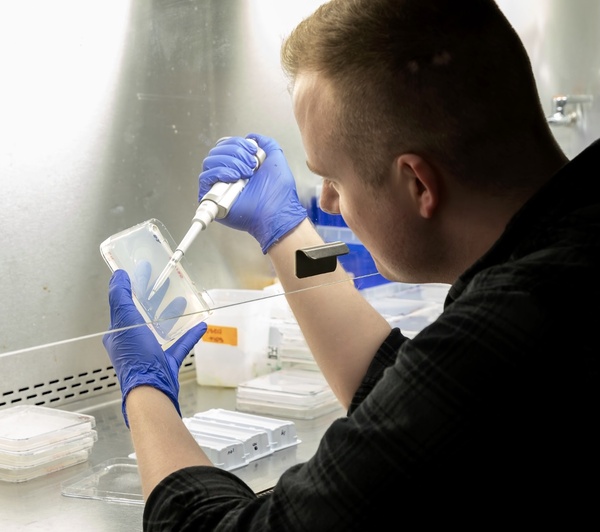
NYU graduate student Will Hinckley places Arabidopsis seeds onto plant media containing nitrogen. Credit: Tracey Friedman/NYU
Scientists have identified a molecular mechanism that helps plants seek out nitrogen-rich patches of soil, a discovery that could eventually help farmers improve crop nutrition while reducing their reliance on fertilisers.
The study, involving researchers at New York University (NYU), Purdue University and other institutions, found that plants can adjust the growth of their roots in response to uneven nitrogen availability. The researchers also identified a previously unrecognised role for a gene-regulating enzyme that is essential to this process.
Nitrogen is one of the nutrients plants need in large quantities to grow. In agricultural soils, however, nitrogen is rarely distributed evenly. Instead, it can occur in patches, meaning plants must find and exploit areas where the nutrient is more readily available.
The research, published in BMC Genomics, examines this behaviour, known as “root nitrogen foraging”. It describes the ability of plants to preferentially expand roots into nitrogen-rich areas of soil, improving their chances of capturing the nutrient they need.
To investigate how this happens, the researchers used a “split-root” experimental system in which different parts of a plant’s root system were exposed to different nitrogen conditions. They then used time-course transcriptomic analysis to track changes in gene activity in the roots and shoots of Arabidopsis thaliana, a widely used model plant.
The researchers discovered that the histone methyltransferase SET DOMAIN GROUP 8, or SDG8, is necessary for the plant’s root-foraging response. Histone methyltransferases regulate gene activity by modifying proteins associated with DNA, suggesting that changes in chromatin — the DNA-protein structure inside cells — are involved in helping plants respond to changing nitrogen conditions.
The team then asked whether the mechanism observed in Arabidopsis also occurs in crops. It compared nitrogen-foraging responses in Arabidopsis, tomato and maize.
The results showed that all three species shared the ability to direct root growth in response to uneven nitrogen supplies, although the researchers also found differences between species and particular genetic varieties. They further identified both shared and distinct patterns of gene activity when the plants encountered heterogeneous nitrogen conditions.
The findings are significant because improving plants’ natural ability to locate and absorb nitrogen could increase nitrogen-use efficiency — the amount of available nitrogen a crop can actually capture and use for growth.
Modern agriculture relies heavily on nitrogen fertilisers to maintain yields, but plants do not use all the nitrogen applied to fields. Unused nitrogen can be lost through processes such as leaching and runoff, contributing to environmental pollution and greenhouse-gas emissions. Improving nutrient uptake could therefore have benefits for both farmers and the environment.
The researchers say their findings provide new insight into the molecular basis of root nitrogen foraging and could ultimately contribute to developing crops that make better use of nitrogen in fields where nutrients are unevenly distributed.
The study does not yet provide a ready-made replacement for nitrogen fertiliser. Instead, it identifies biological processes and genetic mechanisms that could be used in future crop breeding and biotechnology.
With nitrogen costs and environmental concerns continuing to challenge agricultural production, understanding how plants naturally search for and capture nutrients could offer a route towards crops that produce more while requiring less fertiliser.