

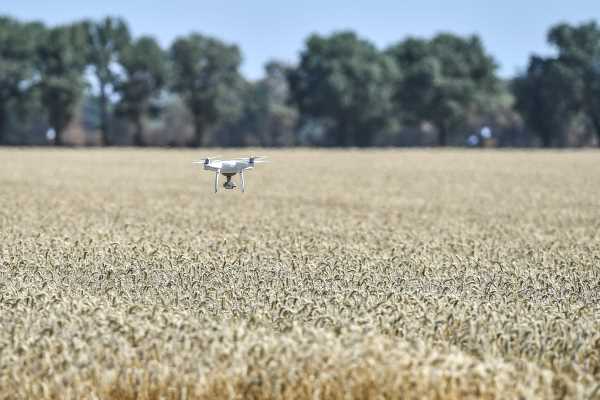
They are fast, flexible and sustainable. More than 600,000 drones, operated by as many pilots, are used in fields worldwide. Deployed in over 100 countries, they are estimated to have saved 410 million tonnes of water and reduced carbon dioxide emissions by 51 million tonnes in 2025 alone. But what regulations govern their use? And what benefits do they offer farmers? These questions were discussed at “Drones in agriculture”, a conference organised by Edagricole/Tecniche Nuove at EIMA, the international agricultural machinery exhibition taking place in Bologna.
Lawyer Maria Flaminia De Capua outlined the legal framework governing their use in the fields. She explained that there is no specific set of rules for agricultural drones: instead, various European and national regulations apply, covering everything from privacy to airspace use. Drones can perform two types of agricultural tasks: gathering information through data collection, and carrying out operations such as seed spreading or spraying.
In Italy, the relevant authority is ENAC, the Italian Civil Aviation Authority. De Capua explained that ENAC authorisation is not required for operations in the Open category, which covers low-risk operations using drones weighing up to 25 kilograms. Other categories, however, always require clearance. Assessing the risks that drone operations pose to people and property is particularly complex. “The European Union has provided pre-filled forms to make the process easier, and a kit containing a manual produced by ENAC, which issues the pilot certificate, has been developed to simplify the procedures as much as possible,” De Capua said.
Ichem Iderrami, an engineer at DJI Agriculture Italia, which introduced various agricultural drones to the market between 2016 and 2026, presented examples demonstrating their benefits for farms: timely operations, flexibility, no crop damage and data integration.
“Drones offer different tank capacities for both spreading materials and spraying, with performance that allows them to cover one hectare in less than five minutes,” Iderrami explained.
Numerous case studies were presented. In Italy, sowing a rice field took five minutes to cover three hectares. In the United States, a case involving maize production recorded a 50% increase in yield. Finally, in Romania, a vineyard treatment reduced the use of plant protection products by 53%.