

Kenya is seeking to more than double its bixa production by expanding the number of growers and fully utilising the country’s 3,000-tonne annual processing capacity, in a move aimed at creating thousands of jobs and increasing rural incomes.
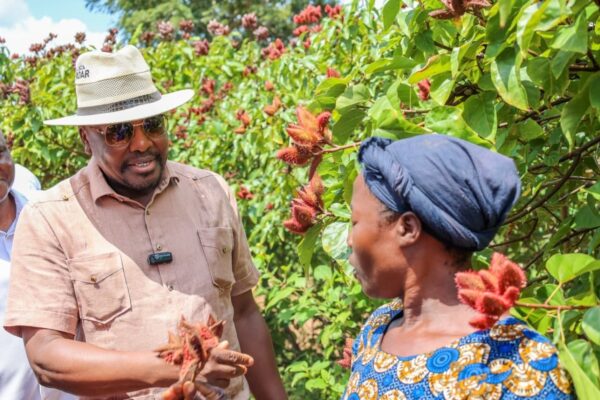
Agriculture and Livestock Development Cabinet Secretary Sen. Mutahi Kagwe announced the initiative during a visit to Kenya Bixa Limited in Kwale County, saying the Government will work with the Agriculture and Food Authority (AFA) and coastal county governments to scale up production of the high-value commercial crop.
According to a statement shared on the ministry’s X account, @CS_MoALD, the expansion strategy will focus on distributing certified seedlings, strengthening extension services, promoting farmer cooperatives and improving access to affordable financing.
Kagwe said Kenya already has the key ingredients required to compete in the global bixa market, including a modern processing plant, established export markets and internationally certified manufacturing standards.
“What is now needed is to rapidly increase production from the farm,” he said.
Kenya Bixa Limited currently processes between 1,000 and 1,400 tonnes of raw bixa annually despite having the capacity to process up to 3,000 tonnes each year. The factory sources its raw materials from between 7,000 and 10,000 contracted smallholder farmers across Kwale, Kilifi and Lamu counties, meaning the plant is operating at less than half its capacity.
To bridge the supply gap, the Government plans to increase the number of farmers growing the crop by rolling out more certified seedlings through AFA. Since bixa is a scheduled crop, the authority will regulate planting materials, support farmers and oversee the expansion of acreage needed to supply additional raw materials.
“This is not just about increasing production. It is about bringing more farmers into a profitable value chain, creating more jobs and putting more money into rural households,” Kagwe said in the statement posted on the Ministry’s X account.
The expansion is expected to generate employment beyond farming by creating opportunities in seed multiplication, transport, aggregation, processing, logistics and exports.
Kenya Bixa Limited currently employs about 150 people directly while supporting hundreds more through contract farming, transport and supply chains. Bringing the factory to full production capacity is expected to significantly increase employment opportunities across the Coast region.
The crop also presents an attractive income opportunity for farmers. Production figures presented during the visit indicate that one acre can accommodate approximately 160 bixa trees planted at the recommended spacing of five metres by five metres.
Each tree produces an average of 10 kilograms annually, translating to about 1,600 kilograms per acre. At the current farm-gate price of KSh95 per kilogram, farmers can earn an estimated KSh152,000 per acre each year.
Unlike many commercial crops, bixa can be intercropped with food crops because of its wide spacing. Farmers are encouraged to grow maize, beans, pigeon peas, cassava, cowpeas and citrus alongside bixa, enabling them to earn income while maintaining household food production.
“The most important thing is to put money into farmers’ pockets. That is my job,” Kagwe said, according to the statement.
To help growers capture more value from the crop, the Cabinet Secretary directed farmers to establish strong bixa cooperatives to enhance collective marketing, improve bargaining power and increase access to affordable credit through the Agricultural Finance Corporation and other financial institutions.
Supporting the Government’s strategy, Agriculture and Food Authority Acting Director General Calistus Kundu announced that the authority has been directed to establish a dedicated support structure for the bixa sub-sector.
The unit will coordinate seed distribution, farmer registration, extension services and market development as Kenya seeks to position bixa among its next generation of high-value commercial export crops.