



Researchers at Hanyang University ERICA in Ansan, South Korea, have developed a faster and more efficient way to produce advanced gas-sensing materials that could improve the detection of harmful air pollutants.
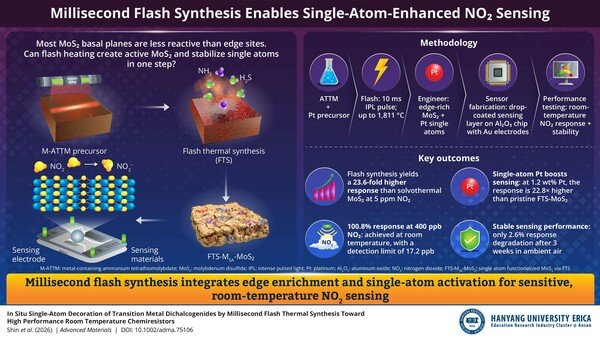
Using intense pulses of light lasting just 10 milliseconds, the team created molybdenum disulfide (MoS₂) flakes while simultaneously anchoring individual platinum atoms to enhance their ability to detect nitrogen dioxide (NO₂).
Nitrogen dioxide is a toxic air pollutant associated with respiratory problems and poor air quality. Detecting it at very low concentrations requires highly sensitive sensors.
The new approach achieved a sensor response of 100.8% when exposed to 400 parts per billion (ppb) of NO₂ at room temperature, with a detection limit of just 17.2 ppb.
Conventional gas sensors often rely on changes in a material’s electrical properties to identify gases. Molybdenum disulfide (MoS₂) is a promising sensing material, but much of its surface is relatively inactive.
Its reactive edges are also difficult to preserve during conventional heating processes. Additionally, catalyst metals added to improve performance can cluster into nanoparticles instead of remaining individually dispersed.
To overcome these challenges, researchers led by Professor Il-Doo Kim of the Korea Advanced Institute of Science and Technology (KAIST) and Assistant Professor Dong-Ha Kim of Hanyang University-ERICA developed a technique known as flash thermal synthesis. Dr. Euichul Shin of KAIST served as the first author.
The technique uses intense-pulsed light to transform a molybdenum-containing precursor into thin MoS₂ flakes. In a single 10-millisecond flash, temperatures can reach approximately 1,811°C before the material rapidly cools in ambient air. During the same process, individual platinum, iridium or gold atoms can be incorporated into the material.
The rapid heating and cooling help preserve the material’s reactive edges while preventing the added metal atoms from clustering into larger nanoparticles. This creates a greater number of accessible active sites that can interact with target gas molecules.
Testing showed that the flash-produced MoS₂ delivered a 23.6-fold stronger response to 5 parts per million of NO₂ than material prepared using a conventional solvothermal method.
Adding 1.2 weight% platinum further improved performance, producing a 22.8-fold enhancement in sensor response. The resulting sensor achieved a 100.8% response to 400 ppb of NO₂ at room temperature.
“The important advance is that we can form the sensing material and add isolated catalyst atoms in one rapid step, without needing a prolonged furnace treatment,” said Dr. Kim.
The platinum-enhanced sensor could detect NO₂ concentrations as low as 17.2 ppb. It also demonstrated selectivity for nitrogen dioxide over several other tested gases and maintained a stable response over 25 exposure-and-recovery cycles. Even after three weeks of exposure to ambient air, its sensing response declined by only 2.6%.
Computational calculations indicated that individual platinum atoms strengthen interactions between the MoS₂ surface and NO₂ molecules, helping explain the improved sensing performance.
“By adjusting the active sites on the material, this approach could help make sensitive and selective gas detection more practical, while offering a flexible way to prepare other functional nanomaterials,” said Dr. Kim.
Beyond sensing performance, the technique offers potential manufacturing advantages. The process consumed approximately 8.6 kilojoules of electrical energy per gram of material.
Its ability to illuminate relatively large areas could also support more scalable production compared with conventional synthesis methods that require hours of heating.
However, the sensors have so far been evaluated under laboratory conditions. Further research will be necessary to establish their performance in real-world environments, where temperature, humidity and other atmospheric conditions can affect sensor reliability.
The findings could have important implications for air-quality monitoring, industrial pollution detection and environmental protection.
The researchers also believe that flash thermal synthesis could be adapted to produce advanced catalysts and functional materials for clean-energy technologies and energy conversion.
The study, published in Advanced Materials on September 21, 2026, demonstrates how brief but intense light pulses can transform the production of advanced sensing materials.
By combining rapid synthesis with the precise incorporation of individual metal atoms, the approach offers a promising pathway towards more sensitive, energy-efficient and scalable gas sensors for future air-pollution monitoring systems.