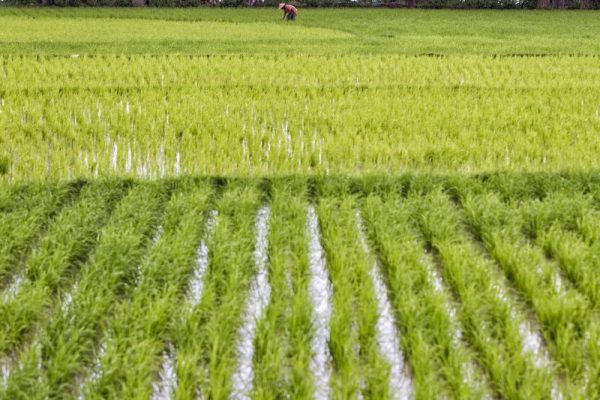
A new study supported by the Consortium of International Agricultural Research Centres’ (CGIAR) Standing Panel on Impact Assessment (SPIA) and implemented by the International Rice Research Institute (IRRI) is providing real-world evidence that “safe” Alternate Wetting and Drying (AWD) can reduce irrigation water use while maintaining rice yields, offering farmers a practical response to growing water scarcity.
The findings come as pressure mounts on rice production systems, which are traditionally dependent on continuous flooding. Rice is a major staple crop worldwide, but its cultivation can be highly water-intensive.
In fact, according to the study, producing one kilogram of rice can require as much as 3,000 liters of water, while many rice-growing areas are increasingly affected by water scarcity, unreliable rainfall and competition for freshwater.
AWD offers an alternative to keeping rice fields permanently submerged. Under the technique, farmers allow the water level in the field to fall for several days before irrigating again.
The field alternates between wet and non-flooded conditions during the growing season, reducing the amount of irrigation water required while keeping the crop supplied with sufficient moisture.
The approach is described as “safe” when farmers follow recommended thresholds that prevent excessive drying and associated yield losses. According to IWMI, a commonly recommended threshold is to allow the water level to fall to about 15 centimeters below the soil surface before irrigating again. The field is then re-flooded to approximately five centimeters above the soil surface.
A simple perforated PVC tube helps farmers make this decision. Installed in the rice field, the tube allows farmers to see how far the water level has dropped below the soil surface. When the water reaches the 15-centimeter threshold, irrigation is applied.
The device is inexpensive and can be made from locally available materials, making the technique accessible to farmers without sophisticated irrigation equipment.
The potential water savings are significant. IWMI reports that AWD can reduce irrigation water use by about 15% to 30% compared with continuous flooding. For farmers relying on pumps, using less water can also mean lower fuel or electricity costs. The approach is particularly relevant in areas where irrigation water is becoming increasingly scarce or expensive.
The benefits can extend beyond water conservation. Continuous flooding creates oxygen-poor soil conditions that encourage the production of methane, a potent greenhouse gas. By periodically allowing the soil to dry, AWD disrupts the conditions that support methane-producing microorganisms.
IWMI reports that studies have found methane reductions of between 30% and 70% under AWD without compromising rice yields.
The technique may also influence soil processes and nutrient availability. Periodic drying can affect nutrient dynamics and, in some soils, improve the uptake of nitrogen and zinc. IWMI also notes that incorporating crop residues into AWD-managed fields can support soil carbon and soil quality while avoiding some of the methane increases associated with residue incorporation under continuously flooded conditions.
However, adopting AWD is not simply a matter of withholding irrigation. Farmers need guidance to understand when the field has dried sufficiently and when it must be irrigated again.
Demonstration plots, farmer training and peer learning can help overcome the long-standing perception that rice must remain continuously submerged throughout its growing cycle.
IWMI highlights farmer training activities in Ghana as an example of efforts to build confidence in the technology and promote more water-efficient rice production.
The emerging evidence therefore strengthens the case for AWD as a practical climate-smart irrigation strategy. By replacing continuous flooding with carefully managed wetting and drying, farmers can conserve water while maintaining production, potentially lowering irrigation costs and reducing greenhouse gas emissions.
As water resources become more constrained and climate variability increases, safe AWD could provide rice-growing communities with a relatively simple way to produce more efficiently without compromising food security.