



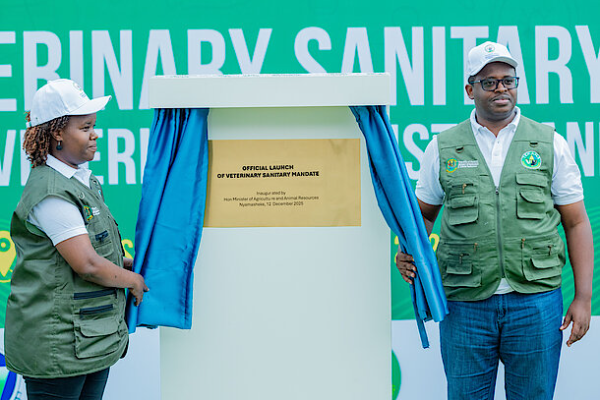
The Government of Rwanda, through the Ministry of Agriculture and Animal Resources (MINAGRI), has officially rolled out the Veterinary Sanitary Mandate (VSM) policy together with the Veterinary Registration and Licensing Module integrated into the Agriculture Management Information System (AMIS).
The official launch was held on 12 December 2025 in Nyamasheke District, located in the Western Province.
The VSM represents a major national reform designed to enhance veterinary service delivery, formalize private sector engagement, and strengthen institutional coordination within the animal health sector. The reform addresses persistent service delivery gaps highlighted in national assessments and is aligned with government priorities under the National Strategy for Transformation (NST2) and the fifth Strategic Plan for the Transformation of Agriculture (PSTA5).
At present, 34 companies accredited by the Rwanda Agriculture and Animal Resources Development Board (RAB) are eligible to compete for veterinary service tenders in their respective districts.
Speaking during the launch, MINAGRI Permanent Secretary Dr. Olivier Kamana emphasized the importance of livestock to Rwanda’s economy. He urged veterinarians to provide high-quality, farmer-focused services, noting that improving livestock productivity is directly linked to national economic growth.
Dr. Kamana observed that the continued growth of the livestock sector has led to rising demand for veterinary and livestock services. A 2022–2023 study found that a single livestock officer at either Sector or District level cannot effectively deliver the full range of livestock production and animal health services.
He further pointed out that more than 55 percent of Sector-level staff are trained in livestock production but do not possess formal veterinary medicine training, a situation that has contributed to gaps in animal health service delivery.
Dr. Kamana also reiterated Rwanda’s goal of increasing milk production to raise output and ensure sufficient supply for milk processing industries. Achieving this objective, he said, depends on the availability of qualified veterinary professionals working closely with farmers and equipped with the necessary technical skills.
Digitalization is a central component of the reform, with veterinary registration and licensing now conducted through AMIS. The Veterinary Registration and Licensing Module was jointly developed to align with professional standards and sector-specific requirements. The system streamlines procedures, improves data management, and enables faster, more responsive services for veterinary professionals across the country.
According to recent data, Rwanda has 6,220 veterinary professionals, including 660 veterinary doctors, 320 livestock production specialists, and 5,240 veterinary technicians. Of these, 88 percent work in the private sector, while 12 percent are employed by government institutions and government-supported projects.
The AMIS Veterinary Registration and Licensing Module replaces the former manual and fragmented regulatory system with a unified national digital platform. It facilitates efficient registration and licensing of veterinary professionals, accreditation of veterinary clinics and pharmacies, and improved compliance monitoring, thereby strengthening professionalism, transparency, and accountability in the sector.
Under the VSM framework, private veterinary practitioners must operate through registered companies that obtain the Veterinary Sanitary Mandate via a restricted tendering process before signing contractual agreements. These companies are required to submit monthly activity reports to district authorities and RAB and receive funds that were previously allocated to districts for implementing mandated veterinary services.
The Rwanda Council of Veterinary Doctors (RCVD) will be responsible for ongoing professional capacity building and for enforcing disciplinary measures in cases of misconduct. At the decentralized level, District and Sector Animal Resources Officers will oversee supervision, monitoring, and evaluation to ensure effective and accountable service delivery.
The launch of the VSM and the veterinary registration and licensing module brought together officials from MINAGRI, district leadership, public and private veterinary practitioners, insurance companies, farmer organizations, development partners, and community representatives, among other key stakeholders.





[…] handover comes shortly after Rwanda launched the Veterinary Sanitary Mandate (VSM) policy alongside the Veterinary Registration and Licensing Module under the Agriculture Management […]
Comments are closed.