

Rwanda has launched the Rwanda Biotech Capacity Building (BioCap) Project, a national initiative aimed at strengthening the country’s scientific capacity to develop improved potato, cassava and banana varieties.
Implemented by the Rwanda Agriculture and Animal Resources Development Board (RAB) in partnership with the International Potato Center (CIP), the project seeks to position Rwanda as a continental hub for safe, climate-smart biotechnology.
Officially unveiling the initiative, Honorable Solange Uwituze, Minister of State in the Ministry of Agriculture and Animal Resources, described BioCap as a programme grounded in the public good. She noted that the project is fundamentally about ensuring Rwandan farmers gain access to better, safer and more resilient crop varieties.
Against a backdrop of climate change and global shocks, she reaffirmed Rwanda’s resolve to place science and innovation at the service of its people.
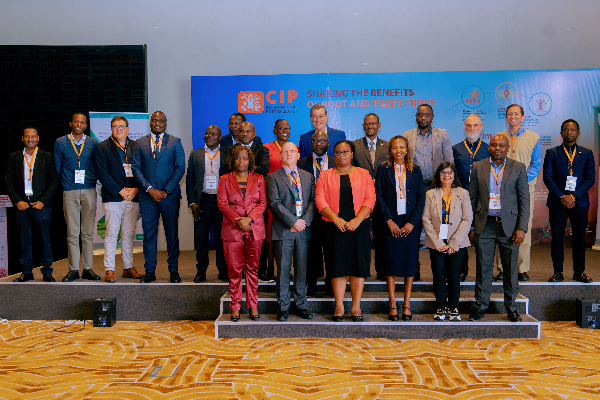
The launch event brought together senior government officials, scientists and development partners, highlighting the collaborative nature of the project. Participants included representatives from the Ministry of Agriculture and Animal Resources (MINAGRI), the Rwanda Environment Management Authority, CIP, the International Institute of Tropical Agriculture, the Donald Danforth Plant Science Center and Michigan State University, among others.
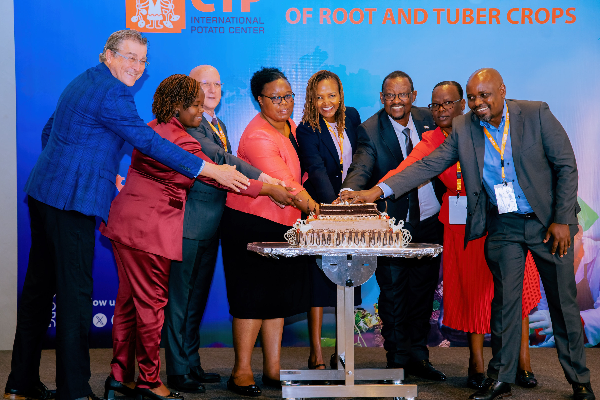
Addressing the gathering, Dr. Simon Heck, Director General of CIP, said the launch reflected the depth and continuity of Rwanda’s long-standing partnership with international agricultural research institutions. He recalled that CIP’s engagement with Rwanda dates back to 1978, when the centre was invited to support the country’s National Potato Improvement Program.
Over the past 47 years, that relationship has grown into a trusted alliance involving Rwandan scientists, research institutions, universities, enterprises and farmers, and was formalised through a Host Country Agreement signed in 2015.
Dr. Heck described Rwanda as a regional, and increasingly global, leader in science, innovation and biotechnology, adding that BioCap demonstrates the country’s commitment to nationally led and responsibly governed biotechnology systems that deliver tangible benefits for farmers, the environment and regional food systems.
The BioCap Project is being rolled out at a critical time, as Africa grapples with intensifying climate pressures, underscoring the urgent need to strengthen regional scientific capacity and climate-resilient agricultural innovation.