

By Louis Strydom Marketing Director, Omnia
From AI-driven analytics to satellite imagery, advances in technology are transforming how the agriculture industry monitors and manages crop production. Where producers once relied exclusively on intuition and experience, important decisions are now increasingly guided by ongoing research and data. With access to accurate insights and smarter tools, farmers can ultimately produce higher yields while using fewer resources.
Microbial product developments
One of the most significant shifts in modern agriculture has been the rise of biological technology, which is already making a profound impact on crop production. Microorganisms such as bacteria, fungi and other microbes play a vital role in soil health and plant development.
Soil health plays a critical role in crop productivity, yet a natural process known as nutrient fixation often limits the availability of nutrients for plant growth. During this process, soil particles temporarily bind essential nutrients making them unavailable to plant roots.
The introduction of specialised microbial products offers an innovative solution. These products work to reverse nutrient fixation, releasing previously locked nutrients and improving their availability for crop uptake. By enhancing nutrient accessibility, microbial solutions help producers maximise soil potential and support sustainable plant growth.
Specialised products such as Omnia’s range of biostimulants, biofertilizers and root-stimulating products fall under this umbrella. Among them is Rhizovator™ G1, a biostimulant blend that boosts germination, root and biomass growth, supports microbial life, and improves nutrient efficiency and resilience.
AgriBio: a case in point
In an era of unprecedented environmental change, the outcomes in terms of yield size are significant. Maize, for example, has a genetic potential of around 35 tonnes per hectare. Yet, in reality, given environmental factors such as drought and soil degradation, the actual average yield in South Africa is much lower, at around 5 tonnes per hectare.
With today’s technology – precision farming techniques, advanced electronics and AI-powered solutions – paired with innovation in the field of biological technology, producers could harvest between 10 and 12 tonnes per hectare.
As a result of these kinds of technologies, maize yields have in fact increased exponentially. Similar results have been observed with other crops, demonstrating the broad impact of these technologies.
Smart machinery driving modern efficiency
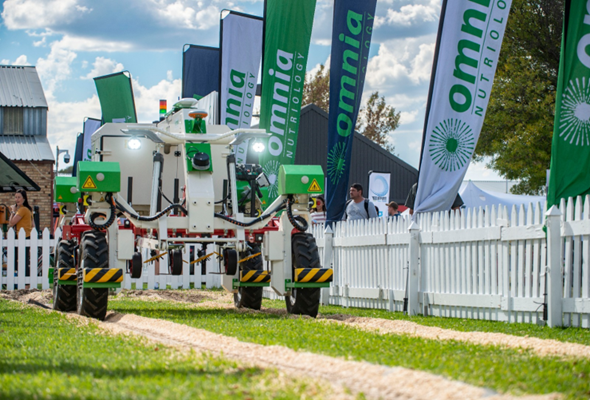
Another trend in agriculture is the evolution of hardware – the machinery and equipment that are key to farming success. Over the past decade, tractors, planters and harvesters have been equipped with advanced technologies such as GPS, sensors and AI-enabled equipment. Many of these machines now operate with autonomous steering capabilities, navigating different types of terrain and applying different rates of chemicals with minimal human input.
These developments have been instrumental in precision farming, which uses data and analytics to manage crops and soil with high accuracy, optimising inputs, reducing waste and improving yields.
This shift in hardware goes beyond creating bigger, faster machines; it’s about integrating smart technology and tools with existing farming systems to produce more sustainable outcomes in the long term.
Bulk data analyses
The last few years have also seen producers relying more heavily on advanced types of analyses – data that can revolutionise decision-making by providing precise insights into aspects such as soil health, plant nutrition and water management. At Omia, multiple types of analyses are combined and cross-referenced to enhance the accuracy of reports and maximise the usefulness of datapoints.
For instance, Omnia’s OMNI-PRECISE™ solution combines soil physical and chemical analyses, variable rate technology, zone management, and proximal and remote sensing, all supported by the expertise of an experienced agronomist. By using these analyses to identify variations within fields, producers can greatly reduce specific risks associated with each unit by implementing the best rectification strategy.
The advent of AI has supercharged this, enabling faster data processing, more accurate predictions, and real-time decision-making. Collectively, these technologies are changing the way producers optimise their resources and make informed decisions, enabling them to build more efficient and climate-resilient businesses.