


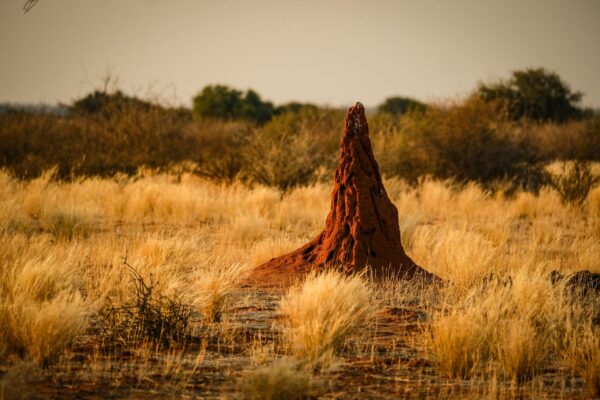
Termites — tiny insects often seen in fields and savannas across Africa — play a complex and sometimes contradictory role in agricultural systems.
For many African farmers, termites are familiar. They appear as conspicuous mounds in fields and savanna landscapes and influence the land in ways that deeply affect soil health, crop growth, and farming sustainability. That influence can be both harmful and helpful, creating what agricultural researchers and practitioners describe as the termite paradox.
What Are Termites and Why Do They Matter?
Termites are social insects in the order Isoptera, living in large colonies underground or in aboveground mounds. They feed on organic materials like dead wood, plant residues, and soil organic matter.
Over 2,000 termite species are found across ecosystems, from humid forests to arid savannas. However, only a small proportion of these species are considered major agricultural pests — roughly about 1% of all termite species — while the vast majority perform essential ecological functions. This dual nature, as both a beneficial ecosystem engineer and a potential crop pest, is at the heart of the termite paradox.
The Harmful Side: Termite Damage to Crops
Termites can cause serious damage to crops, as shown in a recent study in central Ethiopia. Researchers counted subterranean termite nests and surveyed farmers, finding that nests were much more common in some areas. For example, Warabo had 7.25 nests per 1,000 m², while Warke Walensu had only 2.25 nests per 1,000 m².
Farmers reported that teff and wheat suffered the most, with Warabo households losing more land and crop volume to termites than other areas. Annual losses per household were significant — about 4,722 Ethiopian Birr (ETB) for teff and 4,396 ETB for wheat — affecting both income and food security.
Factors such as agroecology, deforestation, grazing, and crop type influence termite abundance and the extent of crop damage. While farmers mostly rely on traditional methods such as mounding or smoke, these approaches offer only limited protection.
Because termite colonies start small and grow quickly, even a seemingly minor infestation can become a major problem — a single acre can host 10-16 colonies, each beginning with tiny larvae that eventually mature into worker termites capable of damaging crops. Early monitoring and integrated management are therefore crucial to prevent small colonies from expanding and causing significant losses.
The Beneficial Side: Termites as Soil Partners
Termites are also important soil engineers whose activities can improve soil health in farming landscapes. In many parts of Africa and the tropics, termite mounds and tunnels create fertility “hot spots” — patches where soil nutrients and organic matter are more concentrated than in the surrounding field.
Termite mound soils often have higher levels of organic matter compared with nearby unmodified soils. These enriched soils arise because termites bring up particles from deeper layers and mix them with organic material as they build and maintain their tunnels and mounds. This creates a physical and chemical environment that supports better soil structure and nutrient availability for crops and plants growing nearby.
The network of underground termite galleries also improves soil aeration and water movement. As termites dig and burrow, they create channels that help rainwater infiltrate deeper into the soil, reducing surface runoff and erosion. Better aeration supports healthier root growth and benefits soil micro‑organisms — key partners in nutrient cycling and soil fertility.
Additionally, termite activity influences the diversity and function of soil microbes. Research shows that soils in and around termite mounds host distinct bacterial and fungal communities important for breaking down organic matter and releasing plant nutrients. These microbial processes support the natural recycling of carbon, nitrogen and phosphorus in the soil, helping maintain long‑term soil productivity.
Because of these benefits, many smallholder farmers in Africa have long collected termite mound soil to amend poor soils and boost fertility, especially where commercial fertilizers are expensive or scarce. Termite mound soil can be mixed with farm soil or used in planting pits to help increase nutrient levels and support crop growth.
In short, while termite activity can damage crops in some situations, their role as ecosystem engineers and nutrient cyclers is also a valuable natural service that contributes to healthier soils and more resilient farming landscapes.
Strategies to Balance Termite Benefits and Risks
The key to managing termites in African agricultural systems lies in harnessing their beneficial ecosystem functions while reducing their pest impacts. Below are some sustainable farming practices that work with termites:
- Utilizing termite mound soil strategically: Where soil fertility is low, carefully collected mound soil can be used with other amendments in planting basins or micro-dosing fertilizer approaches.
- Crop rotation and diversification: Rotating crops every 3 to 4 years and intercropping improve soil fertility and control pests. These practices also reduce termite pressure, making fields more resilient.
- Integrated termite management: Combine cultural practices like timely planting and soil cover with biological pest deterrents and judicious use of targeted control methods when necessary.
- Enhancing termite-friendly habitats: Preserve natural vegetation patches or fallow zones within or near fields to act as buffer zones, keeping termite activity focused on organic matter rather than crops while supporting biodiversity.
- Encouraging beneficial microbes: Apply compost teas or biofertilizers near termite-active areas to boost nutrient cycling and reinforce the positive soil effects termites provide.
- Organic matter management: Add residues, mulch, and cover crops to attract termite activity away from crops. Termite mound soils have higher porosity and organic carbon than nearby soil, improving water movement and soil structure.
- Collaboration and knowledge sharing: Share observations about termite behavior with neighboring farmers or local networks. Collective knowledge helps refine strategies for harnessing benefits and managing risks in specific regions.
- Timing planting around termite activity: Plant crops early in the rainy season or during periods of lower termite foraging to reduce crop vulnerability while benefiting from termite-mediated soil fertility.
- Monitoring and early detection: Identify early signs of pest species versus beneficial species. Simple tools, such as soil probes or observations of mound activity, can help anticipate issues before they affect crops.
- Agroforestry integration: Plant trees alongside crops to divert termite activity toward woody residues, improve soil organic matter, and create microclimates that support both crop growth and soil biodiversity.
Turning the Termite Paradox Into a Farming Advantage
Termites present a paradox for African farmers — small insects that can cause significant crop damage on one hand and deliver vital soil health services on the other. The difference between harm and help often depends on how farmers manage soil, organic matter, crop diversification, and termite interactions.
When understood and managed within sustainable farming approaches — such as building organic-rich soil, preserving soil cover, and using integrated termite management strategies — termite activity can become a resource rather than a burden for African agriculture. By viewing termites through both lenses, African farmers can make informed decisions that strengthen their land, improve food security, and enhance the sustainability of their farming systems.

Jane is an agriculture and environmental journalist and the founder and editor-in-chief of Environment.co, where she covers sustainability and eco-friendly living.