

Ever wondered what it takes to develop a new crop variety? Just like preparing for a marathon, developing a new variety is a carefully calculated journey that demands endurance, discipline, precision and continuous improvement. It takes years of scientific research, meticulous selection, rigorous multi-location testing and close collaboration with farmers before a new variety is ready to cross the finish line and reach farmers’ fields.
The race to secure food, livelihoods and resilient food systems is becoming increasingly demanding. Climate change is shortening the window for developing new crop varieties. Rising temperatures, erratic rainfall, emerging pests and diseases, degrading soils and rapidly evolving consumer preferences are changing the course faster than conventional breeding cycles can respond. The track keeps shifting beneath breeders’ feet, requiring scientists to constantly adjust their pace without losing sight of the finish line.
This race matters because potato and sweetpotato are among the world’s most important food crops. Potato is the third most important crop for human consumption, cultivated on 17.1 million hectares and producing 390.4 million tonnes globally in 2024, with production increasing by more than 50% over the past two decades (FAOSTAT, 2025). Sweetpotato is grown in 112 countries across 7.5 million hectares, producing 93.6 million tonnes in 2023 and supporting food security, nutrition, and livelihoods worldwide (FAO, 2025). Together, these resilient root and tuber crops are increasingly recognized for their contribution to climate adaptation, nutrition, and inclusive economic growth, making continued investment in science and innovation more important than ever.
Hitting the First Milestones: New Varieties Cross the Line
Despite these growing challenges, plant breeders continue to make remarkable progress. The recent release of new potato and sweetpotato varieties in Ethiopia, Malawi and Mozambique is a powerful reason for optimism. The goal is no longer simply to produce more food, but to develop varieties that address today’s challenges while meeting farmers’ and markets’ needs.
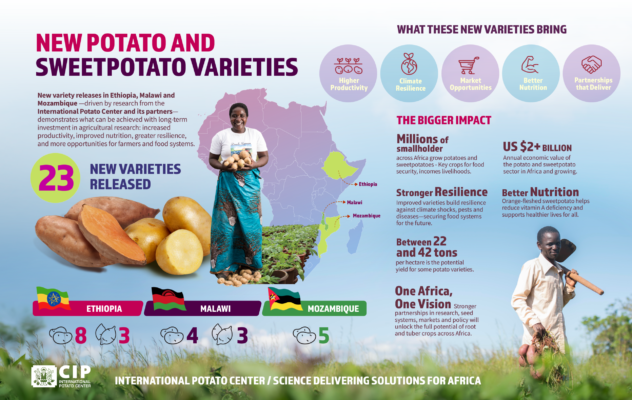
Researchers and national partners have released varieties that offer higher yields, resistance to major diseases, improved drought tolerance, adaptation to diverse growing conditions, superior processing qualities, and enhanced nutritional value. In Ethiopia, the Ethiopian Institute of Agricultural Research (EIAR), regional agricultural research institutes and the International Potato Center (CIP) released eight potato varieties in 2026, addressing diverse production challenges across the country. These include varieties adapted to drought-prone environments (Midekisa), acidic soils (Fitche 1), irrigation systems (Mesino-1), and processing markets (Fitche 1 and CIP315008.154). Under favourable conditions, the highest-yielding varieties, Beri and Midekisa, can produce up to 53 and 50 tonnes per hectare, respectively, while other releases deliver 32–45 tonnes per hectare depending on the target production environment. The same partnership also supported the release of three sweetpotato varieties, including two orange-fleshed sweetpotatoes yielding up to 47.6 tonnes per hectare that are adapted to variable rainfall conditions in eastern Ethiopia, alongside a drought-tolerant white-fleshed variety.
In Malawi, the Department of Agricultural Research Services (DARS), in partnership with CIP, released four new potato varieties—Chikweza, Nyonga, Kadzutsa and Kapenu—combining high yield potential, late blight tolerance, large tuber size and processing quality through participatory variety selection. The partnership also released three orange-fleshed sweetpotato varieties—Mlelambumba, Chitete and Katswiri—with potential yields of 29–36 tonnes per hectare. Rich in beta-carotene, these varieties also offer high dry matter content, improved root quality and suitability for products such as crisps, crackers, buns and puree, helping to improve both nutrition and market opportunities.
Mozambique has also taken a significant step forward with the release of five new potato varieties developed through collaboration between the Agricultural Research Institute of Mozambique (IIAM) and the International Potato Center (CIP). Evaluated across multiple agro-ecological zones with the participation of more than 500 farmers, the varieties achieved yields of between 22 and 42 tonnes per hectare while demonstrating improved resistance to pests and diseases, particularly bacterial wilt. Their release addresses a pressing national challenge: although potato is one of Mozambique’s most important food crops, domestic production falls well short of demand, forcing the country to spend millions of dollars annually importing seed potatoes. These new varieties, combined with investments in sustainable seed production and delivery, offer an important opportunity to strengthen food security, reduce reliance on seed import and improve the competitiveness of the potato sector.
These varieties enable farmers to harvest more from limited land, reduce production risks, access higher-value markets, and increase household incomes. They also create opportunities for seed producers, processors, traders, transporters and food manufacturers. Processing-market friendly potatoes strengthen local industries, while orange-fleshed sweetpotatoes expand opportunities for nutritious value-added products ranging from b and bakery products to purees and complementary foods. Their impact extends well beyond the farm, strengthening food systems, reducing postharvest losses, improving nutrition, and creating economic opportunities across the value chain.
Partnerships Power the Race: From Better Varieties to Better Livelihoods
Behind every new variety are years of collaboration among national agricultural research systems, universities, farmers, seed enterprises, governments and CIP. Through germplasm exchange, participatory variety selection, multi-location testing and scientific capacity development, these partnerships are strengthening breeding programmes while shortening the path from research to farmers’ fields. The launch of the Partnership for Root and Tuber Crops in Africa builds on this momentum by mobilizing science, investment and regional collaboration to accelerate root and tuber crop innovation across the continent.
The work of CIP, together with its national partners, continues to evolve and grow stronger. The launch of Partnership for Root and Tuber Crops in Africa aims to mobilize global science, innovation, partnerships, and investments to scale up RTC-based agrifood systems across Africa. Its approach is designed to be inclusive and evidence-driven, aligning with national and regional development priorities to ensure impact at both grassroots and policy levels.
The Final Stretch: Accelerating Innovation for Greater Impact
Yet the finish line is not simply the release of another crop variety. It is the delivery of locally adapted, market-responsive and climate-resilient solutions that enable farmers to harvest more from limited land, reduce production risks, improve household nutrition and access higher-value markets. The International Potato Center (CIP) renews its commitment to supporting the development and delivery of market-oriented potato and sweetpotato varieties that create real value for farmers, consumers, and businesses across Africa. Working alongside the strong network of partners built over many years, CIP will continue investing in innovation while pushing the boundaries of science to unlock the full potential of root and tuber crops.
The race is on. Success will not be measured by how many varieties cross the finish line, but by how quickly they reach farmers’ fields and how effectively they help communities adapt to a changing climate. Keeping science and innovation ahead in this race is one of the smartest investments we can make for Africa’s food security and prosperity. Together, we are winning the race against climate change, one variety at a time.