

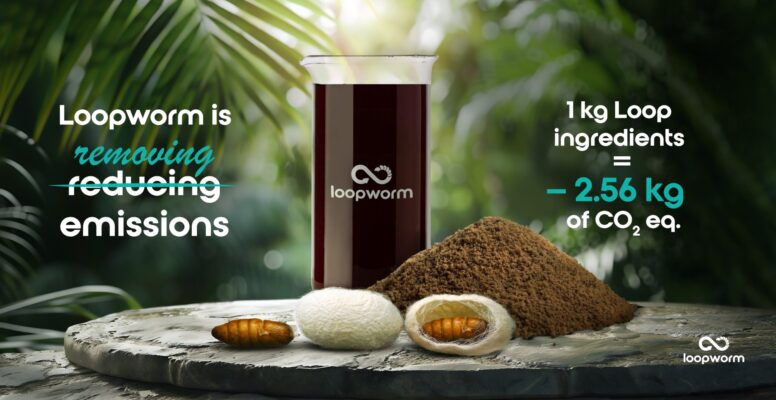
Loopworm, India’s leading insect biotechnology company, announced the results of an independent ‘Life Cycle Assessment’ which reports that its silkworm-based ingredients for pet and animal nutrition are net carbon negative, actively removing more carbon than they emit. Producing 1 kg of Loopworm’s silkworm-based ingredients removes 2.56 kg of CO₂ equivalent on a cradle-to-gate basis.
The assessment, conducted by PwC India in accordance with ISO 14040 and ISO 14044 standards and conducted using defined methodologies and system boundaries, evaluated LoopMeal and LoopOil across 18 impact categories for modelling environmental impacts using SimaPro LCA tool and the ReCiPe midpoint methodology.
The study benchmarks LoopMeal and LoopOil against conventional protein meals and oils used in animal & pet nutrition, evaluating them across 18 sustainability parameters that quantifies marine, terrestrial and human health impact in comparison with conventional marine and plant-based ingredients.
Conventional protein sources like soymeal, soy oil, fishmeal and fish oil carry positive greenhouse gas emissions and are associated with land use pressure, deforestation and marine ecosystem stress. Based on the parameters assessed in the Life Cycle Assessment, Loopworm reports that LoopMeal and LoopOil perform favourably compared to conventional ingredients across the full spectrum of environmental measures while ensuring digestibility, palatability, and positive health outcomes without a planetary cost.
As feed manufacturers across pet, aquaculture and animal nutrition face increasing scrutiny to demonstrate environmental accountability across their supply chains, LoopMeal and LoopOil provide a nutritionally credible and carbon negative alternative. Abhi Gawri, Co-Founder & COO of Loopworm, shared, “We took an initiative to quantitatively prove our impact rather than qualitatively speculate it. Our goal is to help customers future‑proof health and nutrition for animals, de‑risk formulations and create audit‑ready pathways for Scope 3 reporting, BAP, B Corp, and EU Deforestation‑Free certifications while ensuring that quality, sustainability, and social impact need not be trade-offs.”
The Life Cycle Assessment provides Loopworm with quantitative, audit-ready information to support its global commercial activities. With existing market presence in the EU and Japan, among the world’s most stringent regulatory environments for feed ingredients, the findings offer a structured data foundation that Loopworm can use to meet evolving regulatory and reporting requirements.