

New BCG report finds healthier school meals could unlock more than USD 100 million in annual value in Rwanda alone, while creating new growth opportunities across Africa’s food value chains
- 85 million+ children across Africa receive school meals every day
- Diet-related NCDs are rising rapidly across sub-Saharan Africa. The number of people living with type 2 diabetes alone is projected to grow by nearly 150%, from 19 million in 2019 to 47 million by 2045
- ~$120M–$155M in annual health, fiscal and environmental benefits could be generated through healthier school feeding in Rwanda alone
- Over 80% of school feeding funding already comes from public spending
A new report from Boston Consulting Group (BCG), Integrating Food and Health Systems in Africa: A High-Return Investment in Health, argues that food should be treated as a form of health infrastructure and that integrating food and health systems could become one of Africa’s most powerful tools for improving public health, reducing long-term healthcare costs and strengthening economic resilience.
The report highlights a practical opportunity for governments to address rising diet-related disease while supporting agricultural growth: using institutional feeding programmes, particularly school meals, to improve nutrition at scale.
Health systems are already under fiscal strain and cannot afford to pay for negative outcomes unintentionally fueled by food systems,” said Zoë Karl-Waithaka, Managing Director and Partner at BCG and co-author of the report. “Across Africa, we’re facing a dual challenge of rising rates of diet-related disease and increasingly constrained health budgets. If we want healthier populations and more sustainable public finances, we need to look beyond healthcare delivery and address one of the root causes, what people are eating every day.”
The urgency is growing as while undernutrition remains a concern across many African countries, diet-related non-communicable diseases (NCDs) including diabetes, hypertension and cardiovascular disease are rising rapidly. The report notes that one in ten adolescents in sub-Saharan Africa already has elevated blood pressure, creating a significant future burden for health systems as populations age.
“This is not only a health issue but an economic and fiscal issue,” said Karl-Waithaka. “Every finance minister in Africa is looking for ways to bend the cost curve. Food is one of the few levers that can improve health outcomes, strengthen food security and reduce future healthcare spending at the same time.”
The report identifies school feeding programmes as the most practical and scalable starting point for integrating food and health systems.
Across Africa, school meal programmes reach more than 85 million children, around one-third of all enrolled learners. With more than 80% of funding already provided by domestic governments, school feeding is one of the continent’s largest and most established public food platforms.
BCG highlights the significance of school feeding beyond nutrition, confirming that these programmes create predictable institutional demand, influence dietary habits early in life and provide a ready-made mechanism for connecting health, agriculture and economic development objectives.
“School meal programmes are one of the most powerful platforms to drive food systems transformation,” said Peiman Milani, Director, Food Initiative at The Rockefeller Foundation and contributor to the report. “Across Africa and beyond, we have an opportunity to use school feeding to not only improve child nutrition and health outcomes, but also strengthen local food economies, support farmers transitioning to more regenerative practices, and build greater resilience into food systems. When schools create reliable demand for nutritious, locally sourced foods, they catalyze benefits that extend far beyond the classroom.”
The report focuses particularly on grains because they account for as much as two-thirds of calories consumed in many African diets and institutional meals. Replacing refined grains with whole grains and indigenous crops offers one of the most practical opportunities to improve dietary diversity without fundamentally redesigning school feeding systems.
Rwanda demonstrates the business case
Using Rwanda as a case study, BCG modelled the potential impact of transitioning school meals from refined maize flour and polished rice to healthier alternatives including whole-grain maize, unpolished rice and indigenous grains such as sorghum.
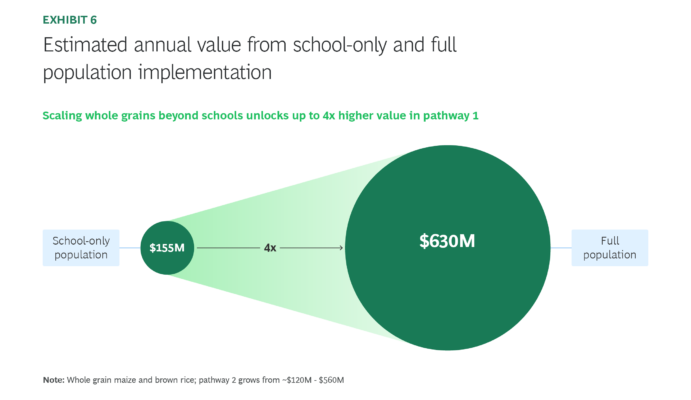
The findings suggest such a transition could generate between USD120 million and USD155 million annually in combined health, fiscal and environmental benefits.
Direct annual monetary savings alone are estimated at USD50 million to USD60 million, equivalent to 7-8% of Rwanda’s health expenditure in FY2022/23. According to the report, these savings would result from reduced rates of diet-related disease, lower import dependence, procurement efficiencies and environmental gains.
These findings challenge the perception that healthier food necessarily comes at a higher cost. The report finds that investments in better nutrition can generate measurable returns for governments, households and businesses alike.
It further highlights strong consumer acceptance of healthier food alternatives from Rwanda and Kenya. In pilot programmes, more than 90% of children and parents preferred whole-grain meal options to refined alternatives, challenging assumptions that healthier meals require difficult behavioral shifts.
New opportunities for agriculture and food businesses
Beyond healthcare savings, the report identifies significant opportunities for the private sector.
Institutional feeding programmes create reliable, long-term demand that can help catalyze investment throughout agricultural value chains. Rwanda’s school feeding programme alone reaches more than four million daily consumers, while Kenya’s reaches approximately 2.5 million.
A transition toward healthier grains and indigenous crops could create new opportunities for farmers, cooperatives, millers, processors, distributors and retailers. While school meals represent the most scalable starting point, the report argues that the same principles can be extended into healthcare delivery itself.
Examples from Rwanda and Kenya demonstrate how medically tailored meals and community-led “Food is Medicine” programmes can improve patient outcomes while reducing pressure on healthcare systems.
Evidence from international markets indicates that medically tailored meals can reduce healthcare costs by roughly 20% and significantly lower hospitalization rates.
To enable this, the report identifies three areas where governments, development partners and the private sector could align:
- Institutional procurement, particularly school feeding programmes, as a source of demand for healthier foods.
- The role of nutrition within health financing and reimbursement mechanisms.
- Agricultural incentives that favor nutrient-dense and climate-resilient crops.
Driving stronger integration between food and health systems can improve resilience while supporting agricultural development, with healthier food systems and stronger agricultural systems reinforcing one another.
At a time when combined wheat and rice import dependence in East Africa averages approximately 55%, exposing countries to foreign exchange pressures, supply-chain disruptions and global commodity price volatility, government procurement can help create demand for nutrient-dense local crops, unlocking investment, strengthening farmer incomes, improving food security and creating new market opportunities throughout the food value chain.
“Africa does not need to build entirely new systems to make this happen,” concluded Karl-Waithaka. “Many of the platforms already exist. The opportunity now is to connect them more intentionally. Countries that succeed will not only improve health outcomes, but will strengthen food systems, unlock private-sector growth and build more sustainable public finances for decades to come.”