




Precision farming is a practice that involves the use of integrated crop management techniques and devices to increase profitability and sustainability and protect the environment by optimizing the use of soil and water resources. Precision farming technologies, such as guidance technology, remote sensing, smart sensors, drones, and variable rate technology (VRT), have enabled farmers/growers to manage soil and increase crop yield effectively. These technologies are used with on-field equipment and devices for guidance and navigation applications. The most significant factor driving the growth of the precision farming market is the increasing focus of farmers on enhancing the efficiency of their fields and increasing productivity to cater to the rising global population and food demand. Precision farming has the potential to transform the agriculture sector by making traditional farming activities more efficient and predictable. The high demand for agricultural products due to population growth, increased adoption of VRT, remote sensing technology, and guidance technologies by farmers worldwide, and strong support from governments for promoting the use of precision farming techniques are the other major factors fuelling the growth of the market.However, the high upfront cost of modern agricultural equipment and the limited technical knowledge and skills of farmers are expected to restrain the market growth. Currently, the precision farming market is in the introductory phase and is expected to grow with the increasing adoption of global positioning systems (GPS), guidance, and remote sensing technologies by farmers/growers. According to MarketsandMarkets The precision farming market is expected to grow from USD 10.94 billion in 2024 to USD 21.45 billion by 2032, at a CAGR of 9.5%.
INCREASING AUTOMATION TREND TO PROVIDE LUCRATIVE OPPORTUNITIES FOR PLAYERS IN PRECISION FARMING MARKET
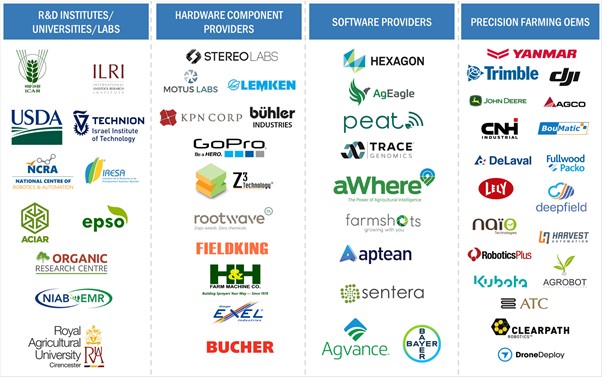
Major players in the precision farming market are Deere & Company (US), AGCO Corporation (US), CNH Industrial N.V. (UK), Ag Leader Technology (US), AgEagle Aerial Systems Inc (US), TOPCON CORPORATION (Japan), Bayer AG (Climate LLC) (Germany), TeeJet Technologies (US), Hexagon AB (Sweden), KUBOTA Corporation (Japan), Trimble Inc. (US), ABACO S.p.A. (Italy), CropX Inc. (Israel), Farmers Edge Inc. (Canada), Grownetics (US), Cropin Technology Solutions Private Limited (India), GAMAYA (Switzerland), DICKEY-john (US), TELUS (Canada), Activat Harxon Corporation (China), Agricolus (Italy), Esri (US), Farmdok GmbH (Austria), Yara (Norway), and CLAAS KGaA mbH (Germany).
Asia Pacific is expected to exhibit the highest CAGR in the precision farming market from 2025 to 2032 due to a combination of increasing agricultural modernization, rising food demand driven by population growth, and strong government support for smart farming initiatives. Countries such as China, India, Japan, and Australia are heavily investing in agricultural technologies like GPS-based equipment, drone surveillance, and remote sensing to boost productivity and ensure food security. Additionally, the adoption of loT, Al, and data analytics in agriculture is gaining momentum across the region, supported by government subsidies, digital agriculture programs, and growing private sector participation. The region’s fragmented land holdings and resource constraints are also pushing the need for more efficient, data-driven farming practices. Furthermore, the rapid development of agritech startups and growing smartphone and internet penetration among rural farmers are fostering the adoption of precision farming tools, positioning Asia Pacific as the fastest- growing market during the forecast period.
Advancements in agricultural technologies refer to the development and integration of tools like drone surveillance, GPS/GNSS devices, robotics, irrigation, and sensor controllers into traditional farming methods. These technologies enable farmers to monitor soil conditions, weather patterns, crop health, and resource usage in real time. By providing actionable insights, they help reduce the wastage of inputs such as water, fertilizers, and pesticides while improving crop yield and operational efficiency.
Additionally, the integration of the Internet of Things (IoT) and smart sensors in agriculture involves deploying interconnected devices that collect and transmit real-time data on various environmental and crop conditions. These technologies enable farmers to monitor factors such as soil moisture, temperature, humidity, and crop health, facilitating informed and timely decision-making. By leveraging this data, farmers can optimize irrigation schedules, apply fertilizers more efficiently, and detect pest infestations early, leading to increased productivity and resource conservation. Smart sensors equipped with cameras also help detect pest presence, enabling targeted pest management strategies. With scalable and cost-effective innovations, these technologies are becoming increasingly accessible to farmers worldwide, contributing to sustainable agricultural practices.
Innovative solutions are increasingly redefining modern agricultural operations. For instance, GPS-guided tractors, Al-powered irrigation systems, and sensor-based crop monitoring are transforming how farms are managed. In January 2025, autonomous tractors by Deere & Company (US) and biodegradable loT-based soil sensors were enhancing both productivity and sustainability. Another notable advancement in precision farming is the introduction of the AGRO Autonomous Al Rover in early 2025. This unmanned ground vehicle (UGV) integrates machine learning, computer vision, and sensor technologies to autonomously traverse agricultural fields. It captures real- time data to assess crop health, determine pistachio yields, and perform environmental mapping. By automating these resource-intensive tasks, AGRO enables farmers to make data-driven decisions, enhancing operational efficiency and supporting sustainable farming practices.
These developments are helping farmers improve productivity, reduce input waste, and implement more sustainable farming methods, thereby positively influencing the adoption and growth of precision farming across various regions. These developments are significantly contributing to market growth by making farming more data-driven, cost-efficient, and environmentally responsible.
As drones, irrigation controllers, GPS, flow and application control devices, guidance and steering systems, handheld mobile devices, sensors, and displays are central to the precision farming ecosystem. These technologies are widely used in dairy & livestock management, field farming, harvest & inventory management, soil & irrigation management, pruning, and weather monitoring. Automation and control systems are increasingly leading the way in automating field operations like crop scouting, planting, tilling, spraying, and weeding.
Agricultural software plays a vital role, offering modules for crop protection, environmental monitoring, waste & pollution management, landscape & soil care, and crop nutrition optimization. With advancements in Al, lot, blockchain, and cloud services, software adoption is accelerating, creating lucrative opportunities for providers to deliver solutions that enhance operational efficiency, energy use, and accessibility. As global adoption of precision farming grows, new revenue streams are emerging for equipment manufacturers, while rising demand for smart sensors, drones, and Al-powered tools continues to drive market expansion. To leverage these opportunities, companies are investing in innovation and diversifying their technology offerings.
REVENUE SHIFT AND NEW REVENUE POCKETS FOR PLAYERS IN PRECISION FARMING MARKET
GROWING EMPHASIS ON SUSTAINABLE AGRICULTURAL PRACTICES
The growing global emphasis on sustainable agricultural practices is significantly influencing the adoption of precision farming methods. Sustainable agriculture focuses on protecting natural resources, reducing dependency on chemical inputs, conserving water, and promoting biodiversity while ensuring food security. Precision farming aligns closely with these goals by using technologies such as soil sensors, satellite imaging, and data analytics to manage fields more efficiently. These tools allow farmers to apply inputs only where needed, reducing waste and environmental harm while maintaining or even improving crop yields.
Recent developments highlight how governments and institutions are supporting sustainable farming initiatives that are indirectly boosting precision farming. In May 2025, the Government of India initiated the development of 88 natural farming clusters in Jharkhand under the National Mission on Natural Farming, promoting eco-friendly and low-input agricultural methods. Similarly, in May 2025, the Mizoram government signed an MoU with the Bharat Rural Livelihood Foundation to promote non-pesticide-based agriculture and environmental conservation.
These efforts underscore a shift toward environmentally responsible farming models, where precision technologies play a key role in achieving sustainability at scale. Additionally, in December 2024, the Food and Agriculture Organization (FAO) and the International Fund for Agricultural Development (IFAD) launched an USD 82 million program targeting climate and environmental action through agriculture and food systems. This initiative focuses on transforming global agrifood systems to be more sustainable, resilient, and inclusive, with precision agriculture technologies playing a significant role in achieving these goals.
Governments around the world are increasingly recognizing the role of technology in modernizing agriculture and addressing critical challenges such as food security, climate change, and rural development. Smart agriculture, aimed at enhancing farm productivity, is being actively supported through government policies, subsidies, and dedicated initiatives. Smart agriculture is driving improvements in farm productivity and is being actively promoted through strategic policies, financial incentives, and targeted initiatives aiming to reduce farmers’ financial burden by adopting high-tech tools and encouraging widespread adoption of precision farming techniques.
In 2025, the Australian Government’s Smart Farms Program continues to support initiatives that leverage digital technologies to improve resource efficiency and agricultural productivity, with several grants awarded to smart farming projects. Prior to this, in September 2024, the Government of India announced an investment of approximately USD 715.33 million to promote smart farming practices through the adoption of technologies such as artificial intelligence (AI), drones, and data analytics. Furthermore, in November 2024, Japan advanced smart agriculture through government-backed subsidies, Al, robotics, and data platforms to combat labour shortages and boost farm efficiency. These initiatives directly support precision farming by enabling data-driven, sustainable, and high-efficiency agricultural practices.
The ecosystem of the precision farming market is composed of a diverse range of stakeholders that collectively enable the integration and functioning of advanced agricultural technologies. Key players in the ecosystem include hardware, software, and service providers, each contributing unique capabilities across the precision farming value chain. Companies like Deere & Company, AGCO Corporation, CNH Industrial, and Trimble Inc. offer end-to-end solutions, including equipment, digital tools, and support services. Meanwhile, specialized firms such as Ageable Aerial Systems and Ag Leader Technology focus primarily on hardware and software solutions. Others, like ABACO S.p.A., provide software-only platforms, while companies such as Tee Jet Technologies concentrate on core hardware components. This layered ecosystem ensures that farmers can access tailored solutions for field monitoring, data analytics, and automated farming operations, driving the overall efficiency and sustainability of modern agriculture.
KEY PLAYERS IN PRECISION FARMING ECOSYSTEM



[…] Read more on Farmers Review Africa […]
Comments are closed.