

Africa is one of the most biodiverse continents and South Africa is home to the Cape Floral Kingdom – by incredible margins being both the smallest and richest of the six floristic regions of the world with some of the most important national heritage assets literally rooted in the soil – as indigenous plants occurring only on our shores. However, the work of conservationists is never complete and indigenous biodiversity is never secure as alien plants proliferate triumphantly, save for the efforts of those vigilant few who work to address this silent menace.
One has to say that invasive species occupy a peculiar and somewhat odd niche in the popular imagination: while we’re generally taught to respect and even revere nature, invasive species are usually the only part of nature that we’re explicitly told to dislike, disapprove of and attempt to eradicate. Terrestrial context and regionality is everything in how we evaluate or favour one plant over another. For the botanically-keen individual an alien species stands out sorely on any landscape, whereas for others it can barely register as precious hectare after hectare is consumed by overly successful foreign vegetation, with nothing to keep it in check. There may be a cognitive dissonance here, however slight, that must be overcome. A tree is a tree is a tree, after all – or isn’t it? ‘Plant-blindness’ is a jibe used by some botanists for those individuals who pay no attention to the plants that they see on a given landscape, or who are otherwise disinterested (or perhaps unwilling) to make basic distinctions between flora.
Throughout the world biological invasions are – like climate change – an ecological crisis that humans are widely responsible for. The Columbian exchange from the 15th and 16th centuries saw the transfer of plants and animals between transatlantic hemispheres by European powers. Deliberate yet heedless – while it was done for the obvious benefit of people and their practical designs, little consideration was given to the impacts on natural habitats and their fauna. Protection of indigenous species – never being a standout colonialist priority – was similarly neglected by the time of the founding of the Cape Colony in 1652. And today we are exhaustively burdened with the consequences.
Some scientists have, however, been worried about the impact of relocated organisms for centuries. In the 1800s, British botanists grappled with the way their nation’s imperialism had facilitated the introduction of species to new environments across the world. Technically, the word “alien” is just a fact about whether a species originated domestically or not, although today it’s politicised almost universally as a slander or pejorative term. A species is native when it lives in the geographic territory it occupied prior to modern human transformations. Outside of that ancestral land it’s an alien. In The Ecology of Invasions by Animals and Plants (1958), Charles Elton argued that some aliens are dangerous threats that cause damage and can spread rapidly. Elton’s ideas eventually established the scientific field of invasion biology in the 1980s as a response to an increased consciousness about the inimical effects of globalisation on ecosystems.
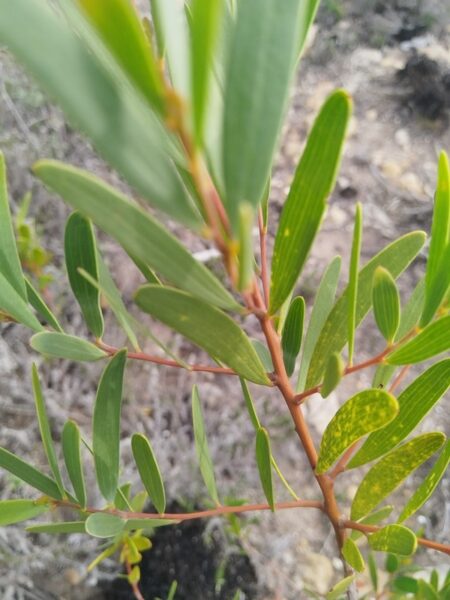
In an impressively dismal case of human utility gone awry, Rooikrans (Acacia cyclops, or ‘Roopitjie’ by the local vernacular) is an originally Australian shrub introduced to South Africa by the British around the 1850s to stabilise the shifting sand dunes of the Cape Flats, thereby aiding transport and expansion. Having few natural enemies it rapidly spread, thriving in the nutrient-poor soils and overwhelming the native fynbos. Rooikrans turned out to be a major threat to natural and rare dune vegetation as it grows prodigiously in those conditions – as well as in limestone fynbos, Sandveld and the critically endangered Renosterveld. Today Rooikrans has become a seemingly ineradicable feature on the rolling hills of the Western Cape, forming dense thickets that guzzle up groundwater and crowds out indigenous biodiversity. While difficult to quantify exact numbers of these trees, they’re extremely widespread. For context, there are over 370 invasive alien species heavily impacting the biodiversity of the Western Cape, and these are controlled under the National Environmental Management: Biodiversity Act (NEMBA), which lists over 381 plant taxa across South Africa. To the average person: Rooikrans is a ubiquitous braai-wood of choice. Farmers and conservationists on the other hand, usually at loggerheads on various contentious issues, are of one mind regarding the plant as a leafy cancer: devouring lands and choking waterways. CapeNature lists Rooikrans as the top invasive alien plant affecting the Western Cape province.
The Acacia cyclops (also known as red-eyed wattle) is named for its distinctive, shiny seeds with a bright crimson iris that resembles a bloodshot eye – harkening back to the Cyclops of Greek mythology: a hostile monocular giant. Alongside Black Wattle (Acacia mearnsii), Port Jacksons (Acacia saligna) and Poplars (Populus simonii) that grow aggressively they are some of the most threatening alien vegetation in the Cape, ousting native species and reducing water run-off by as much as 30 percent. When severe water restrictions are issued during the hot, dry Western Cape summers it should trouble residents to know that around a third of catchment-area rainfall is being subsumed by invasive species – which with adequate funding and labour could otherwise be managed and mitigated.
Working for Water is a public programme operating across South Africa intended to conserve water resources by controlling invasive plants. Late last year they successfully released a number of plant hopper insects in the Hartbeespoort dam to combat its water hyacinth problem, for example. While the programme sounds promising, it’s far from a perfect solution as budgetary constraints have meant that there are inconsistencies in the number of workdays for participants, with shortcomings in the quality and availability of skills training, and a lack of a structured system for tracking long-term outcomes. Clearing invasive alien vegetation is a relatively invisible solution compared to drastic water use-restrictions or the building of large desalination plants on the coastline – but it remains a practical and a high-impact environmental intervention for improving water availability. Recently the World Bank (Washington D.C.) launched its new ‘Water Forward’ programme to improve global water security. This brings some hope for improved efficacy and more financial support as leading financial institutions begin to recognise the importance of natural resources and conservation as key pillars of economic stability and prosperity, particularly in developing nations.
Wildfires are naturally-occurring events in the fynbos region, promoting growth and seed germination. Intervals of approximately 15-20 years are an appropriate period for the vegetation to be refreshed in its normal lifecycle, however with hotter & drier climates on the rise these fires have been happening far more frequently, and a burning period of less than 5 years is far too often for robust fynbos growth. Here Rooikrans enters again as an environmental beneficiary – a prolific seeder, its seeds can survive underground waiting dormantly for up to 90 years – exploding into growth and outcompeting other species as soon as the earth has been scorched. Whereas fynbos burns out mildly and rapidly, Rooikrans not only makes ecosystems more prone to fires; it burns at a higher intensity of heat and for longer durations, causing more damage. Part of the problem is that the same fires that are supposed to reinvigorate fynbos growth tend to result in denser Rooikrans. Working on Fire is another public programme which trains workers from marginalised communities in fire awareness, prevention and suppression skills. While an honourable task, yet again there are persistent challenges such as funding gaps and a need for better coordination between agencies and communities to ensure unified fire prevention and extinguishing efforts.
Managing Rooikrans is highly labour-intensive. Once the plant grows above 50 centimeters high its deep, sturdy roots make them hard to pull out by hand and it becomes necessary to saw them down, applying poison directly to the raw stumps to help curtail future offshoots. While some may recommend spraying with herbicide (and they do), this will usually kill or harm the surrounding indigenous plants indiscriminately. Once cleared the real struggle has only just begun as these areas need to be inspected and re-addressed multiple times as coppices often regrow and previously dormant seeds may begin to sprout. Some seedbeds need to be addressed for over a decade. Additionally, wild olives and certain species of protea are sometimes misidentified as Rooikrans and can become unfortunate victims of clearing operations. Left unattended the invasion recrudesces afresh like a relapsing cancer. Therefore, it’s crucial to emphasise not just the vast scope of the problem – but that alien species clearing is a reiterative, manual process, and not an instant fix.
Ordinarily, alien-clearing operations leave Rooikrans trees in situ after it has been cut so that it simply self-rots. However the raw material can be put to use and there are various options for resource beneficiation apart from just chopping it up into firewood. Composted, Rooikrans is nourishing for the soil. Recycling the wood for construction or mulching is possible, however processing requires additional resources and equipment. Farmers have shown that Rooikrans can be fed to sheep, but livestock will only eat the shoots when they’re very small due to the tannin content in the leaves. With the use of a pyrolysis furnace the organic material can be decomposed by heating it in a low-oxygen environment which results in biochar – a carbon-rich type of charcoal that improves soil fertility and reduces nutrient leaching. A newer, innovative pathway for alien species-utilisation is in the use of novel building materials such as at a community centre near Citrusdal, which was recently opened. This was built entirely from bricks made by using invasive biomass – substantially cutting down on the use of sand, cement and stone, and reducing carbon emissions associated with construction.
Says Gill Simpson, Executive Director of the Wild Rescue nature reserve, “The clearing of invasive species is always worthwhile and we have seen big differences in terms of indigenous biodiversity returning to the land where we have done this work – even in the most heavily infested areas. Rooikrans is a top driver for biodiversity loss as it dangerously outcompetes fynbos. Who knows if we’ll ever be completely rid of it in our region, but if we make the effort, with sufficient funding and labour it can be effectively contained.”
Alien plants are an enormous contributor to ecosystem degradation in South Africa. If we want to agree on the route toward a lasting solution we first need to agree on the map: by developing a shared picture of the extent of this crisis, and what we risk (or perhaps lose) by treating it as a low or negligible priority.