

According to latest research by Growth Market Reports, the global Geo-Spatial Agriculture Analytics market size reached USD 1.94 billion in 2024 and is projected to grow at a robust CAGR of 13.2% during the forecast period, reaching USD 5.45 billion by 2033. This remarkable growth trajectory is driven by the increasing adoption of precision agriculture technologies, the proliferation of IoT-enabled devices, and the growing need for sustainable farming practices.
The Geo-Spatial Agriculture Analytics Market is emerging as a key pillar in the evolution of precision farming and data-driven agricultural practices. The market is witnessing strong global adoption as farmers, agribusinesses, and governments increasingly rely on spatial data insights to improve productivity, optimize resource usage, and enhance sustainability. The market is witnessing accelerated investments in digital transformation across agriculture, as stakeholders recognize the value of geo-spatial analytics in optimizing crop yields, resource allocation, and supply chain efficiency.
Key Market Drivers
Rising Adoption of Precision Farming
One of the primary drivers is the rapid shift toward precision agriculture. Farmers are adopting geo-spatial tools to maximize crop output while minimizing input costs such as fertilizers, water, and pesticides. This data-driven approach enhances efficiency and reduces environmental impact.
Integration of AI, IoT, and Big Data
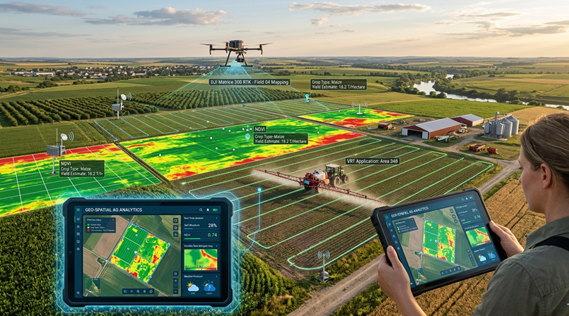
The convergence of advanced technologies like artificial intelligence, Internet of Things (IoT), and big data analytics is accelerating market growth. IoT-enabled sensors collect real-time field data, which is analyzed using AI-powered platforms to deliver actionable insights.
Government Support and Agricultural Modernization
Many governments are investing in digital agriculture initiatives to modernize traditional farming practices. Subsidies, smart farming programs, and rural digitization projects are boosting the adoption of geo-spatial analytics solutions.
Challenges in the Market
Despite strong growth, the market faces challenges such as high initial investment costs, lack of digital literacy among farmers in developing regions, and concerns related to data privacy and security. Additionally, integration complexities with legacy farming systems can slow down adoption rates.
Technological Advancements
Technological advancements are playing a transformative role in the Geo-Spatial Agriculture Analytics Market by significantly enhancing data accuracy, speed, and usability. The integration of high-resolution satellite imagery and advanced remote sensing technologies enables real-time monitoring of crop health, soil moisture, and vegetation patterns with greater precision than traditional methods. Artificial intelligence (AI) and machine learning algorithms are further improving predictive analytics, allowing farmers to forecast yields, detect early signs of pest infestations, and optimize irrigation schedules.
Competitive Landscape
- Trimble Inc.
- Deere & Company (John Deere)
- Raven Industries
- Ag Leader Technology
- Climate LLC (A subsidiary of Bayer)
- Granular (A Corteva Agriscience Company)
- Topcon Positioning Systems
- Taranis
- Planet Labs
- Descartes Labs
Future Outlook
The future of the Geo-Spatial Agriculture Analytics Market looks highly promising as digital transformation continues to reshape agriculture. Increasing adoption of smart farming technologies, combined with advancements in satellite imaging and machine learning, will further enhance predictive capabilities. As global demand for food rises, geo-spatial analytics will play a critical role in ensuring efficient, sustainable, and resilient agricultural systems.
Source: https://growthmarketreports.com/report/geo-spatial-agriculture-analytics-market