

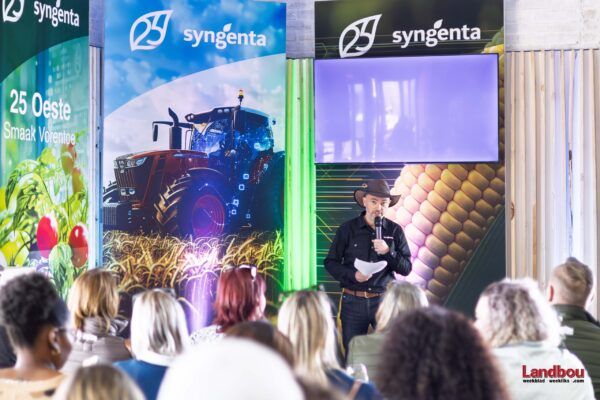
Despite real challenges facing agriculture, the “extraordinary” strength, ingenuity and resilience of South African farmers create optimism and belief that the best of South African agriculture is still ahead. This is according to Luc Henry, Managing Director of Syngenta South Africa.
Innovation and cultural heritage took centre stage as Syngenta hosted media members, industry stakeholders and friends at its Boerekos Plaaskombuis during the annual Nampo agricultural expo from 12 – 15 May 2026. Henry led the event, highlighting the company’s 25-harvest journey with South African farmers, while focusing on the future of sustainable food production.
“Twenty-five harvests mean 25 moments of truth. Twenty-five times that farmers have trusted Syngenta to stand alongside them, to help protect their crops, improve their yields, and ultimately bring good food to the table,” says Henry.
“For 25 seasons, we have shared their challenges – unpredictable weather, rising input costs, evolving pest pressures – and we have worked relentlessly to bring forward new technologies, formulations and solutions.”
Since arriving in South Africa from Syngenta’s Head office in Basel (Switzerland) in 2024, Henry has learnt that farming in South Africa involves more than just production numbers. “It is not only about yields or hectares; it is about value,” he says. “Value in relationships, value in resilience, value in feeding families, communities, and ultimately a nation. There is a sense of purpose here and deep pride amongst the South African farming communities.”
Syngenta’s main focus remains on the future. As the world’s demand for food grows and environmental pressures increase, the company assists farmers to produce more with fewer resources while protecting natural ecosystems. Henry states, “Our purpose is clear: to help safely feed the world while taking care of the planet.”
One of the most important aspects of this focus is working in partnership with agri sector role players to ensure South Africa’s regulatory environment evolves in a manner that supports sustainable long term growth. The country’s approach to Regulatory Data Protection (RDP), for example, is an urgent point of action.
“South Africa’s RDP legislation is significantly out of line with global norms at the moment,” says Henry. “Unlike most established agri economies, the country does not provide more than two years effective protection in relation to data or confidential information to market participants bringing new agricultural remedies to market. Innovator companies are thus unable to recoup their significant investment costs, ‘disincentivising’ them from bringing new agricultural remedies to market, and weakening their position relative to key competitors.’
The South African RDP status quo risks driving a reduction in crucial, locally relevant trials and product releases, resulting in fewer products able to successful mitigate local environmental conditions, and an overall weakening of the foundations of the South African agri economy – impacting food security and general national economic performance, with $13.7bn in annual agricultural exports at risk.
“The good news here is that key players across the sector have joined forces via the RDP Working Group,” Henry continues. “Policy challenges have been articulated and understood, and strong policy recommendations have been agreed upon and submitted to government. We are hopeful that the local agri sector will take the final collective steps necessary to ensure South Africa’s agri legislation is aligned to global norms in a way that will strengthen the long-term sustainability and competitiveness of South African agriculture, while helping to protect food security, exports and future sector growth.”
In addition to collaborative policy work, R&D is another key component of Syngenta’s approach to driving sustained agri value in South Africa and across the continent. The company’s goal with its cutting-edge research programme is to develop new, sustainable solutions that do not jeopardise quality food production.
Syngenta therefore continues to invest in more seed solutions and crop protection technologies, with new product announcements expected soon. With its platform, Cropwise, the company encourages data-driven precision farming which allows growers to optimise inputs, enhance crop yields, reduce waste, and minimise environmental impact. Innovation in agriculture does not happen overnight. “It takes years of research, investment, and careful regulatory processes to ensure that products are safe, effective, and sustainable.
“And while that journey can be long and complex it is one we are committed to because farmers in South Africa deserve the best science we can offer.”
Henry describes the Syngenta Boerekos Plaaskombuis, a popular feature at Nampo since 2024, as more than just a food venue. This is a celebration of where food comes from. It is where agriculture meets culture, where science meets tradition, where ‘farm to fork’ becomes something you can see, taste, and experience.
Over the last two years, thousands of visitors have enjoyed its offerings. Visitors come not only for the food but for an immersive experience that mixes traditional South African cuisine with modern cooking techniques.
The menu is compiled by Landbou Boerekos editor Arina du Plessis, using local ingredients. She works with a new generation of chefs from Roots Academy Chef School in Potchefstroom who create a space where heritage is respected while being reimagined for today’s diners.
The venue also serves as a platform for sharing knowledge. Farmers and other visitors are encouraged to discuss ways to improve farming practices and enhance the overall food production process.
Despite the challenges facing South African agriculture, Henry is optimistic about the sector’s future. He credits the resilience and creativity of local farmers as key factors for future success and is confident that both Syngenta and the country’s agricultural industry have considerable growth potential ahead.
“Strategic partnerships with government decision-makers, growers, retailers or consumers are the key to sustainable and responsible food production. By working together we can, quite literally, change the world through food production,” concludes Henry.