

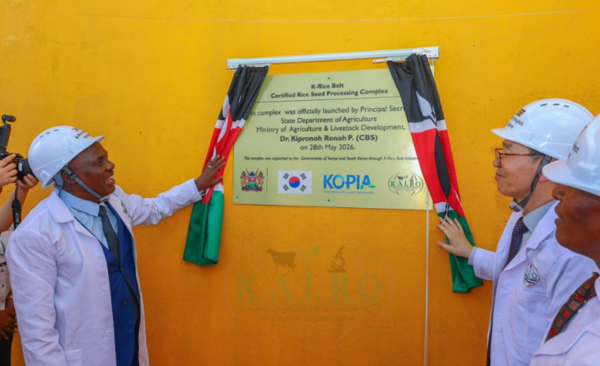
Kenya and the Republic of Korea have launched a modern rice seed production and processing facility aimed at strengthening the country’s rice seed systems, improving farmers’ access to certified seeds and boosting national rice production.
The K-Rice Belt Certified Rice Seed Processing Complex was officially launched yesterday at Kirogo Farm by the Kenya Agricultural and Livestock Research Organization (KALRO) in collaboration with the Korea Partnership for Innovation of Agriculture (KOPIA), the Rural Development Administration (RDA), Republic of Korea’s global program for agricultural technology transfer and locally adapted innovation, delivered through KOPIA Centers in partner countries under the K-RICE Initiative.
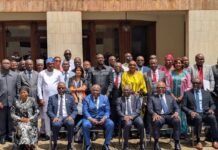
The event brought together senior government officials, KALRO and KOPIA representatives, Kirinyaga County leaders and members of the farming community.
Speaking during the launch, Agriculture Principal Secretary Dr. Kiprono Rono said the new facility would play a key role in transforming Kenya’s rice sector by increasing the production and supply of certified rice seeds to farmers.
Dr. Rono noted that the processing complex will raise certified rice seed production capacity from the current 40 tonnes per day to 700 metric tonnes, significantly enhancing seed availability across rice-growing regions.
He said the increased supply of high-quality seed would help farmers improve yields, reduce reliance on imported rice and contribute to national food security.
“The facility will improve farmers’ access to quality certified seed, reduce rice imports and strengthen national food security,” said Dr. Rono.
He further urged farmers to adopt climate-resilient rice varieties such as the Komboka rice variety and embrace modern agricultural technologies to improve productivity and livelihoods.
According to Dr. Rono, adoption of improved seed varieties and advanced farming methods is critical in addressing the challenges posed by climate change and rising food demand.
KALRO Board Chairman Dr. Thuo Mathenge said the new facility would help lower the cost of certified rice seed, making it more affordable and accessible to farmers.
Dr. Mathenge noted that many farmers have struggled with the high cost and limited availability of quality seeds, forcing some to rely on uncertified planting materials that result in poor harvests.
“The cost of rice seed will be lowered, ensuring farmers can access certified seeds more affordably,” he said.
He added that the initiative would directly benefit farmers by reducing input costs, increasing productivity and strengthening food security at both household and national levels.
KALRO Director General Dr. Patrick Ketiem described the launch as a major breakthrough in addressing one of the most significant challenges in the rice value chain — inadequate access to certified seeds.
Dr. Ketiem said a majority of rice farmers in Kenya have for years depended on uncertified seeds, contributing to low yields and the country’s continued dependence on imported rice.
“This facility marks the beginning of solving the biggest constraint in the rice value chain, inadequate access to certified seeds by farmers,” he said.
“For too long, the majority of farmers have relied on uncertified seeds, leading to low yields and forcing the country into continued imports annually,” he added.
Stakeholders said the K-Rice Belt Certified Rice Seed Processing Complex represents a major milestone in Kenya’s efforts to modernize rice production and achieve greater self-sufficiency in food production.
The facility is expected to strengthen rice seed systems by ensuring a steady supply of affordable, high-quality and climate-resilient seeds to farmers, ultimately improving rice productivity and farmer incomes.
The initiative also highlights the growing agricultural cooperation between Kenya and the Republic of Korea through technology transfer and innovation-driven partnerships aimed at enhancing sustainable food production systems.
With the launch of the processing complex, Kenya is expected to take a significant step toward reducing rice import dependency while empowering farmers with the tools needed to increase production and improve livelihoods.