

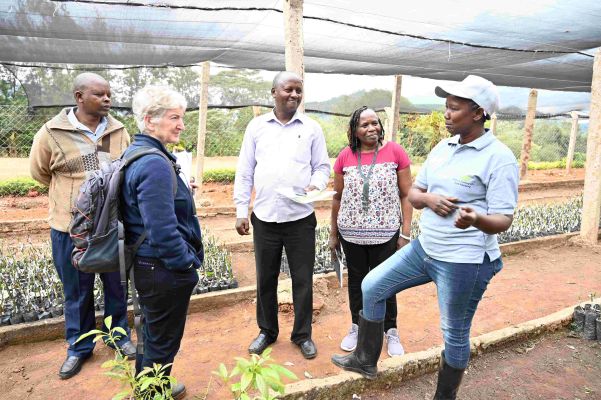
A decade ago, Mary and Paul Mwanza were living comfortable corporate lives in Nairobi, working in the hotel and information technology sectors.
Today, they are among Kenya’s leading champions of climate-smart tree farming, running a thriving commercial nursery that is helping restore degraded landscapes, improve food security and inspire a new generation of farmers.
Their journey from office desks to tree seedlings demonstrates how innovation, training and strategic partnerships can transform livelihoods while addressing the growing impacts of climate change.
Seeking a slower, more meaningful life, the couple relocated in 2014 to Makueni County, about 100 kilometres southeast of Nairobi. They invested in a small parcel of land and later established Palma Mukuyuni Tree Nursery in 2016.
Initially, the nursery supplied neighbours with a handful of seedlings, but growing demand soon turned it into a commercial venture and a training centre serving farmer groups, cooperatives and individuals across Kenya.
Initial stages
The transition, however, was anything but easy.
Operating in a region characterised by water scarcity and nutrient-poor soils, the couple struggled with limited horticultural knowledge and an oversaturated market.
“We had specialised in Grevillea robusta, locally known as Mukima, used for timber, poles, and firewood. However, since so many of us were growing this single species, the market was flooded,” Paul Mwanza recalled.
“Therefore, the profit margins were low or close to none. Additionally, we used to harvest soil from anywhere for potting. Still, the seedlings would be as frail as one harbouring kwashiorkor.”
Their fortunes changed through an initiative led by the Australian Centre for International Agricultural Research (ACIAR) in partnership with the Center for International Forestry Research and World Agroforestry (CIFOR-ICRAF).
The project, Fruit Trees for Climate Adaptation and Mitigation in East Africa, equipped farmers in Kenya and Rwanda with practical skills to improve fruit tree production, strengthen climate resilience and enhance household nutrition and food security.
For the Mwanzas, the project provided intensive training in seed sourcing, vegetative propagation, nursery management, pest and disease control, and business development. The emphasis on producing high-quality seedlings enabled them to transform their modest nursery into a professionally managed enterprise.
Today, Palma Mukuyuni Tree Nursery is accredited by the Kenya Plant Health Inspectorate Service (KEPHIS) and the Kenya Forest Service (KFS), allowing it to produce certified seedlings from approved seed sources with higher survival rates.
The nursery now stocks more than 150,000 fruit, indigenous and ornamental tree seedlings. Its customer base extends well beyond Makueni, with orders coming from counties including Bungoma, Kwale, Kilifi, Malindi, Kajiado and Kitui. Floodlights keep the nursery operational around the clock to serve travellers and customers purchasing seedlings at all hours.
Centre for knowledge sharing
Beyond selling seedlings, the couple has positioned Palma as a centre for knowledge sharing. Farmers receive practical guidance on planting, managing and nurturing trees to maximise survival and productivity.
Paul leads the technical training, drawing on lessons acquired through the project.
Mary oversees the business operations.
“I run the managerial aspects, ensuring the nursery’s procurement process and day-to-day running, including overseeing the nursery operators’ work and welfare, remain on schedule. Also, I prepare lunch for our workers to ensure they’re in the best shape to carry out the required tasks,” she said.
The nursery’s influence continues to spread. Working through primary and satellite nurseries, the Mwanzas collaborate with 84 farmer groups and 164 nursery operators, helping improve the quality of tree planting materials while creating employment opportunities within local communities.
They also hope to engage schools, taking advantage of Kenya’s evolving curriculum to educate young people about tree growing, environmental conservation and climate change. Meanwhile, their son is developing a website to strengthen the nursery’s digital marketing presence.
The impact extends well beyond one family.
In Kenya, the ACIAR-CIFOR-ICRAF project reached 2,695 beneficiaries, 46 per cent of them women, through training in good agricultural practices, tree nursery management, gender-inclusive approaches and climate-smart farming. School outreach activities also introduced quality avocado seedlings to hundreds of learners.
In Rwanda, more than 1,100 farmers and extension officers benefited from similar training programmes, while six nurseries received technical support to strengthen local seedling production. The project also continues supporting 30 individual nurseries in Kenya, improving certification processes and access to quality planting materials.
According to project leader Professor Catherine Muthuri, inclusive capacity building is central to the initiative’s long-term success.
“Embracing gender-inclusive approaches in capacity strengthening efforts is key to ensure tree nurseries can produce healthy tree planting material that meets smallholders’ multiple needs. This creates green jobs and realises national and global targets on climate change, restoration and biodiversity conservation.”
For Mary and Paul Mwanza, what began as a bold departure from corporate careers has grown into a flourishing enterprise—one that is proving that climate resilience, sustainable agriculture and profitable business can thrive together.