


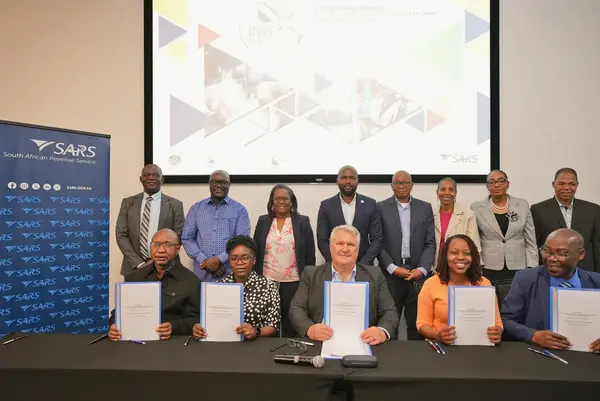
Customs administrations from Malawi, Mozambique, South Africa, Zambia and Zimbabwe have agreed on a common roadmap to interlink their systems and enable trade information to move ahead of goods, in a move aimed at speeding up cargo clearance, strengthening revenue collection and curbing illicit cross-border flows.
The agreement was reached during a three-day meeting in Pretoria from 24 to 26 August 2026, where senior customs, legal and ICT officials adopted a joint Roadmap and Action Plan for the development and rollout of Customs-to-Customs (C2C) data exchange across the region.
Hosted by the South African Revenue Service (SARS) and convened by TradeMark Africa (TMA), with participation from the Southern African Development Community (SADC) Secretariat, the meeting reaffirmed C2C cooperation as a tool for improving trade corridor performance, enabling pre-arrival processing, strengthening risk management and revenue assurance, increasing transparency and facilitating the movement of compliant goods.
Beyers Theron, SARS Director for Customs and Excise, said customs authorities must balance the facilitation of legitimate trade with protecting revenue, safeguarding economies and managing compliance risks.
He called for a shift from enforcement-heavy approaches towards an assurance-based and facilitation-oriented model in which borders become points of confirmation rather than delay.
“When neighbouring customs administrations exchange trusted information securely and efficiently, the benefits extend beyond our institutions. Traders experience faster and more predictable processes, governments strengthen revenue assurance, border agencies make better-informed decisions, and our region becomes more connected and competitive,” he said.
TMA Regional Director for Southern Africa Hope Situmbeko said border delays can undermine regional manufacturing by disrupting the movement of inputs needed by factories.
She cited electrical cable production as an example, noting that manufacturers may depend on copper, polymers, specialised additives and machinery sourced from several countries, with every border crossing creating the possibility of delays and higher production costs.
“Information should not have to wait for the truck,” she said, arguing that the success of C2C should ultimately be measured by its operational impact rather than its technical sophistication.
“A competitive factory creates employment. It purchases services. It pays salaries. It generates corporate income. It supports suppliers and logistics companies. It exports. It creates economic activity from which governments collect revenue in many different forms. In that sense, trade facilitation and revenue mobilisation need not be competing objectives. Good C2C systems can strengthen both. Better advance information can improve risk management and revenue assurance while allowing compliant trade to move faster,” she noted.
Efficient trade corridors
Ally Alexander Mwangolombe of the SADC Secretariat said C2C data exchange provides a practical route towards digitally enabled interoperability and more efficient trade corridors.
He stressed the importance of reducing repeated documentation and unpredictable delays, particularly for smaller traders, while ensuring that SMEs, young entrepreneurs and women involved in cross-border trade benefit from more efficient regional markets.
Implementation of the roadmap may begin with priority corridors, building on bilateral data-exchange links already underway, including connections between Zambia and Malawi and between Zambia and Zimbabwe.
The initiative is ultimately expected to support the development of Smart Corridors and advance the region’s long-term ambition of moving from One-Stop Border Posts to “Non-Stop Borders”.
The potential economic gains are significant. Afreximbank estimates that Southern Africa accounted for about 41% of intra-African trade, worth roughly $192 billion, in 2023.
The five administrations have therefore committed to timely implementation of the roadmap and continued cooperation to improve the performance of the region’s trade corridors.