

International Pollinator Week runs from 22-28 June, as a celebration dedicated to protecting the small creatures and creepy crawlies that sustain our ecosystems and food supply.
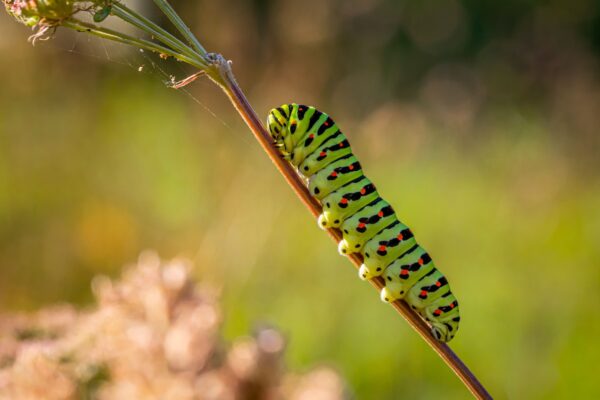
“Life on a Leaf: Celebrating Caterpillars and Host Plants” is this year’s theme inspiring grassroots action – so to speak – by highlighting the fact that caring for pollinators requires providing food and shelter for their young, as nearly all butterfly and moth larvae rely on specific native host plants to survive.
Caterpillars are vital links in the food web that are directly harmed by the use of pesticides and insecticides. Many species of butterflies and moths depend on the leaves of host plants to feed, grow, and eventually mature into adult pollinators. There are few easy substitutes for the services pollinators provide. Once they decline, food production becomes less reliable and the natural systems become harder to restore. In South Africa, pollinator losses are a growing ecological and economic concern as millions of managed and wild honeybees are dying off due to pesticide misuse, habitat fragmentation and monoculture farming – directly threatening the yields of over 50 domestic crops and the reproduction of indigenous flora. Recent estimates have suggested that 90 percent of flowering plants (roughly 307,000 species) are partially or fully dependent on animal pollination. This includes roughly 75 percent of the world’s leading food crops, amounting to about 35 percent of crop production yield.
Pollinators are a vital part of the machinery that keeps ecosystems productive and resilient. There are some 350,000 pollinator species – including over 21,000 known bee species – from insects to birds to bats. Much of this biodiversity goes unnoticed and unappreciated until the vital systems they support begin to fail. Pollinators contribute an estimated USD 235 billion to USD 577 billion annually to the global economy. Without pollinators, the foods at the center of a healthy diet would rapidly become less abundant, less reliable and more expensive. Pollinators help keep ecosystems functioning and underpin robust landscapes and rural livelihoods, sustaining wetlands, vulnerable coastal flora that defends against storm surges, and riparian vegetation that stabilise soils and reduce water runoff.
Bees are widely considered the most efficient pollinators. Charles Darwin’s “humble-bee” is a hard worker and in Europe around 80 percent of wildflower and crop species depend entirely on bee pollination for fertilisation. Bees are what’s known as a keystone group, the removal or drastic decline of which would result in a domino effect of ecological impacts. There are now estimated to be at least 24,705 to 26,164 bee species in the world, thousands of which are yet to be described and studied by science – mostly expected to be found in Asia and Africa. This is unsurprising as some African countries have zero usable bee data and others are very limited in what they have available – leaving significant potential for undiscovered biodiversity on our continent.
The humble bumble may be the bees knees when it comes to pollination, but relying too heavily on one species is risky when chemical use, climate change stress, disease or other adverse factors hit. Some regions and pollinator groups remain poorly understood as research and funding focuses heavily on commercially preferred species – while ignoring some native pollinators are actually better adapted to local crops and climates.
Beehives are unfairly analogised as places of extreme confusion as a new study has demonstrated that honey bees have a remarkable ability to assess the reliability of the information they communicate – actively increasing their recruitment efforts when they know the directions they are providing to food sources are accurate and verified. The “Flight of the Bumblebee” by Nikolai Rimsky-Korsakov is a famously complex musical composition requiring maintained speed and pristine articulation to perform skillfully. This year-1900 homage to the busy hexapod captured their intricacies presciently as a 2026 study has shown that bees demonstrate advanced cognitive abilities, even using tools to solve problems. We might have taken this for granted as bees (appearing on Earth about 120 million years ago) already solved sophisticated engineering challenges long before the evolution of Homo sapiens. The honeycomb conjecture states that a regular hexagonal grid is the most efficient way to divide a surface into regions of equal area while using the absolute minimum total perimeter – which bee brains instinctively calculated would give them the maximum amount of honey storage for the minimum amount of wax.
With the brilliance of bees becrowned; other pollinating species are surprisingly high in number, often with specially-evolved relationships to their floral counterparts. One of the remarkable things about the Cape Floristic Region is that many plant species evolved alongside very specific pollinators – sometimes a single bird, beetle, fly, or moth. Bees deliberately collect pollen to feed their young, making them exceptionally efficient at moving pollen between flowers. Butterflies move pollen over longer distances than many insects and help maintain genetic diversity across plant populations. Moths are night-shift pollinators and many pale, strongly scented flowers evolved specifically for moth pollination. Beetles are some of the oldest pollinator species and were spreading that sweet powder between flowering plants long before bees became dominant. In South Africa especially, monkey beetles are major pollinators in parts of the Cape flora. Wasps are crucial for some specialised plants, and fig wasps are one of nature’s most famous one-to-one pollination partnerships. Birds such as hummingbirds, sunbirds and the cape sugarbird are among the most specialised pollinators – particularly for tubular flowers – as they transfer pollen while feeding on nectar. Bats are critical pollinators for many night-blooming trees and succulents; moving pollen across very large distances. Various small mammals and primates, as well as reptiles also contribute to pollination, each in their own ecological niches.
Pesticides – especially insecticides – pose severe threats to bees and other pollinators by causing direct mortality, impairing navigation, and weakening immune systems. Pollinators exposed to these chemicals often fail to forage efficiently, which threatens colony survival and reduces crop yields. Direct contact with active chemical sprays or pesticide drift can kill bees instantly in the field or cause them to bring contaminated nectar and pollen back to the colony. Even non-lethal doses can be severely impairing as affected bees struggle to find their way back to the hive, ultimately leading to depopulation. Insecticides like neonicotinoids are absorbed by plants and end up in their pollen and nectar, exposing bees long after the initial application.
Says Gill Simpson, executive director of the Wild Rescue nature reserve, “At a moment of climate instability, accelerating biodiversity loss, and pollinator decline, our food systems are crucially dependent on healthy soils, functioning ecosystems, and biological diversity. Transitioning away from industrial pesticides is a necessity for safeguarding food security and ecological resilience. Productive and resilient food systems do not require escalating chemical use: they require ecological integrity, functional biodiversity, and policies that support farmers to work with nature rather than against it. Pesticide use is well established as a driver of biodiversity decline, and how we choose to regulate, manage and restrict these chemicals will have large consequences for biodiversity conservation in South Africa.”
As Africa’s second-largest pesticide user, with climate change intensifying pest pressures and food security concerns, South Africa faces escalating applications across extensive croplands. These impacts ripple through ecosystems, eliminating non-target insects, disrupting soil ecosystems, and creating feedback loops where declining populations of species that feed on invertebrates necessitates further pesticide intensification. According to a report by the African Center for Biodiversity, “Biological control, agroecological design, and habitat-based pest management are particularly well suited to many African contexts because they are knowledge-intensive but input-light. Their effectiveness, however, depends on healthy soils, rich biodiversity, and coordinated action that extends beyond individual farms. This underscores the need to treat certain ecological pest management approaches as public goods, and to rethink public investment, regulatory frameworks, and extension systems that continue to privilege input-intensive models.”
In the pursuit of short term high yields, modern agriculture is increasingly eroding the very natural systems that make farming possible. Yet the decline of pollinators is not irreversible; strengthening pesticide regulation and the adoption of pollinator-friendly pest management is a crucial step toward rebuilding healthier and more resilient food systems. Protecting bees and other pollinators is not simply an environmental responsibility; it is an investment in food security, in helping our indigenous fauna and flora endure, and in the wellbeing of future generations and communities.