

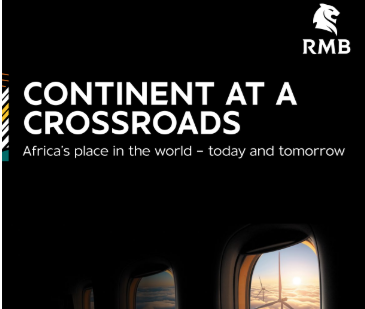
A new report by Rand Merchant Bank (RMB), one of the leading African corporate and investment bank has outlined a bold and data-driven assessment of Africa’s economic trajectory, highlighting the investment pathways and reforms needed to unlock the continent’s prosperity.
The ‘Continent at a Crossroads: Africa’s place in the world – today and tomorrow’ report draws on insights from long-form interviews with 47 prominent leaders across the continent and a 36-question public survey to identify nine themes shaping Africa’s future.
According to Isaah Mhlanga, RMB Chief Economist the November 2025 RMB White Paper describes Africa as a paradox, with a wealth of resources, a burgeoning population, and a strategic geographic position at the intersection of global trade routes juxtaposed by a longstanding struggle with weak governance, fragmented markets, underdeveloped infrastructure, and an external dependency on aid and extractive industries.
Governance is identified as the central constraint on Africa’s economic progress, with interviewees citing weak institutions, corruption and inconsistent regulatory systems as major barriers to competitiveness.
World Bank governance indicators referenced in the report show sub-Saharan Africa lagging well behind global averages on rule of law, regulatory quality and government effectiveness.
Business leaders interviewed warned that “corruption is the biggest issue” and argued that “businesses want certainty, to pay once… not face multiple levies across borders.”
Regional integration emerging as a game-changer
Regional integration emerges as the continent’s “potential game-changer,” with AfCFTA positioned as a pathway to scale, trade efficiency and stronger bargaining power in global forums.
Interviewees note that AfCFTA offers “a once-in-a-generation opportunity to really put the African continent as a political bloc,” even as implementation remains slow due to localised tax regimes, non-tariff barriers and weak customs enforcement.
Survey and interview responses highlight that many African governments remain hesitant to relinquish aspects of sovereignty, a challenge one economist describes as “African countries unwilling to let go of that autonomy.”
Intra-African trade remains at only about 16% of the continent’s total trade, dramatically lower than in Asia or Europe, despite the existence of eight regional economic communities that could support deeper integration.
Experts point out that physical and logistical barriers such as poor infrastructure, high transport costs and limited cross-border mobility continue to undermine the promise of AfCFTA.
Demographics as Africa’s defining advantage
Demographics are highlighted as Africa’s strongest comparative advantage, with half of the continent’s population under the age of 19 and its labour force expected to grow faster than any region globally.
Interviewees describe Africa’s youthful population as its “greatest endowment” and its “biggest competitive advantage,” especially when compared to aging populations in Europe and North America.
Several contributors warn that without investment in education, healthcare and employment creation, the youth boom could transform into “a recipe for destabilisation.”
Survey findings reveal that respondents are deeply concerned about governments’ ability to deliver basic services, with many citing education, healthcare and youth unemployment as the continent’s biggest long-term challenges.
Technology and innovation driving leapfrogging potential
Technology is identified as a major accelerant of change, with leaders arguing that Africa’s digital adoption and innovation ecosystems offer unprecedented opportunities to leapfrog development stages.
One investor notes that “the challenges that we face as Africans give birth to the innovation that will be key in uplifting our economies,” highlighting fintech, logistics and e-commerce as sectors attracting significant capital.
Mobile money remains dominant across the continent, with Africa accounting for 76% of global mobile money transactions in 2024 and continuing to expand access to financial services for millions.
Several interviewees stress the importance of scaling internet access, digital skills and affordable connectivity to ensure that Africa’s digital transformation does not widen inequality.
Minerals, capital and climate pressures
Resource wealth is also highlighted as a major economic opportunity, particularly as global demand for critical minerals used in clean energy transitions accelerates.
The report warns, however, that Africa’s development remains constrained by limited and costly access to capital, shrinking aid flows and volatile private lending that restrict governments’ fiscal space.
Climate change is described as both an environmental and economic threat, worsening Africa’s vulnerabilities despite the continent contributing the least to global emissions.
Geopolitical shifts and rising African agency
Geopolitical interest in Africa is increasing, but the report warns that renewed global attention will only translate into empowerment if African leaders unite behind a shared agenda.
Interviewees insist that Africa must shift “from being objects of aid and extraction to being proactive shapers of the global future,” particularly following the AU’s admission as a permanent G20 member.
The report outlines three possible futures for the continent, ranging from a prosperous and unified Africa to a bleak scenario of missed opportunities if reforms and investments fail to materialise.
“This report enhances our shared understanding of this complex, fascinating and growing continent” and adds that “this may prove invaluable in helping to set Africa on the right course for future prosperity,” said Mhlanga.