

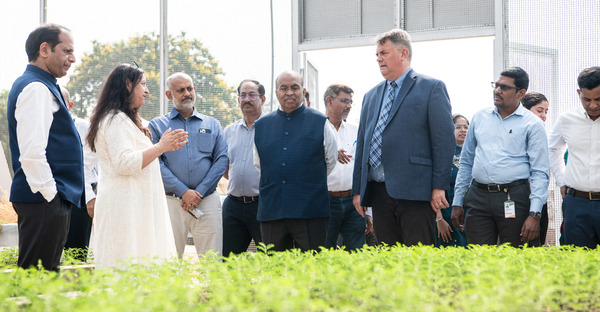
Inauguration of the Dry Root Rot Phenotyping Facility at ICRISAT headquarters in Patancheru [Apr 2026]
The International Crops Research Institute for the Semi-Arid Tropics (ICRISAT) is intensifying efforts to strengthen plant health and build climate-resilient agricultural systems across the drylands of Asia and Africa as rising temperatures and shifting climate patterns fuel the spread of pests and diseases.
Marking the International Day of Plant Health, the institute said healthy plants remain central to agricultural productivity, food security, and resilient farming systems.
According to the Food and Agriculture Organization, plant pests and diseases destroy up to 40 percent of global food crops annually, leading to agricultural trade losses exceeding USD 220 billion every year.
With global food production expected to rise by nearly 60 percent by 2050 to feed a growing population, ICRISAT said safeguarding plant health is becoming increasingly urgent, especially for millions of smallholder farmers in dryland regions vulnerable to climate shocks.
The institute is using an integrated approach that combines host plant resistance, biological control, predictive analytics, climate science, and farmer outreach to manage emerging threats to crops.
A major pillar of ICRISAT’s work focuses on breeding crop varieties resistant to pests and diseases affecting dryland agriculture. Scientists at the institute have developed and promoted resilient chickpea and pigeonpea varieties capable of withstanding diseases such as fusarium wilt, ascochyta blight, and sterility mosaic disease.
The institute said these genetic improvements reduce dependence on chemical pesticides while helping farmers protect yields under increasingly difficult climatic conditions. ICRISAT’s genebank has also played a critical role in conserving genetic resources used in disease resistance breeding programs.
In one of the largest global chickpea disease resistance studies, ICRISAT scientists screened more than 13,500 chickpea accessions from 40 countries for resistance to fusarium wilt and identified 160 resistant lines.
Further screening of 5,084 additional accessions from the ICRISAT Genebank and India’s National Bureau of Plant Genetic Resources identified 133 lines resistant to fusarium wilt, 33 resistant to ascochyta blight, 34 resistant to Botrytis grey mould, and 74 resistant to dry root rot.
According to the institute, the findings are helping researchers better understand the molecular defense systems in chickpea and paving the way for next-generation climate-resilient cultivars capable of surviving increasingly hostile disease environments.
Beyond crop breeding, ICRISAT’s legumes pathology and entomology teams are advancing biological control and integrated crop management strategies aimed at reducing excessive pesticide use.
The institute said its research has contributed to environmentally safer solutions for soil-borne diseases such as wilt and root rots, as well as destructive pests including borers, miners, and fall armyworm.
ICRISAT is also increasingly deploying digital technologies to support farmers through real-time crop advisories. Through the SMART-CROP initiative implemented in partnership with the SBI Foundation, the institute is integrating satellite imaging, artificial intelligence, machine learning tools, and weather forecasting to detect crop stress early and guide farmers on integrated pest and disease management practices.
The initiative, which focuses on pigeonpea and chickpea production, has digitally onboarded more than 4,800 farmers across Telangana and Karnataka within one year.
The institute has also invested in new research infrastructure to strengthen preparedness against emerging plant diseases. Recently, ICRISAT inaugurated a state-of-the-art Dry Root Rot Phenotyping Facility at its headquarters in Patancheru, India.
In Kenya, the institute established a Fusarium Wilt Screening Facility at Kibiko in Nairobi to support regional disease screening and plant health research efforts across Africa.
ICRISAT said the facilities complement broader climate change research aimed at understanding how changing environmental conditions influence plant-pathogen interactions and pest emergence.
The institute is also strengthening knowledge sharing and farmer capacity building across Africa and Asia through training programs, stakeholder consultations, and science-led advisory services.
In Ethiopia, ICRISAT partnered with the Ethiopian Institute of Agricultural Research to organize a three-day consultation workshop on legume plant and soil health, bringing together researchers, universities, extension agencies, and private-sector stakeholders to address challenges affecting legume production.
In India, farmers from Odisha participated in practical training sessions on healthy seed production, seed treatment, seed purity, and improved sowing practices aimed at reducing disease incidence and improving crop establishment.
ICRISAT said emerging and transboundary pests and diseases require stronger preparedness systems, resilient crop genetics, sustainable management practices, and climate-informed decision-making tools.
The institute noted that integrating scientific advances in plant resistance, biological control, digital agriculture, and farmer-centered innovations will remain critical in securing food, nutrition, and livelihoods for millions of smallholder farmers across the drylands of Asia and Africa.