



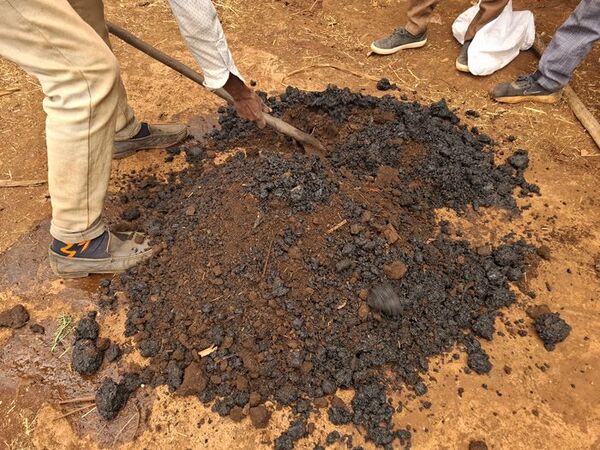
Production of biochar-based fertiliser from enset biochar and compost. Picture: ©DBFZ
Ethiopian smallholder farmers are receiving financial compensation from carbon sink certification for the first time, marking a milestone in the country’s efforts to link climate action with improved agricultural productivity and rural incomes.
The payments are being made under the “ETH-Soil” project, a five-year initiative coordinated by the German Biomass Research Centre (DBFZ) and funded by Germany’s Federal Ministry for Economic Cooperation and Development (BMZ).
The project promotes the use of biochar-based fertilisers (PbD) and integrated soil fertility management practices to restore degraded land, increase crop yields and sequester carbon in soils.
Nearly 300 participating smallholder farmers are now receiving proceeds from the first sale of carbon sink certificates in Ethiopia. For carbon sinks established by 2025, each farmer will receive an average of 1,700 Ethiopian birr (ETB), equivalent to roughly one-third of an unskilled worker’s monthly wage.
Project officials said the payments demonstrate how climate finance can directly benefit rural communities while supporting sustainable farming practices.
The majority of the revenue generated from the sale of Artisan C-Sink certificates goes directly to participating farmers. At least 60% of the proceeds are distributed to smallholders, while the remainder covers training, data collection, quality control and auditing.
Alternative soil fertility practices
The initiative comes at a critical time for Ethiopia’s agricultural sector, which has long depended on imported synthetic fertilisers. Supply chain disruptions caused by global crises, including the war in Ukraine and tensions in the Gulf region, have highlighted the vulnerability of relying heavily on imported farm inputs.
In response, the Oromia region has increasingly embraced alternative soil fertility practices. The ETH-Soil project has demonstrated that green manuring and vermicomposting of organic waste can be implemented throughout the year, reducing dependence on imported inputs.
Biochar, a charcoal-like substance produced from biomass, has emerged as a key component of the project. In Ethiopia’s highland areas, it is replacing expensive agricultural lime, helping retain nutrients in the soil during heavy rainfall and improving humus formation.
The project’s success is now contributing to a broader national shift toward nutrient recycling and the domestic production of organic fertilisers from waste materials.
Encouraged by the results, the Oromia Regional Government began in 2025 to expand the use of biochar-based fertiliser technologies to other soil fertility programmes supported by Germany, the European Union and the World Bank.
Scientists involved in the initiative say the benefits extend beyond climate mitigation and additional income from carbon credits.
Biochar-based fertilisers
According to project findings, biochar-based fertilisers can effectively substitute synthetic fertilisers while significantly improving crop productivity. In pilot regions covering approximately 31 hectares of heavily degraded land, yield increases of between 11% and 30% were recorded for staple cereals including wheat, barley, maize and teff compared with conventional synthetic fertiliser use.
Even greater gains were achieved for beans and potatoes, where yields increased by between 9% and 68%.
Researchers also reported significant improvements in soil quality. In the Kofele district, where acidified soils had pH values of around 5, the use of alkaline biochar raised pH levels to between 5.8 and 5.9, improving growing conditions for crops.
The porous structure of biochar also enhances phosphate availability and increases soil organic carbon content. Acting like a sponge, the material retains nutrients that would otherwise be washed away during periods of heavy rainfall.
For participating farmers, the combination of higher crop yields, reduced spending on synthetic fertilisers and income from carbon certificates is generating substantial economic benefits.
Project coordinators say the initiative demonstrates how climate-smart agriculture can strengthen resilience among smallholder farmers while contributing to global climate goals.
The ETH-Soil project also aligns with the broader mission of DBFZ, which focuses on developing sustainable and efficient uses of biomass resources. The German research institute works with partners in science, industry and government to identify and demonstrate innovative bioenergy and bio-based solutions that can contribute to sustainable development.
For Ethiopia, the first carbon payments to smallholder farmers represent more than a financial milestone. They signal the emergence of a new model in which farmers are rewarded not only for producing food but also for delivering environmental services through carbon sequestration and sustainable land management.
As climate change and geopolitical disruptions continue to challenge global food systems, the project offers a promising example of how locally produced organic fertilisers and carbon markets can improve agricultural resilience, reduce dependency on imported inputs and create new income opportunities for rural communities.




[…] farmers in Ethiopia have successfully secured financial compensation through a novel soil carbon sink certification mechanism, marking a […]
very informative articles or reviews at this time.
[…] have received proceeds from the first sale of soil carbon sink certificates under the five-year ETH-Soil project. Coordinated by the German Biomass Research Centre (DBFZ) and funded by Germany’s Federal […]
Comments are closed.