

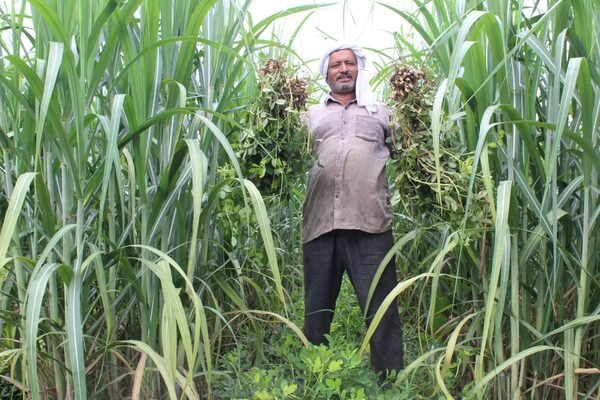
In Mahalka village, Meerut, farmer Virender Singh Vihan’s one-acre sugarcane–groundnut plot by the highway has drawn wide attention from neighboring farmers (Photo: Nima/CIMMYT).
For decades, sugarcane has dominated the agricultural landscape of western Uttar Pradesh, India, providing an important source of income for farmers while remaining deeply embedded in the region’s agricultural economy.
However, its long growing cycle and intensive use of water and nutrients can contribute to declining soil fertility and limited crop diversity, prompting farmers and researchers to explore how the space between sugarcane rows can be used to create new opportunities.
Researchers from the International Maize and Wheat Improvement Center (CIMMYT) and the Indian Council of Agricultural Research–Indian Institute of Farming Systems Research (ICAR-IIFSR) are promoting additive intercropping, a system in which farmers grow a short-duration crop such as groundnut between rows of sugarcane without replacing or reducing the main crop.
The approach allows farmers to produce an additional food and oilseed crop, generate extra income and improve soil health without bringing more land under cultivation.
Making better use of space between rows
Sugarcane is planted in relatively wide rows to provide sufficient space for crop growth and field operations. During the early stages, however, much of this space remains unused. Groundnut can occupy this area while the sugarcane is still developing.
Short-duration groundnut varieties mature in roughly 90 to 100 days, allowing farmers to harvest the crop before the sugarcane canopy closes.
In western Uttar Pradesh, where sugarcane is commonly planted during February and March, this growing window provides an opportunity to produce a second crop without interfering significantly with the main harvest.
This is what makes the practice “additive.” Farmers do not have to sacrifice their principal cash crop for another crop; instead, they add groundnut to the existing production system and make productive use of land that would otherwise remain largely unused during the early sugarcane season.
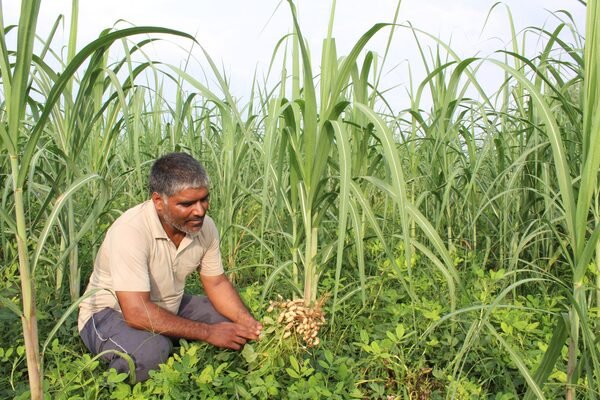 A farmer in Meerut examines freshly harvested groundnut pods grown alongside sugarcane through intercropping. (Photo: Nima/CIMMYT).
More than an additional harvest
The benefits of groundnut extend beyond the income generated from its pods. As a legume, groundnut fixes atmospheric nitrogen, potentially contributing to soil fertility.
Its low-growing plants also provide ground cover that can suppress weeds and help conserve soil moisture. Researchers further suggest that groundnut may help reduce pest and disease pressure in sugarcane by functioning as a trap crop.
Early results have been encouraging. CIMMYT and ICAR-IIFSR reported that additive intercropping with groundnut increased sugarcane yields by 10–15% during the first season of trials, while overall system productivity increased by 30–35% when measured through sugarcane equivalent yield. On-farm observations have also recorded sugarcane yield increases of up to 10%.
Water management is another important advantage. Research using paired-row sugarcane has shown that wider beds can accommodate intercrops while providing space for field operations.
Combined with surface and subsurface irrigation systems, the approach has demonstrated potential water-use-efficiency gains of 75–80%.
From research to farmers’ fields
The approach is now moving beyond research plots. Farmers in Meerut, Muzaffarnagar, Baghpat and Hapur have begun testing groundnut and other intercrops alongside sugarcane.
In 2025, CIMMYT reported that 50 farmers were participating in the initiative, gaining practical experience with modified planting arrangements and short-duration crops.
Among them was Meerut farmer Nimesh Kumar, who planted groundnut alongside sugarcane for the first time. Despite some initial trial and error, both crops performed well enough to encourage him to expand the practice.
His experience highlights the importance of farmers’ participation in adapting agricultural innovations to local conditions.
A wider opportunity
The significance of the approach extends beyond individual farms. India imports about 60% of its edible oil requirements, while farmers in major sugarcane-producing regions have strong economic reasons to continue cultivating the profitable cash crop rather than replacing it with oilseeds.
Additive intercropping offers a way to address both challenges. Uttar Pradesh has approximately 2.7 million hectares under sugarcane, and CIMMYT estimates that intercropping just 20% of this area with groundnut could produce an additional 652,800 tonnes of groundnut annually and generate about INR 4,907 crore in additional farmer income.
The wider ambition is to scale the approach to one million hectares through research, extension, improved seed systems, mechanization and supportive policies.
For western Uttar Pradesh, the combination of sugarcane and groundnut demonstrates how farmers can produce more from the land they already cultivate.
Rather than expanding agricultural land, additive intercropping makes better use of existing space, while offering farmers another source of income and potentially improving soil and water management.
The spaces between sugarcane rows could therefore become more than empty ground—they could become an important part of a more diversified and productive farming system.