BY JOHAN GERBER
Garlic is much more than a kitchen staple. Its naturally occurring sulphur compounds, particularly allicin, have been studied for their ability to repel and control a range of agricultural insect pests.
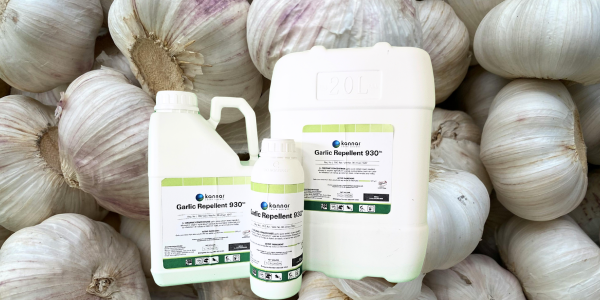
Kannar Garlic Repellent 930 offers growers a convenient way to harness the power of garlic in the garden, greenhouse or field. Garlic-based pest control has been investigated for decades, with research showing activity against certain insects, mites and plant-parasitic nematodes. Its effectiveness depends on the type of pest, garlic concentration and efficiency of the formulation to deliver the garlic to where it’s required. A properly formulated product, backed by science is key.
According to the New York State Integrated Pest Management Program at Cornell University, garlic has demonstrated insecticidal, acaricidal, nematicidal and fungicidal properties. Garlic-based products have also been used as repellents against certain pests, including aphids and some moth species. Kangar Garlic Repellent is registered against aphids and American bollworm.
The US Environmental Protection Agency first registered a garlic-based pesticide as a bird repellent in 1983, followed by a garlic-only insecticide registration in 1991. Kannar Garlic Repellent has been registered in South Africa since 2003 and organically certified since 2009.
For gardeners and growers looking for alternatives to conventional chemical pest control, garlic offers an interesting natural option. Kannar Garlic Repellent 930 harnesses this well-known property of garlic to help create an environment that pests are less likely to want to call home.
As with any pest-control product, results depend on the pest and the conditions in which the product is used. The value of garlic lies not in being a miracle cure, but in its scientifically documented potential as part of an integrated approach to pest management.
Sources: Brian P. Baker and Jennifer A. Grant, New York State Integrated Pest Management Program, Cornell University, Garlic and Garlic Oil Profile; US National Center for Complementary and Integrative Health (NCCIH), Garlic: Usefulness and Safety; Fejes et al., Frontiers in Nutrition (2024), review of human research on raw garlic consumption.