

The livestock and feed industry in Africa needs to place greater emphasis on feed safety, antibiotic reduction and improved animal nutrition to support healthier animals and safer food for consumers, according to Michael Nyarko, Area Manager for West Africa at Biochem Zusatztoffe Handels.
Speaking during the ongoing VIV Africa 2026, taking place at the Kigali Convention Centre in Rwanda from October 7–8 and bringing together stakeholders across the feed-to-food value chain serving the poultry, dairy and agriculture industries in Sub-Saharan Africa, Nyarko said the event provides an important platform for networking, sharing experiences and gathering feedback from customers across the continent.
“I am from Ghana, but I represent Biochem, West Africa,” Nyarko said, adding that the company is using the exhibition to connect with industry players from different African markets.
“This event will surely attract people from my region. So the idea is also to connect to those people,” he said.
He added that the presence of participants from East, Southern and other parts of Africa makes the exhibition particularly useful for companies seeking to expand their networks and better understand market needs.
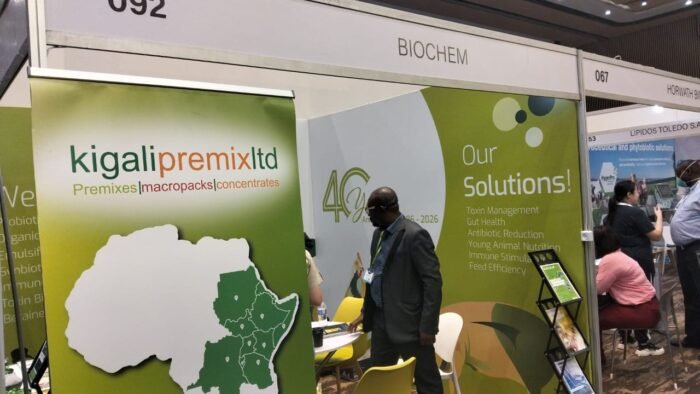
Biochem, he explained, has more than 30 products, covering several areas of animal nutrition and health. Rather than focusing on individual products, the company presents its offerings as a range designed to address different challenges facing livestock producers.
Biochem promotes alternatives to antibiotics
One of the key areas is antibiotic reduction, where Biochem provides solutions aimed at helping livestock producers manage pathogens while reducing reliance on antibiotics.
“There are products that help you to deal with pathogens without the use of antibiotics,” Nyarko said.
He noted that restrictions on antibiotic use in some markets have increased interest in alternatives that can support animal health without compromising productivity.
“A lot of countries have banned antibiotics. But pathogens will not die. They will still be with us,” he said.
Biochem’s portfolio includes probiotics and prebiotics, which Nyarko said are among the company’s key products for antibiotic-reduction strategies. He said the company has particular experience in this area, having started producing probiotics and prebiotics about four decades ago.
“Biochem actually started as a producer of these two products 40 years ago. So that area we are very strong,” he said.
The company also focuses on young animal nutrition, immune stimulation and feed efficiency. Nyarko compared the nutritional needs of young animals with those of children, noting that animals at an early stage of life require specific nutritional support.
“Very young animals. Their nutrition obviously is different. It’s like children,” he said.
He added that Biochem’s feed additives are designed to improve digestibility and, consequently, animal performance.
“So we have feed additives. Products you put in your feed to improve the digestibility. And then the performance of the animals,” he said.
Nyarko said feedback from farmers and other users of the company’s products has generally been positive, particularly around its probiotic and prebiotic solutions.
He also highlighted the wider reasons for reducing unnecessary antibiotic use, including concerns about the impact of antibiotics on beneficial microorganisms and the need for responsible livestock production.
Feed safety is central to food safety
Nyarko said the conversation should ultimately go beyond animal productivity to include the safety of food consumed by people.
He warns that livestock producers should pay close attention to what they give their animals because the food and other substances consumed by animals can ultimately affect the people who consume meat and other animal products.
“You’ve forgotten that you end up eating the pig. You end up eating the chicken,” Nyarko said stressing that animal feed should be safe for human consumption through the food chain.
“Our focus is that, what you are giving to your animal, let it be safe for humans,” he said. “So the same food you will not take, you won’t give to your animal.”
For Nyarko, safe feed is therefore not simply a matter of improving animal performance but an essential component of the wider food-safety system.
“Your food should not only be nutritious, but should be safe for your consumption,” he said, describing this principle as central to Biochem’s approach to animal health and nutrition.
As VIV Africa 2026 brings together producers, feed manufacturers, veterinarians, agribusinesses and other players across the livestock value chain, Nyarko said the event offers an important platform for promoting approaches that link animal health with the safety of food reaching consumers.