Farming has always run on data rainfall patterns, soil condition, the feel of a season. What has changed is where that data now lives. An increasingly larger portion of this data is stored on digital agriculture platforms – computer software and devices that transform random field data into organized information. The Recent Industry analysis has revealed that this particular sub-sector will experience significant growth in the coming years, with revenue being doubled in mid-2030s globally.
A market moving from niche to mainstream
Digital agricultural technologies, which encompass a range of solutions from farm management software to connected sensors and consulting services, had a value of about $19.8 billion in 2025. However, market analysts have predicted that these numbers will grow to about $57 billion by 2034, posting a CAGR of 12.5%, as indicated in a research report by Dataintelo. This will be among the most consistent growth success stories of agri-tech because it has been fueled by adoption rather than hype, and the technology is proving itself through savings and higher yields.
The shift is being felt across farm sizes. Large commercial operations were early adopters of precision technology, but cloud-based delivery and falling hardware costs are now putting similar capabilities within reach of small and medium-sized farms — the segment that makes up the overwhelming majority of the world’s agricultural operations.
What is powering the growth
Several forces are converging to push adoption higher.
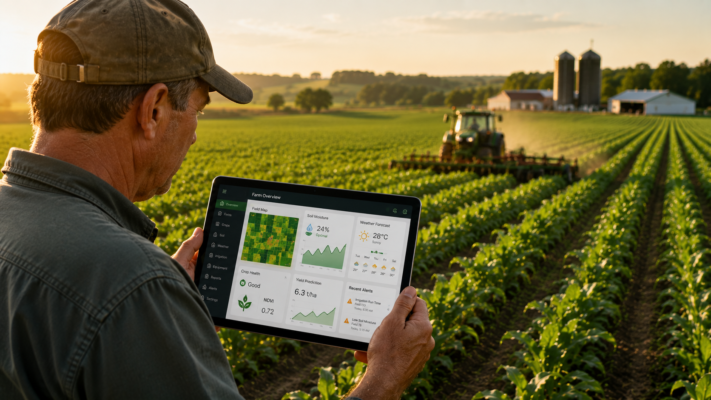
The first is the quantity of data already being generated on the farm. The sensors used to measure soil quality, along with weather stations and crop monitoring systems, are becoming cheaper and more prevalent. They generate data regarding moisture content, nutrient levels, and the condition of the crops. That data is only useful, though, if it can be turned into a decision which is where digital platforms come in, aggregating scattered readings into recommendations farmers can act on immediately.
It is performing a comparable function on a larger scale. Instead of buying their own server farms, subscription-based services have taken up the role of managing storage, software updates, and analysis on an off-site basis and also making it available through the device held by the farmer on-site. Cloud deployment has become the standard in the market, and it will continue to expand over the coming years.
Labour issues also play their role, especially with regard to livestock production and greenhouse agriculture, where automation provides the ability to monitor the herd or crop growth through such means as automatic feeding or health monitoring, thus enabling a smaller number of people to control more cattle or more area. In many countries, regulations also play their part in forcing farmers towards precision methods by introducing sustainability reports, nutrient management, and carbon trading.
Precision farming prevails but others are following
Within the broader platform market, precision farming applications variable rate input application, yield mapping and GPS-guided equipment remain the largest single category, reflecting how central these tools have become to row-crop and broadacre operations. Livestock monitoring is the next-largest segment, gaining ground as automated health and reproductive monitoring shows clear returns for dairy and beef producers. Smart greenhouse and aquaculture applications, while smaller in overall share, are growing quickly as controlled-environment production expands and water-quality management becomes more automated.
On the technology side, software remains the most valuable component of the market, ahead of hardware and services, and it is also the fastest-growing a reflection of how much of the value in digital agriculture now sits in analytics and decision-support rather than in the sensors themselves.
Where the growth is concentrated
At the regional level, Asia Pacific is home to the greatest contribution towards platform income, which is due to the number of smallholder farms and digitalisation efforts backed by governments tackling the issue of water shortages and lack of mechanization. North America follows, underpinned by established equipment manufacturers integrating software directly into their machinery lines, while Europe’s growth is closely tied to environmental compliance requirements that make digital documentation close to unavoidable for many farms.
Africa and the Middle East currently represent a smaller slice of the global figure, but the underlying opportunity is significant. Much of the world’s remaining smallholder farming base well over a billion farmers globally still has minimal exposure to digital platforms. As mobile-first tools and lower-cost subscription models mature, this is increasingly seen as the next frontier for platform providers, rather than a market to be addressed later.
A market still finding its shape
Growth of this scale rarely comes without friction. Farmer concerns about who owns and controls farm-generated data remain a real barrier to adoption in several markets, and cybersecurity risk is a growing consideration as more of a farm’s operations move online. Interoperability is another sticking point: despite years of talk about open data standards, many platforms still don’t talk to each other cleanly, leaving farmers to manage several disconnected systems rather than one.
Consolidation is also reshaping who controls the market. Large machinery companies and agriculture businesses have begun buying specialized software firms to form integrated solutions, something that is predicted to continue as standards for platforms evolve and competition is no longer driven by hardware alone but by data and analysis.
The bigger picture
None of this affects what digital farming solutions are designed to achieve in the end: to enable farmers to make more informed choices based on information available to them, be it irrigation timing, fertilizer requirements of a particular field, or care of animals even before the symptoms occur. The amount of investment expected to go into this segment over the course of the coming decade indicates that such a move towards data-based and not just intuition-based farming practices is no longer limited only to large and well-endowed farms.
Reference: https://dataintelo.com/report/global-digital-agriculture-platform-market
Ashish Kolte is a Marketing Manager at DataIntelo with expertise in marketing, market intelligence, and business strategy. He combines marketing insights with industry research to analyze market trends, identify growth opportunities, and provide data-driven perspectives on emerging industries and global business developments.
LinkedIn: https://www.linkedin.com/in/ashishkolte/