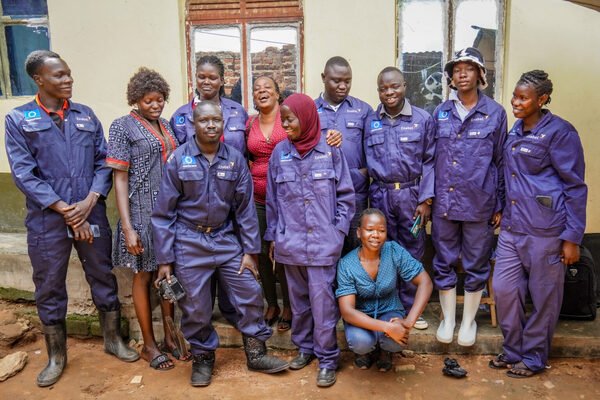
Members of the Arua City Youth Poultry Farmers Association. Photograph: George Bush Ocen/Cordaid.
Young poultry farmers in northern Uganda are turning collective action into a strategy for building stronger and more profitable businesses, pooling knowledge, markets and resources to overcome challenges that often constrain small-scale agribusinesses.
According to a report by Cordaid, the Arua City Youth Poultry Farmers Association has brought together young entrepreneurs who are using shared skills and resources to improve poultry production, access markets and invest in businesses.
The association, which started in 2025, now has 62 members, including 39 men and 23 women, with 20 members from the refugee community in Arua City.
“We support each other to meet customer demand and link one another to new business opportunities,” Kevin Akech, chair of the association told Cordaid.
The young farmers initially faced challenges including weak record-keeping, limited access to markets and gaps in poultry management, particularly disease prevention and flock health.
While many were already engaged in poultry farming, they needed stronger business systems and technical skills to move from survival-oriented production to more sustainable enterprises.
Through the WeWork – Green & Decent Jobs for Youth Project, the farmers received training in financial management, market research, digital marketing and poultry production.
The programme also provided start-up grants, allowing the members to turn the knowledge gained through training into practical investments.
The collective approach has changed how farmers respond to orders. Instead of competing individually, members can support one another when a farmer receives more orders than they can fulfil.
“We used to sell individually without thinking about how we could work together,” said Akech. “Now, if one farmer receives more orders than they can supply, they reach out to another member. We support each other to meet customer demand and link one another to new business opportunities.”
Peer learning has also helped members improve farm management. Ezaruku Damian, member of the association said training and cooperation had strengthened their approach to disease management while encouraging members to explore other income-generating activities.
“Through the training and peer learning, we have improved the way we manage diseases. By collaborating instead of competing, I have also diversified into piggery, which has increased my income and allowed me to invest more in my poultry business,” Damian told Cordaid.
One of the association’s major investments has been a 500-egg incubator powered by both solar energy and electricity. Previously, farmers depended on external suppliers for day-old chicks, with deliveries sometimes taking two to three weeks.
Cordaid reports that producing chicks through their own incubator has helped the group save an estimated 25.2 million Ugandan shillings, money that can be redirected into flock expansion, feed, vaccination and market supply.
“Our orders for day-old chicks could take two to three weeks to arrive. Having our own incubator has helped us close that gap and ensure that our farms are not disrupted by supply delays,” Damian said.
The farmers are also exploring additional opportunities, including duck farming, brooding services and the conversion of poultry waste into organic inputs for horticultural production.
Their plans now extend beyond individual farms. They hope to acquire land, establish a central office, expand incubation capacity and supply chicks and poultry products to farmers across the region.
The experience of the Arua youth farmers shows how shared knowledge, collective investment and market cooperation can help young entrepreneurs address common business constraints while creating new opportunities for income and expansion.
The WeWork – Green & Decent Jobs for Youth Project in West Nile is funded by the European Union and the Government of Belgium and implemented by Cordaid, Caritas Arua Diocese and Enabel.