


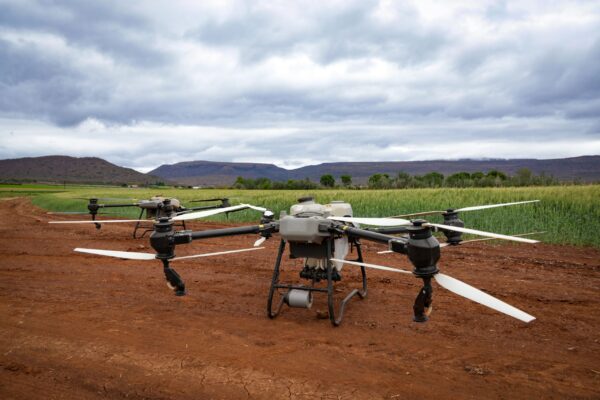
According to MarketsandMarkets the agriculture drones’ market is projected to grow from USD 3.45 billion in 2026 to USD 14.42 billion by 2031, registering a robust CAGR of 33.1%. Across Africa, a quiet technological shift is reshaping how food gets grown. Unmanned aerial vehicles (UAVs) once a novelty confined to pilot projects and NGO demonstrations — are increasingly finding their way onto commercial farms, cooperative plots, and even smallholder fields. While the continent still trails North America, Europe, and Asia-Pacific in absolute market size, it is emerging as one of the fastest-growing regions globally for agricultural drone adoption, driven by a mix of necessity, investment, and improving digital infrastructure.
Market Size and Growth Trajectory
Global market trackers typically fold Africa into a combined “Middle East & Africa” (MEA) region rather than reporting it as a standalone market, which makes precise continent-wide figures harder to pin down. Even so, the available data paints a consistent picture of rapid, if early-stage, growth.
Industry estimates put the MEA agriculture drone market at roughly $195–500 million in 2025, with projections reaching anywhere from $1.3 billion to $4.3 billion by the early-to-mid 2030s. That implies compound annual growth rates in the range of 27–28% — among the highest of any region worldwide, reflecting the low base the market is growing from as much as the strength of underlying demand.
Africa’s share of the global agriculture drone market remains modest, estimated at under 6% of worldwide revenue as of 2025. But growth rates matter more than current share at this stage of adoption: the region is following a pattern common to emerging Agri-tech markets, where a handful of early-mover countries establish infrastructure and demonstrate ROI before adoption broadens.
South Africa stands out as the continent’s most developed market. Estimated at around $12 million in 2024, it’s projected to grow nearly tenfold to over $110 million by 2033 — a roughly 28% CAGR — making it likely to post the fastest country-level growth rate in the MEA region over the coming decade.
What’s Driving Adoption
Several forces are converging to push drones onto African farms faster than many analysts initially expected:
- Falling hardware costs and startup activity. A wave of Agri-tech startups is producing more affordable, farmer-oriented drone models. Rather than importing expensive industrial platforms designed for North American or European farms, local and regional companies are building lower-cost units suited to smaller plots and tighter budgets — often bundled with services rather than sold as standalone hardware.
- Advanced capabilities are becoming accessible. Multispectral imaging, crop health assessment, and soil evaluation — once reserved for large commercial operations — are increasingly built into entry-level drone packages, thanks to AI-driven analytics that reduce the need for in-house data science expertise.
- Digital infrastructure catching up. Mobile connectivity and broader digital infrastructure investment have made real-time drone data transmission viable even in relatively remote agricultural areas, addressing what was previously a major adoption barrier.
- Institutional and investor backing. The African Development Bank and similar institutions have flagged rising investment in drone-enabled agriculture and logistics, often channeled through regional innovation hubs. Venture capital interest in African agri-tech has grown correspondingly, giving startups the runway to iterate on cost and usability.
- Structural pressure on farming. Labor availability, climate variability, and the need to raise yields on constrained land are pushing both large commercial farms and cooperatives to explore tools that improve precision and reduce input waste — the same pressures driving drone adoption globally but often felt more acutely in African agricultural economies.
Where Technology Is Being Used
Rotary-wing drones dominate the African market, accounting for roughly three-quarters of MEA drone revenue — a preference driven by their versatility on smaller, more fragmented plots and their suitability for spraying and low-altitude monitoring tasks, compared to fixed-wing drones that need more space and are better suited to large-scale mapping.
Primary applications mirror global trends but with local emphasis:
- Crop monitoring and field mapping assessing crop health and detecting stress or disease before it’s visible to the naked eye
- Precision spraying applying pesticides and fertilizers only where needed, reducing input costs that are often a major burden for smaller operations
- Soil and irrigation analysis particularly valuable given water scarcity concerns in several African farming regions
- Yield estimation and crop scouting support better planning and reducing post-harvest losses
Market Stage: Still Early, But Shifting
Analysts consistently describe Africa’s broader drone market — agriculture included — as being in transition from experimental adoption to strategic deployment. Early use cases were often pilot programs run by NGOs, development agencies, or research institutions. What’s changing now is the emergence of commercially sustainable models: drone-as-a-service operators, Agri-tech platforms bundling hardware with data services, and cooperative-level purchasing that spreads costs across smallholders who couldn’t individually afford a unit.
This shift matters because it signals the market is moving past proof-of-concept and toward the kind of repeat, paying demand that sustains long-term industry growth.
Country Landscape
While South Africa leads in market maturity and available data, industry coverage of the region typically also tracks Kenya, Ethiopia, Egypt, Sudan, and other markets under a “Rest of MEA” grouping — reflecting both real market activity and, frankly, thinner public reporting on individual countries. Kenya and Ethiopia in particular have been focal points for Agri-tech investment and drone pilot programs tied to food security initiatives, though granular market-size figures for these countries are less consistently published than for South Africa.
Challenges Facing Adoption
The same structural issues that make Africa’s growth rate impressive also constrain how fast the market can scale:
- Land fragmentation. A large share of African farmland is held by smallholders on parcels too small to justify individual drone ownership — a dynamic pushing the market toward shared-service and cooperative models rather than direct ownership.
- Even with falling hardware costs, upfront investment remains a barrier for many farmers, particularly without accessible financing or credit models.
- Regulatory uncertainty. Airspace regulation and drone-operation rules vary significantly by country and are, in many cases, still catching up to the pace of commercial demand.
- Data literacy and management. Turning raw drone imagery into actionable farming decisions requires technical capacity that not all operations currently have, echoing a challenge seen in the global market but often more acute where agronomic extension services are limited.
Africa’s agriculture drone market is unlikely to rival Asia-Pacific or North America in absolute size within the next decade. But its growth rate — consistently forecast in the high-20s percentage range — reflects a market still finding its footing rather than one nearing saturation. As drone-as-a-service models mature, financing options expand, and regulatory frameworks solidify, the gap between pilot-stage experimentation and everyday farm tool is likely to keep narrowing, with South Africa continuing to lead and East African markets such as Kenya and Ethiopia positioned as the next tier of growth.