

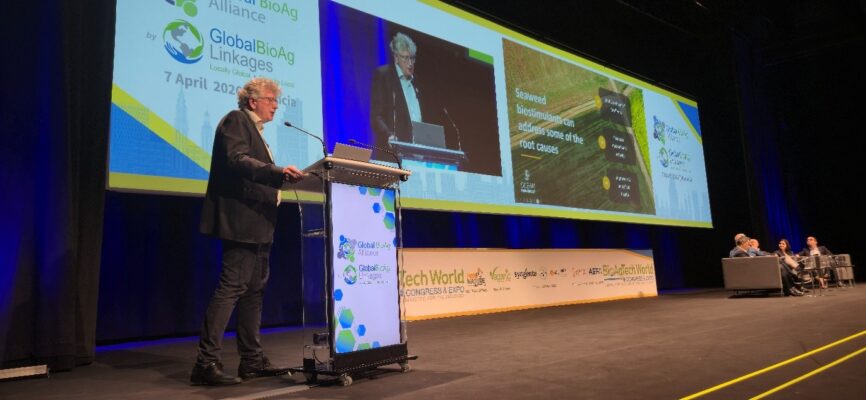
With roots dating back to L’Horta’s medieval irrigation systems and almost 1,700 agri-tech companies in the region, Valencia hosts the 7th edition of the largest global congress on biological agriculture
Valencia has something that few cities in the world can offer a congress on biological agriculture: it is both history and laboratory. L’Horta de Valencia is a collective irrigation system with more than a thousand years of continuous operation, recognised by UNESCO as an intangible heritage of humanity. It is one of the most enduring examples of smart management of soil and water. Today, the same region is home to almost 1,700 agri-technology companies, centres of applied research and innovation projects in the field. It was in this scenario that Global BioAg Linkages chose to host the 7th edition of the BioAgTech World Congress & Expo.
The BAW Congress has travelled the world since 2019, alternating between the main agricultural centres of each continent. In each edition, the congress dives into the local ecosystem, connecting global solutions with regional realities. Valencia, with its geographical position between Europe, Africa and Latin America and with its historical vocation for agricultural innovation, is the natural setting for an edition that places international convergence at the centre of the conversation.
Throughout the first day, the workshops and the GBA Conclave demonstrated that this convergence is not abstract. It is already underway and depends less on parallel discussions and more on the ability to connect science, regulation, capital, agronomy, retail and farming into a shared agenda.
WORKSHOP 1 — INVASIVE SPECIES: BIOLOGICAL SOLUTIONS AT SCALE
Focused on invasive species management, the discussion made it clear that today’s agricultural risks can no longer be treated in isolation. Luke Flory of the University of Florida framed invasion science as an inherently interdisciplinary field, involving ecology, economics, public policy and human impact. During the same session, Luis Pacheco (Ministry of Agriculture and Livestock, Brazil) presented concrete cases of eradication, containment and strategic preparedness, reinforcing Brazil’s role as a reference in coordinated response and in the large-scale application of biological solutions. The core message that emerged was clear: prevention and response require coordination, monitoring, institutional alignment and continuous action.
By addressing the growing severity of HLB, also known as citrus greening, Jesús Yáñez warned of one of the most severe threats to global citrus production and one widely recognised as among the most serious affecting Mexico’s citrus sector. According to his presentation, without integrated management, orchard productivity can collapse within just three to five years. In response, he advocated an integrated biological approach guided by field efficacy, plant safety, operational viability, and the consistent reduction of losses.
WORKSHOP 2 — EUROPE, AFRICA AND LATIN AMERICA: THE NEW BIOAG TRIANGLE
A highly engaged audience follows the debate on BioAg’s emerging global triangle
This same spirit of coordination reappeared in Workshop 2, perhaps the most geopolitical session of the day, which examined why Europe has not yet converted its full BioAg potential and how the Europe, Africa and Latin America axis is emerging as a new growth and commercialisation triangle. Philippe Cognet, Charlie Bender, André Kraide and other participants demonstrated that the future of the sector will not be defined by a single region, but by complementary environments of science, scale, regulation and adoption. Charlie Bender of DuxAgri captured this dynamic by stating that “collaboration is definitely something that is going to get stronger.” André Kraide of Agrivalle added a strategic perspective, noting that the next phase of bioinputs will require more specific solutions, deeply connected to soil conditions and local realities, making decentralised and agronomically contextualised innovation inevitable.
The session also highlighted that the value of BioAg can no longer be communicated simply as input substitution, but as a reorganisation of production logic. As expressed during the discussion, consumer pressure for sustainability will only translate into real transformation if it is accompanied by performance, trust and farmer education.
WORKSHOP 3 — CAPITAL AND INNOVATION: CONNECTING STARTUPS AND INVESTORS
“IMMMP launch — BAW Congress 2026 connects the next generation of BioAgTech innovators with global capital.”
Workshop 3 shifted the conversation to another critical driver of transformation: capital. With the launch of the Investor Magnet and Match-Making Program, the congress moved beyond discussion and introduced a concrete mechanism to connect startups, scale-ups and qualified investors. In his opening remarks, Giuseppe Natale of Vedalia summarised a key principle by stating that “finance must serve the business, not dominate it.” He further emphasised that biological solutions “must be built on real agronomic value” and that “credibility, discipline, and patience are essential in agriculture.” The workshop was therefore not about fundraising in abstract terms, but about aligning science, business maturity and sector understanding so that innovation can reach the market with consistency.
This perspective was reinforced later in the Conclave, where Natale highlighted that innovation requires not only capital, but also critical mass, technological understanding and stronger connections between investors and the real complexity of agricultural biology. The shared conclusion was not a lack of innovation, but the need for more intelligent environments to transform innovation into scale.
WORKSHOP 4 — SOIL AND WATER RESILIENCE
Workshop 4: soil resilience as the foundation of sustainable production.
Workshop 4 brought the focus back to the foundation of all agricultural systems: soil and water. In a context of increasing climate uncertainty, the discussion started from a principle that is becoming increasingly unavoidable: productive resilience begins in the soil. From there, the conversation addressed one of the sector’s key challenges, translating science into practice, and practice into adoption. This theme was further developed in the GBA Conclave, within the Agronomist & CRO Forum, where it was highlighted that there is still a disconnect between technological development, agronomic validation and farmer perception. As stated during the session, without science-based validation, data and clear communication, innovation does not build trust, does not generate purchase decisions and does not convert into real adoption.
GLOBAL BIOAG ALLIANCE CONCLAVE
“Global BioAg Alliance Conclave 2026 — industry leaders define priorities and commitments for the next phase of the alliance.”
t was, however, in the GBA Conclave that the first day reached its most comprehensive expression. The alliance’s strategic meeting emerged as a space for articulation, continuity and alignment across its different forums and leadership groups. In the opening, Carl Van Wetter captured the spirit of the initiative by stating that “collaboration will be more important than ever” and that no actor in the sector operates in isolation. Adrian Percy reinforced this vision, noting that in the biologicals space, progress will depend less on a single winner and more on “a real coalition of the willing.”
This perspective was reflected across the forums presented during the Conclave. In the Innovation Forum, Carl Van Wetter offered a concise definition: “innovation is about turning ideas into invoices.” In the Retail Forum, it was highlighted that one of the main barriers to scaling biologicals is not only cost, but the lack of reliable data, decision-support tools and the need to shift from transactional to advisory sales models. In the Farmers & Food Chain Forum, priorities were clearly defined: invasive species management and training, with a focus on prevention, preparedness and integrated system responses.
By the end of the first day, one idea stood out with clarity. The advancement of biological agriculture will not result from a single technology or a single institutional agenda. It will depend on the ability to connect what has long operated in silos. Without regulatory alignment, innovation does not scale. Without well-oriented capital, it does not mature. Without agronomic validation, it does not build trust. Without education and integration across the value chain, it does not achieve consistent adoption.
This is precisely why the BAW Congress must be understood beyond a commercial event. What took place in Valencia on this first day was the construction of a platform for legacy. A space where the sector not only presents solutions, but identifies shared bottlenecks, aligns priorities and builds continuity beyond the event itself. The legacy begins here, when conversation evolves into alignment, shared language and commitment among the actors shaping the future of agriculture.
If the first day was dedicated to connecting foundations, the second will deepen execution. Tomorrow’s plenary sessions will expand this movement, bringing together regulators, international institutions, industry leaders and farmers to address a central question: how to transform convergence into implementation, and vision into scale. The direction is already clear. In Valencia, BAW Congress 2026 begins by demonstrating that the future of sustainable agriculture will not be built through parallel solutions, but through connected systems.