

The International Institute of Tropical Agriculture (IITA) and Bayer have announced a new research partnership aimed at accelerating the development of climate-resilient, high-yielding, and nutrient-dense crops for smallholder farmers across sub-Saharan Africa.
The collaboration, which will run through 2028, brings together IITA’s long-standing expertise in tropical crop improvement and smallholder farming systems with Bayer’s advanced global breeding technologies. The partners aim to deliver improved crop varieties capable of achieving at least a 25 percent yield increase in farmers’ fields, a target expected to strengthen food security and boost rural incomes.
The initiative will focus on seven key crops critical to African food systems—maize, soybean, cowpea, cassava, yam, banana and plantain, and Bambara groundnut. These crops are widely grown by smallholders and play a central role in both nutrition and livelihoods across the region.
According to Dr Bernard Vanlauwe, IITA Deputy Director General for Research for Development, the partnership reflects a growing trend of collaboration between public and private sector actors to address agricultural challenges on the continent. He noted that combining complementary strengths would accelerate the delivery of next-generation crop varieties while strengthening scientific capacity in Africa.
The programme is structured around three main pillars, starting with people development. Through training and knowledge exchange, the partnership will enhance expertise in genomic selection, molecular breeding, biotechnology integration, and data-driven decision-making among African scientists. This is expected to build a pipeline of skilled professionals capable of sustaining long-term agricultural innovation.
The second pillar focuses on enabling capabilities. The collaboration will strengthen IITA’s breeding systems through investments in digital phenotyping, statistical modelling, and centralized breeding operations. These upgrades are intended to improve the precision and efficiency of crop development processes.
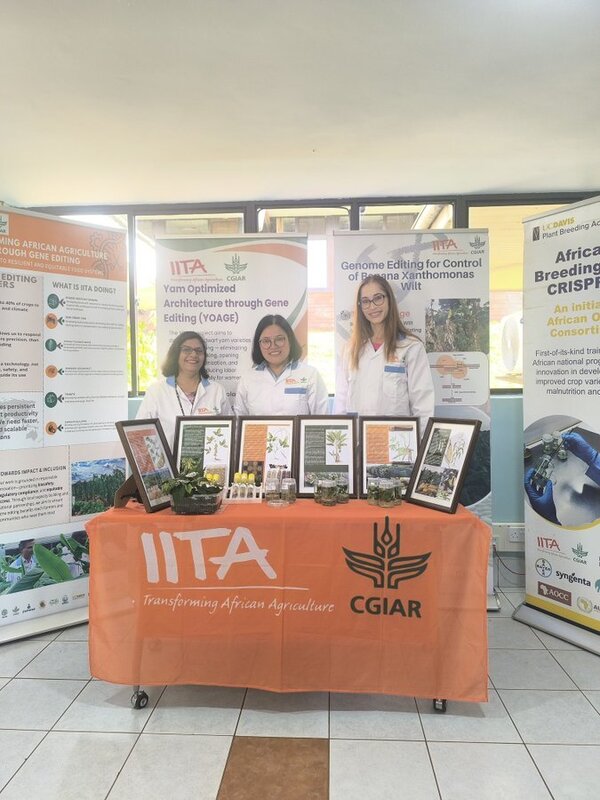
Under the third pillar, breakthrough products, the two organizations will jointly develop new crop varieties with improved traits. These include biotech maize suited for West Africa, rust-resistant soybean varieties, gene-edited insect-resistant cowpea, and disease-resistant banana breeding lines.
Dr JD Rossouw, Senior Vice President and Plant Breeding Lead at Bayer, said the partnership aligns with the company’s goal of supporting 100 million smallholder farmers in developing countries by 2030. He emphasized that sharing technologies and expertise would help deliver practical solutions that enable farmers to adapt to climate change and improve productivity.
As part of the agreement, Bayer will provide up to $1.2 million in in-kind support, including technical advisory services, access to advanced breeding tools, and training platforms. IITA will lead implementation, drawing on its research infrastructure and regional networks. The collaboration is supported by the Bill & Melinda Gates Foundation through its Genetic Innovations Public-Private Partnerships platform.
Key innovation areas under the partnership include the integration of molecular tools and genomic selection into breeding workflows, the use of drones and digital sensors for advanced phenotyping, and the application of biotechnology and gene editing to develop improved crop traits. The initiative will also leverage data analytics and bioinformatics to guide breeding decisions, alongside efforts to modernize seed systems through digitization and mechanization.
The collaboration builds on earlier joint efforts between IITA and Bayer, such as the Modern Breeding Project and research aimed at increasing genetic gains in cowpea. It is expected to benefit up to 30 million smallholder farmers across sub-Saharan Africa.
Dr Leena Tripathi, IITA Genetic Innovation Director, said the partnership would accelerate the delivery of improved crop varieties at greater speed and scale. She added that integrating advanced genomic tools with Bayer’s global expertise would not only enhance crop performance but also strengthen Africa’s scientific leadership in agricultural innovation.
The initiative also aligns with Bayer’s broader vision for regenerative agriculture, which focuses on increasing productivity while restoring natural resources and promoting sustainable farming practices.