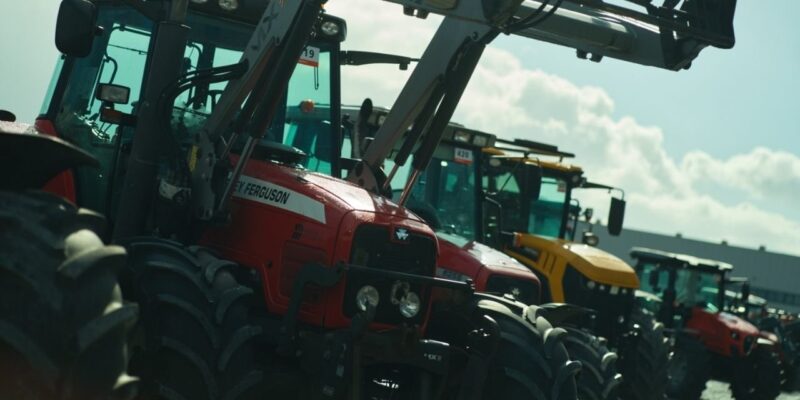
| For generations, buying agricultural used machinery was a hands-on process. Farmers would walk around a tractor, inspect the wear on its tyres, check the engine and make a judgement based on what they could see, hear and feel. Today, that model is being quietly rewritten. Now tractors, balers, combines, ploughs – you name it – is increasingly being bought online, sometimes without the buyer ever seeing them firsthand. |
This complexity brings benefits but also introduces challenges. “Assessing condition today is no longer as simple as starting the engine and seeing how much smoke comes out,” says Potka. “Evaluating used equipment now requires far greater technical understanding than in the past – and increasingly, more structured inspection processes.”| Building trust at scale | | For used equipment auction platforms such as Ritchie Bros, this has led to a multi-layered approach to inspection. Machines are assessed and supported by detailed reports, photographs and videos. “Our job is to give buyers as complete a picture as possible,” says Potka. “If they cannot stand next to the machine themselves, they need enough reliable information to make an informed and confident purchasing decision.” | | While this may have seemed alien to start with, over time, farmers have learnt that descriptions are accurate, inspections are thorough – and that what they see online reflects reality. In short, they’ve grown to trust them. | | “In this market, trust is everything,” Potka says. “If a buyer purchases one machine that is not as described, we may not get a second chance.” | | That trust is exactly what buyers like Markus Blömer, a farmer from Rhede, Germany, value: “When I buy agricultural equipment online, trust is crucial to me. With Ritchie Bros., I know that the entire process is transparent and professional. Even though it’s an online auction, the company doesn’t feel anonymous. The team ensures that the entire sales process runs smoothly and that the customer is satisfied in the end.” | | | Markus Blömer, a farmer from Rhede, Germany | | Why digital auctions are here to stay | | The shift to online buying was accelerated by the pandemic, but it has endured because it works. Timed online auctions have replaced many traditional live events, giving buyers convenient, round‑the‑clock access to equipment they might never have found locally, while providing sellers with exposure to a broader, more international audience. | | In Europe, it is now common for a significant proportion of farm machinery to be sold across borders, with buyers relying entirely on inspection reports to make buying decisions. For larger or more complex machines, some farmers still choose to attend open days and inspect equipment in person. But for many, the combination of detailed reporting, trust in the auction platform and familiarity with the machinery type is enough. | | Why digital auctions continue to grow | | That confidence is reflected in Ritchie Bros.’ agricultural business across Europe, the Middle East and Africa. In the first quarter of this year, the company has sold 1,330 agricultural lots and attracted 920 buyers from different countries, with the strongest participation coming from Italy, Germany, France, Spain and Poland. Demand has been led by agricultural tractors, haying equipment, headers, discs and combines, showing that buyers are increasingly comfortable making high-value purchasing decisions online. | | For farmers, the appeal lies in being able to search widely, compare options and bid with confidence — whether they are looking for a single machine or equipment to support the next season’s work. | | | Informed decision making | | There is also an element of expertise at play. Farmers are not casual buyers, they approach machinery with a clear understanding of specifications, features and their own requirements. A comprehensive set of photographs and a detailed technical description can reveal far more to an experienced farmer than it might to a general consumer. Details such as hours worked, configuration and visible wear all contribute to an informed decision. In this sense, digital buying does not remove judgement – it refines it. | | Buying used machinery naturally carries a degree of uncertainty, as every piece of equipment tells its own story. That’s why transparency is essential to communicating its true condition. What matters most is clarity — knowing what’s included, what’s not, and exactly what state the machine is in. At Ritchie Bros., every asset is presented clearly and sold as it is and where it is. Each lot description provides detailed information on specifications, conditions, and key features, helping buyers make informed decisions and ensuring expectations are aligned from the start. | | As an example of the precision Ritchie Bros. applies to lot descriptions: when a tractor is listed as ‘GPS-ready,’ that designation means the machine can support a GPS system – not that the GPS system itself is included. “Clear communication is absolutely essential,” says Potka. | | A new kind of marketplace | | What is emerging is a different kind of marketplace – one that blends technology, transparency and trust. Physical inspection has not disappeared, but it is no longer the default approach. Instead, buyers are relying on data, documentation and the reputation of the platform facilitating sales. It is a shift that reflects broader changes across industries, but in agriculture it carries added weight. Here, trust is hard-earned and easily lost. | | In a market where relationships still matter, the ability to deliver on that trust – even at a distance – is what ultimately drives success. |
|