

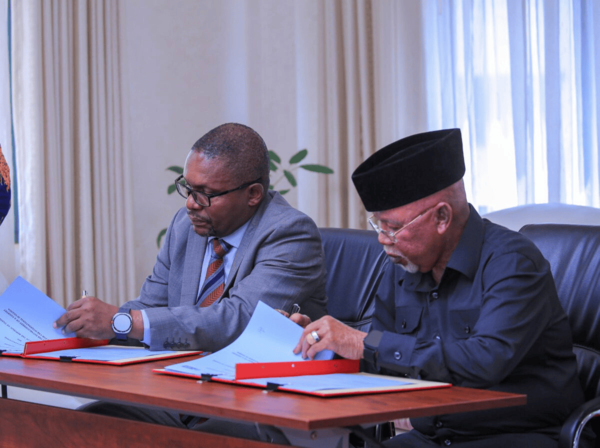
Uganda Minister for Foreign Affairs, Gen. Odongo Jeje Abubakhar and CABI’s Executive Director for Africa, Dr Morris Akiri during the HCA signing ceremony. Photo courtesy of CABI.
The government of Uganda has signed a Host Country Agreement (HCA) with the Centre for Agriculture and Bioscience International (CABI), strengthening the international organization’s presence in the country and deepening a partnership that has played a major role in addressing agricultural challenges for more than six decades.
The agreement was signed by Odongo Jeje Abubakhar on behalf of the Ugandan government and Morris Akiri representing CABI. The signing ceremony was also attended by Monica Kansiime, Christine Alokit, and Nassib Mugwanya.
Officials said the agreement marks a significant milestone in the long-standing collaboration between Uganda and CABI, with expectations that it will support the expansion of science-based agricultural solutions and strengthen partnerships across the country.
Speaking during the signing ceremony, Gen. Odongo described the agreement as a reflection of the strong relationship between Uganda and CABI.
“This Host Country Agreement is a testament to the strong and enduring partnership between Uganda and CABI. We welcome CABI’s formal presence in Uganda and greatly value the organization’s long-term commitment to addressing agricultural challenges particularly sanitary and phytosanitary issues that affect Uganda’s agricultural global trade,” he said.
Dr Akiri said the agreement signaled a renewed commitment to tackling emerging agricultural threats, improving trade and supporting farmers’ livelihoods.
“This agreement marks not just a milestone, but a renewed promise to work hand-in-hand with Uganda to address emerging agricultural threats, protect safe trade, and improve the livelihoods of Ugandan farmers,” he said.
Dr Akiri noted that CABI’s relationship with Uganda dates back to 1962, when the organization established an East African station at Kawanda Research Station. Early activities focused on the biological control of invasive species and identifying natural pest enemies for use both within Africa and internationally.
He also acknowledged ongoing collaboration with the Ministry of Agriculture Animal Industry and Fisheries and the National Agricultural Research Organisation, alongside other development partners supporting agricultural transformation in Uganda.
Dr Mugwanya said the partnership between NARO and CABI had contributed significantly to strengthening science-based responses to agricultural threats affecting Ugandan farmers.
According to CABI, its work in Uganda has expanded over the years to address emerging issues including plant health, trade facilitation, pesticide risk reduction, digital advisory services and youth engagement in agriculture.
Among its major initiatives is a European Union-funded programme implemented with the Ministry of Agriculture, HortiFresh and COLEAD aimed at strengthening Uganda’s sanitary and phytosanitary systems.
The initiative seeks to reduce export rejections and improve compliance with international standards, with projections showing it could unlock up to $150 million in additional revenue for Uganda’s horticultural sector.
Uganda is also a focus country under the global PlantwisePlus Programme, which supports farmers with timely scientific advice to respond to crop pests and diseases.
Through collaboration with the agriculture ministry, the programme has strengthened the training and certification of agro-input dealers, many of whom previously operated without the required credentials.
CABI has additionally worked with partners including CropLife and the Kampala City Council Authority on public awareness campaigns promoting food safety and safer pesticide use, particularly on horticultural products such as tomatoes.
The organization has also partnered with NARO to tackle invasive species including papaya mealybug, mango mealybug and parthenium weed, while supporting One Health initiatives that integrate crop and livestock health services to improve food safety and environmental protection.