


Written by Renier Kriek
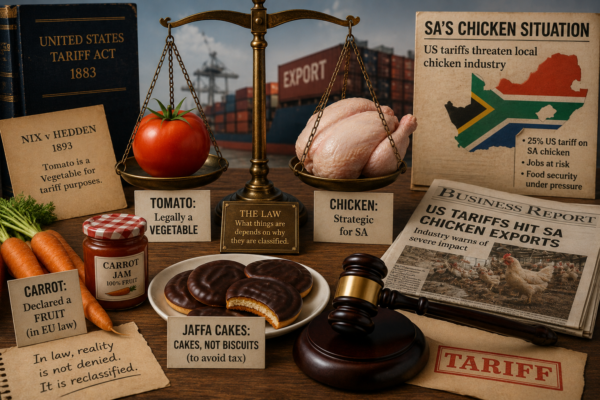
The law is often less interested in what things are than in what taxes, tariffs and statutes require them to be called. In law, principles and facts are moved around to fit political or economic necessity. That is how tomatoes become vegetables, carrots become fruit, and Jaffa Cakes escape tax.
South Africa has its own recurring version of this drama in the debate over imported frozen chicken, which has once again put tariffs, “dumping” and the interests of consumers and local producers in the spotlight. It is also why chicken can become strategic for an embattled government and for those who care about ordinary South Africans.
It has been said that knowledge is knowing the tomato is a fruit, while wisdom is not serving it in a fruit salad. In law, however, wisdom is something else entirely.
The United States Tariff Act of 1883 imposed a tariff on imported vegetables, while fruit entered free of duty (don’t tell Mr Trump!). This produced a question of sufficient importance to occupy the Supreme Court of the United States: was the humble tomato a vegetable, and therefore taxable, or a tax-exempted fruit?
In the American spring of 1886, the Nix family imported a shipment of tomatoes from the West Indies into New York. Edward L Hedden, the Collector of the Port of New York, classified them as vegetables and imposed the tariff.
The Nix men, who by their desire to avoid the tax were undoubtedly sensible men of commerce, disagreed. Botanically speaking, tomatoes are fruits. They paid the assessed tariff under protest lest the goods spoil and then, convinced by the scientific facts, sued the government for repayment.
The argument slowly wound its way through the American court system until, in 1893, it landed on the august, mahogany desks of the United States Supreme Court.
The Nix family plainly had science on their side. A tomato develops from the ovary of a flowering plant and contains its seeds. Technically, it is not merely a fruit but also a berry. The same broad botanical category includes cucumbers, squashes, beans and peas.
The Court was unmoved by the science. The question, it said, was not what botanists meant by “fruit”, but what ordinary people understood by the terms “fruit” and “vegetable” when buying, selling and eating food. Tomatoes are generally grown in kitchen gardens and served at dinner with soup, fish or meat. They are not ordinarily served as dessert. Therefore, in common speech, they are vegetables.
The Court took judicial notice of this, “taking judicial notice” being legalese for saying that something is so obviously true that nobody should be required to prove it. The tomato was therefore ruled to be taxable as a vegetable.
The judgment in Nix v Hedden survives as a neat illustration of statutory interpretation. Unless legislation suggests otherwise, ordinary words in laws and other legal documents are generally given their ordinary meanings. Dictionaries may help, but they do not necessarily win the argument: context does.
The law had not truly discovered that a tomato was a vegetable. It had merely decided that, for the purpose of collecting a tariff, it would be treated as one. This is a recurring legal achievement, and one that inspires at least some of the popular ire held against lawyers: reality is not denied. It is simply re-classified conveniently, until it suits the ends of the interpreter.
Brussels at breakfast
There is, however, a complication in the Supreme Court’s reasoning. Tomatoes can be made into jam. And unless sweet potato preserve is your particular fetish, most well-balanced people would agree that to be jam – without exhaustive further qualification – is to be made from fruit.
European law could not otherwise than confront precisely this question. In a directive adopted in 2001 and published the following year, the Council of the European Union set out common rules for jams, jellies and marmalades. The purpose was respectable enough: products sold under the same name across the European market should broadly contain the same things.
The directive defined jam in conventional terms as a gelled mixture involving sugars and fruit pulp or purée. Without so much as a pause, it then announced that, for its purposes, tomatoes, the edible parts of rhubarb stalks, carrots, sweet potatoes, cucumbers, and pumpkins were to be fruit
Brussels had not disproved botany. It had merely suspended it for the purposes of breakfast (and tax!). No wonder the British, a nation of jam eaters, were fed-up with such Bruxellois-meddling and promptly left the customs union as part of Brexit.
There is, of course, a practical explanation for the EU’s bizarre classification of carrots and rhubarb stems as fruits. Some European culinary traditions make preserves from produce that is not ordinarily described as fruit. Portuguese carrot jam is the example most often given. If such products were to be sold legally as jam under a harmonised European regime, then either the definition of jam, or the definition of fruit had to move. Fruit moved, in the end.
This is what law does when reality refuses to fit neatly into the boxes prepared for it. The boxes remain. Reality is amended and reclassified.
The commercially minded have always naturally understood, and exploited, the value of such classifications.
In an earlier American tariff dispute, traders argued that imported beans were seeds rather than vegetables. Botanically, they had a point. Commercially, the Court held, beans were eaten and traded as vegetables. A walnut might also be a seed in natural history, but nobody expects to find it next to the green beans.
American school-lunch regulations have likewise, at various times, allowed the tomato paste on pizza to satisfy part of a vegetable requirement. The nutritional merits of the rule may be disputed, but its administrative elegance is difficult to deny. A child may resist vegetables. Few children resist pizza. Once measurement replaces meaning, almost anything becomes possible – even feeding children their daily dose of vegetables.
A case that went stale
The British made their own distinguished contribution to edible jurisprudence through the Jaffa Cake.
In the United Kingdom, most ordinary food is zero-rated for VAT. Cakes remain zero-rated even when covered in chocolate. Biscuits are also generally zero-rated – until they are covered wholly or partly in chocolate, at which point they become a specifically taxable indulgence.
This left the Jaffa Cake in a precarious tax position. It was small, round, chocolate-covered, packaged like a biscuit, displayed beside biscuits, and notoriously eaten with the fingers in the manner of known biscuits.
McVitie’s nevertheless insisted that it was a cake – for no apparent reason other than escaping the tax. Her Majesty’s Customs and Excise, contemplating the VAT that might be gathered from millions of Jaffa Cakes, displayed serious doubts.
The inevitable tribunal convened to consider this conundrum analysed the product with an intensity properly reserved for constitutional disputes. Its name counted slightly in its favour, it’s called Jaffa Cake, after all, although calling something a cake does not necessarily make it one. Its ingredients and spongey texture pointed towards cake. Its size, packaging, placement in shops and manner of consumption pointed towards biscuit.
Then there was the question of decay. A cake, when stale, becomes hard. A biscuit, by contrast, goes soft. And Jaffa Cake? It becomes hard like cake.
The case was not decided on staleness alone. The tribunal considered the product as a whole and concluded that, although it had characteristics of both cake and biscuit, it had enough of the characteristics of a cake to qualify as one. This after lawyers for McVitie’s baked a batch in court for the tribunal to consider, in what can only be considered transparent lawfare. And the Jaffa Cake was accordingly spared VAT in the end.
It is comforting to know that even in tax law there remains a point at which the decisive evidence may be what happens when the exhibit is left unattended in a cupboard. Legal scholars, no matter how serious, have stomachs too. One suspects that edible evidence enjoys certain forensic advantages not available to the ordinary affidavit.
Those presently down on their legal luck might take note. Where the facts are weak and the authorities unhelpful, it may still be worth bringing cake.
And lately, chicken
South Africa has its own recurring version of this drama in the argument over imported frozen chicken, which is in the news again. “Dumping” is one of those legal terms whose ordinary meaning and technical meaning do not quite coincide – a fact neatly exploited by one side of the dispute over chicken tariffs.
In everyday speech, dumping suggests that something unwanted, defective or possibly hazardous is being offloaded on an unsuspecting public. It calls to mind toxic waste, broken appliances and mattresses left to gather rats beside the road.
In international trade law, dumping generally means that a product is exported at less than its “normal value” – often assessed by comparing the export price with the price charged for a like product in the exporter’s home market. Before anti-dumping duties may properly follow, there must ordinarily also be material injury, or a threat of injury, to the domestic industry.
Dumped chicken is therefore not necessarily diseased, inferior or rejected chicken. It may be perfectly respectable chicken sold at a price that offends the applicable trade-law calculation. Yet it cannot be denied that the word does useful political work.
Cheap imported chicken sounds like a benefit to consumers. Dumped chicken sounds like an assault on the nation.
Once the classification changes, so does the argument. A low price is no longer merely a low price. It becomes evidence of injury. A tariff is no longer straightforward protection of a domestic industry. It becomes a legal remedy against unfair trade.
This is not to say that domestic poultry producers have no legitimate case. Local employment, productive capacity and food security matter. So do investment, competition and the danger of relying excessively on foreign supply.
But affordability matters too, particularly in a country where households spend a substantial share of their income on food and chicken is among the most accessible sources of animal protein.
The already well-stuffed domestic producer invokes jobs as its argument. The importer invokes consumers’ rights. Government invokes balance. The consumer, meanwhile, is invited to admire the sophistication of the classification, while paying for it at the till.
The free market remains a sacred national principle, although its observance becomes more flexible when it arrives in a refrigerated container. And so, the law continues its patient work.
Tomatoes become vegetables because they accompany the main course. Carrots become fruit because otherwise they cannot become jam. Jaffa Cakes establish their identity by the hardness of their old age. Chicken becomes dumped when its price is low in a way that the capitalist class finds to be lower than their profit expectation.
Knowledge is knowing what these things are. Wisdom is knowing what to serve with dessert, if you can afford it. And government is hopefully realising, after much consultation, that the chicken is politically strategic.
About the author : Renier Kriek, managing director at Sentinel Homes, is a seasoned public speaker and thought leader in the property market.
He has a diverse background in law, banking and corporate real estate. His unconventional career path, from a BA in Afrikaans and Philosophy to Law and Property Development, shaped his entrepreneurial approach.