

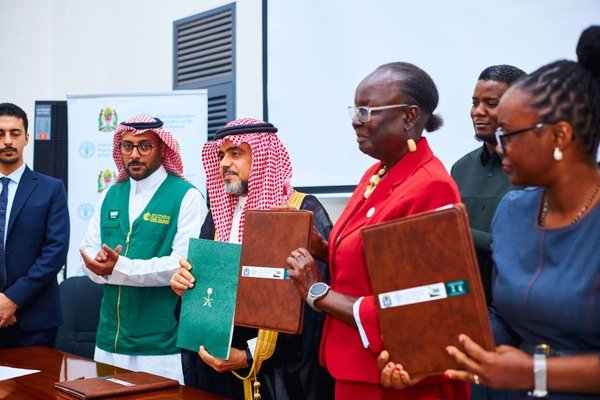
Saudi Arabia’s King Salman Humanitarian Aid and Relief Centre (KSrelief), in partnership with the United Nations Food and Agriculture Organization (FAO), has launched a project to promote drought-resilient agriculture and diversify farmers’ incomes through date palm cultivation in Tanzania.
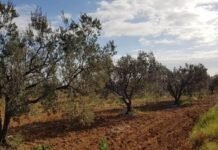
The initiative, launched in Dodoma, involves planting 3,000 date palm seedlings and training local farmers in cultivation techniques to strengthen agricultural resilience, improve food security and create alternative sources of income.
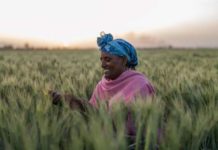
The project will directly benefit 250 smallholder farmers and indirectly reach approximately 1,150 people through agricultural training, improved production systems and the development of local farming capacity.
According to the Saudi Press Agency (SPA), the initiative seeks to establish date palm cultivation as a sustainable agricultural activity in Tanzania, particularly in areas vulnerable to drought and changing climatic conditions.
Irrigation systems and agricultural equipment
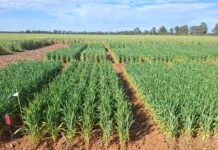
The project will establish pilot, experimental and demonstration fields to introduce farmers to date palm cultivation and promote sustainable agricultural practices.
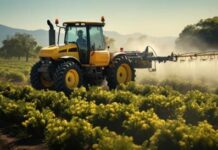
It will also provide irrigation systems, agricultural machinery and approximately 3,700 seedlings, alongside technical training for farmers and agricultural extension officers.
The support is intended to strengthen local expertise in date palm production, improve farming practices and equip beneficiaries with the knowledge required to sustain the crop.
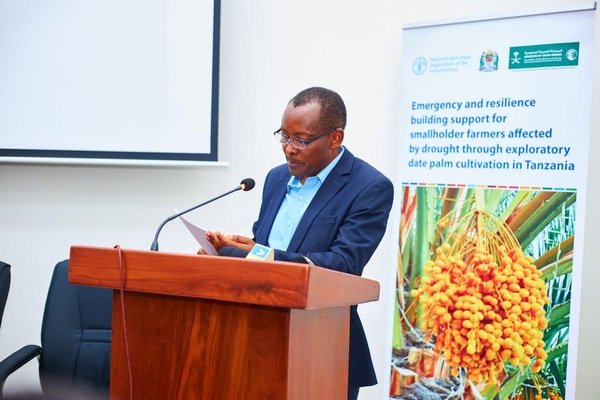
The launch ceremony was attended by Saudi Ambassador to Tanzania Yahya bin Ahmed Okeish, Tanzanian Deputy Minister of Agriculture David Silinde, the ministry’s Director of Crop Development, Jacinta Musigela, Tanzania Agricultural Research Institute (TARI) Director General Thomas Bwana and FAO Representative Nyabenyi Tipo.
The participation of government officials and agricultural research institutions highlights the project’s emphasis on cooperation in developing Tanzania’s agricultural sector.
Addressing drought and improving farmers’ incomes
Date palm cultivation is being promoted as an alternative for farmers facing increasingly difficult agricultural conditions, particularly in semi-arid areas.
The crop’s ability to withstand arid climatic conditions makes it suitable for regions experiencing water shortages and irregular rainfall. Its introduction is expected to help farmers diversify production and reduce their dependence on conventional rain-fed crops.
The project builds on earlier cooperation between KSrelief and FAO to support smallholder farmers affected by drought through exploratory date palm cultivation.
The FAO has previously identified Dodoma and neighbouring regions as suitable locations for exploring the crop’s potential, given their semi-arid conditions and the challenges facing rural agricultural communities.
The initiative is also expected to create opportunities for income generation by introducing farmers to a crop with nutritional and economic value.
Developing Tanzania’s date palm industry
Beyond improving agricultural resilience, the project could contribute to the development of a new agricultural value chain in Tanzania.
A report published by The Guardian in September 2026 highlighted the potential of date palm cultivation to create opportunities for commercial production, agro-processing and exports.
The Saudi-backed initiative has generated research and practical experience on growing date palms in selected drought-prone areas, providing a foundation for expanding cultivation.
Developing the sector could create opportunities for farmers and other participants in the agricultural value chain, including those involved in processing, marketing and distribution.
However, the development of a commercial industry will depend on sustained investment, appropriate production techniques and the establishment of reliable markets for locally produced dates.
Strengthening agricultural research and training
The project places significant emphasis on transferring agricultural knowledge and strengthening local research and extension services.
Through collaboration with TARI and FAO, the initiative aims to improve farmers’ understanding of date palm cultivation, including seedling management, irrigation and production practices.
Agricultural extension officers will also receive training to help disseminate technical knowledge to farming communities and support the adoption of improved cultivation methods.
The provision of agricultural equipment and irrigation infrastructure is expected to complement these training activities by giving farmers access to resources needed to establish and maintain date palm plantations.
The involvement of Tanzania’s agricultural research institutions is also intended to support the adaptation of cultivation practices to local environmental conditions.
Supporting food security and climate resilience
The initiative forms part of Saudi Arabia’s broader humanitarian and development assistance through KSrelief, which supports agricultural development and food security in vulnerable communities.
For Tanzania, promoting drought-resistant crops offers an opportunity to diversify agricultural production while strengthening the livelihoods of smallholder farmers exposed to climate-related challenges.
The project is also expected to contribute to food security by expanding agricultural production and creating additional income opportunities for participating households.
With the introduction of date palm cultivation, the partnership between KSrelief, FAO and the Tanzanian government is seeking to establish a foundation for sustainable production while building local capacity to manage the challenges associated with drought and changing weather patterns.