

The wind carries no suitcase, yet moves forests, across centuries.
From gentle breezes to tempests fierce, air as an animating force in nature and the stuff of breath has always held a secure, if somewhat perplexing position, in human imagination and reverence.
Talking about the weather is clichéd as a universal icebreaker. Oscar Wilde called it the “last refuge of the unimaginative.” However, environmental matters don’t operate in a vacuum and at the risk of being banal one can acknowledge that issues aerial have been the subject of much fancy over the eons. Across all cultures and global mythologies there are over 100 named deities for air, wind, and storms. So venerated was the sky that from this rarefied pantheon; especially the Egyptians, Greeks, Vedic Hindus, the Chinese, Aztecs, Polynesians and Native Americans have had multiple air-related gods represented in their respective belief systems. Even wind directions and seasonal winds had their own gods. Unsurprisingly; seafaring societies and those inhabiting great plains, deserts and other windswept geographies were pragmatically more prone to windy divinities – whereas people from relatively windstill regions, or those less dependent on wind conditions, seems to have had few to none. The air is not just for the birds & the bees: it has long been thought to be something magical, immaterial, inscrutable, yet powerful and universal – thus earning divine stature among ancient cultures without breaking a sweat.
The Mesopotamian god Anu was the divine personification of the heavens, regarded as the king of the gods and the supreme source of cosmic order. The Greek Anemoi were the four winged gods responsible for the directional winds. Vayu in Hinduism was revered as Prana – the vital breath of the world. The Japanese kamikaze – before it took a darker connotation during World War II – literally translates to “divine wind”, originating from the 13th century typhoons that destroyed invading Mongol fleets. In Shinto, air represents both the benevolent and awe-inspiring, unpredictable powers of nature – with Fūjin, the god of wind – as a symbol of nature’s unpredictable duality. In South Africa, for the Khoi and San peoples air and wind were life-giving expressions of the divine, a vital essence embodying the interconnectedness of all living things. “Cabo de tormenta” or the “Cape of Storms” was coined in 1488 by Portuguese explorers in reference to the fierce weather on the peninsula, after enduring terrifying gales while sailing around the tip of Africa. It is a wonder our fair headland didn’t generate more wind-worshipping folk. Climatic determinism is a controversial theory and an oversimplification, though there could be hints of it here: the gods didn’t’ make the weather – as we know now – but the weather made for many gods – a flawed attempt by our earlier ancestors to rationalise the world and its natural phenomena. Sky gods are a dime a dozen. Wind, personified, often becomes more than weather – it becomes breath, movement, change, chaos, freedom, inspiration or life itself. Today, in reference to religious thought, creation, invention or spirit we still reflexively look up to the atmosphere rather than down to our feet. Air as a global commons has always been profoundly significant – a fact that we have only better understood and appreciated scientifically in more recent times.
If bees and butterflies had a god, surely it would be a wind god.
Pollinators are not a niche concern: they are part of the machinery that keeps ecosystems productive and resilient. There are some 350,000 pollinator species (including over 21,000 known bee species), from insects to birds to bats. Much of this biodiversity goes unnoticed and unappreciated until the vital systems they support begin to fail. Pollinators contribute an estimated USD 235 billion to USD 577 billion annually to the global economy. Roughly 75 percent of the world’s leading food crops, about 35 percent of crop production yield and 90 percent of flowering plants is partially or fully dependent on animal pollination. Without pollinators, the foods at the center of a healthy diet would rapidly become less abundant, less reliable and more expensive. Pollinators help keep ecosystems functioning and underpin robust landscapes and rural livelihoods, sustaining wetlands, vulnerable coastal flora that defends against storm surges, and riparian vegetation that stabilise soils and reduce contaminated water runoff. Bees are widely considered the most efficient pollinators. Charles Darwin’s “humble-bee” is a hard worker and in Europe around 80 percent of wildflower and crop species depend entirely on bee pollination for fertilisation. While most cereal crops rely on wind for pollination, 90 percent of the crops consumed worldwide are pollinated by bees.
The humble bumble may be the bees knees when it comes to pollination, but relying too heavily on one species is risky when chemical use, climate change stress, disease or other adverse factors hit. Some regions and pollinator groups remain poorly understood as research and funding focuses heavily on commercially preferred species. While native pollinators are better adapted to local crops and climates – in parts of Africa there is often a lack of basic data on them, crop dependencies and threats. The “Flight of the Bumblebee” by Nikolai Rimsky-Korsakov is a famously complex musical composition requiring maintained speed and pristine articulation to perform skillfully. This year-1900 homage to the busy hexapod captured their intricacies presciently as a new 2026 study has shown that bees demonstrate remarkably advanced cognitive abilities, even using tools to solve problems. We might have taken this for granted as bees (appearing on Earth about 120 million years ago) already solved sophisticated engineering challenges long before the evolution of Homo sapiens. The honeycomb conjecture states that a regular hexagonal grid is the most efficient way to divide a surface into regions of equal area while using the absolute minimum total perimeter – which bee brains instinctively calculated would give them the maximum amount of honey storage for the minimum amount of wax. Human mathematicians only figured this out in 1999.
International Pollinator Week runs from 22-28 June, as a celebration dedicated to protecting small creatures and creepy crawlies that sustain our ecosystems and food supply. “Life on a Leaf: Celebrating Caterpillars and Host Plants” is this year’s theme inspiring grassroots action – so to speak – by highlighting the fact that caring for pollinators requires providing food and shelter for their young, as nearly all butterfly and moth larvae rely on specific native host plants to survive. Caterpillars are vital links in the food web that are directly harmed by the use of pesticides and insecticides. Many species of butterflies and moths depend on the leaves of host plants to feed, grow, and eventually mature into adult pollinators. There are few easy substitutes for the services pollinators provide. Once they decline, food production becomes less reliable and the natural systems become harder to restore. In South Africa, pollinator losses are a growing ecological and economic concern as millions of managed and wild honeybees are dying off due to pesticide misuse, habitat fragmentation and monoculture farming – directly threatening the yields of over 50 domestic crops and the reproduction of indigenous flora.
Every breath is a conversation older than memory, and every living thing is still speaking.
While land, sea and airspace has been claimed as sovereign jurisdictions, the air itself (only about 21 percent oxygen) and everything it carries ignores the artificial constraints of political borders. Climate scientists study the Earth as one integrated system and every inhalation has likely touched mountains, deserts, forests, and seas before reaching you.
Air turns continents into neighbours. Air as a global medium connects ecosystem to ecosystem. One of the most extraordinary atmospheric journeys on Earth involves part of the Sahara desert helping feed the Amazon rainforest. Warm winds sweep across dry lakebeds and fine mineral particles are lofted high into the atmosphere. Moving like a flying river westward over the Atlantic, it travels more than 5,000 kilometers to South America where it settles as fertiliser. The phosphorus in Saharan dust helps plants grow, and satellite images regularly capture entire plumes in transit. All vascular plants need nitrates to grow and lightning converts atmospheric nitrogen (our most abundant gas) into forms plants can use biologically, helping feed entire ecosystems. The atmosphere is increasingly recognised as a dynamic microbial habitat and thousands of diverse bacteria and fungi have been documented soaring through the skies. Biological material moves between continents in the atmosphere and every breath literally contains tiny traces of distant landscapes.
High above the ground are jet streams: narrow bands of very fast-moving air that influence storm tracks, aviation routes, rainfall patterns and temperature extremes. At floor level the wind is a landscaper; building and shaping dunes, coastlines, soil movement and vegetation. Compared with Earth’s size, the breathable atmosphere is like the skin of an apple – a thin layer makes all life possible. Petrichor is the distinct scent that fills the air when rain falls which comes from plant oils, petite aerosols launched into the air by raindrops and compounds released by soil microbes. Research has shown that plant seeds can sense the vibrations generated by falling raindrops, responding by waking from their state of dormancy and beginning to germinate in anticipation of the coming deluge. Pluviophilia means ‘a love of rain’ and describes someone who finds comfort and joy in rainy weather – and so perhaps we can identify with these rain-delighted seeds. The atmosphere is partly a living transport network; ferrying pollen, seeds, insects, fungal spores, bacteria and other microorganisms, salt crystals, fine minerals and dust, nutrients, heat, moisture and – yes indeed – our precipitation. The carbon in your body once moved through air as carbon dioxide before becoming plants, food, and – eventually – you.
Air currents are one of Earth’s great invisible systems. What feels like local weather is often connected to events thousands of kilometres away. Borrowing poetically, the “butterfly effect” is a concept from chaos theory which argues that even miniscule changes in the initial conditions of a complex system – like weather and ecosystems – can cascade into massive, unpredictable variations in long-term outcomes. Accordingly, the flap of a single butterfly’s wings in Brazil reverberates out to ultimately cause a severe tornado in Texas weeks later.
Careful how you breathe.
This isn’t just pie-in-the-sky: air currents interact continuously with ocean currents, especially dramatic in South Africa with the meeting of the warm Agulhas current and the cold Benguela current affecting coastal winds and inland weather, rainfall, fynbos ecosystems and agriculture. Weather in one place can influence another through a mechanism called teleconnection which links weather anomalies across widely separated regions – transmitting climate effects and altering patterns such as wind circulation and rain.
Says Gill Simpson, executive director of the Wild Rescue nature reserve: “The Cape Floristic Region is one of the most biodiverse plant regions on the planet, with extraordinary specialisation in pollination systems and environmental niches. Fynbos is deeply connected to the air through its reliance on wind for pollination and seed dispersal, its adaptation to atmospheric moisture (coastal sea spray and fog), microclimates and its evolutionary dependency on the smoke and atmospheric heat from fires to regenerate. With fynbos, the wind is not passing through the ecosystem – the ecosystem is growing inside the wind – and while we work here in the Southern Cape with boots on the ground and soil on our hands we cannot underestimate the vital importance of the air, and how it connects us globally.”
Our biome is tied to the sky through critical processes, such as the wind spreading pollen between isolated plant populations across valleys, and helping winged and feathered seeds (like those of Proteas and Asteraceae) take flight over long distances. Karrikins are plant growth-regulating compounds found in the smoke of burning vegetation, triggering dormant seeds to germinate en masse in nutrient-rich, post-fire environments. When wildfires occur these chemical cues are released into the air, and many fynbos seeds remain dormant in the soil for years, only germinating when smoke signals indicate that competition has been cleared. Temporary “fire ephemerals” sprout, grow, and reproduce quickly before competition returns: such as Fire Lilies (Cyrtanthus ventricosus) erupting into bright red flowers just after a blaze and Everlastings (Syncarpha vestita) or “Cape Snow” daisies with their silky, paper-like flowers. Research also suggests that karrikin signaling pathways can help plants mitigate environmental stressors like drought, salinity, and extreme temperatures – and play a fundamental role in mediating beneficial plant-microorganism interactions.
Many fynbos plants rely on the moisture-dense air coming off the oceans as they capture mist and dew directly from the air, providing vital hydration during the arid summer months. The mountainous topography channels coastal winds and sea breezes, regulating and moderating temperatures and creating the air circulation and low humidity that helps fynbos thrive. That “fine bush” appearance of fynbos is partly an adaptation to moving air and the wind shapes the plants themselves through strong coastal winds and summer dryness, reducing leaf area and keeping growth compact. Around 12 percent of fynbos plants are estimated to be wind-pollinated, especially groups such as restios. The Southern Cape ecosystem is connected through moving air, and without ocean-atmosphere interaction much of it would look very different.
Healthy land is not permanent.
Desertification is a critical threat in South Africa, where over 91 percent of the land is classified as arid, semi-arid, or dry sub-humid. Driven by climate change, severe droughts, and unsustainable human land-use, the country loses 300 to 400 million tons of topsoil annually, severely impacting food security. The Karoo is highly susceptible as overgrazing and cyclical droughts have caused productive grasslands to convert into barren shrublands. In Limpopo severe soil erosion, largely due to the overexploitation of natural resources and deforestation, has led to heavy siltation in river systems.
While Southern Africa as a whole continues reeling from the severe effects of the 2023/2024 El Niño episode which has caused the worst drought ever recorded across the region, gird your sunscreen as an even hotter & drier “super El Niño” is yet to be experienced this coming summer. Global atmosphere and ocean temperatures already hovered near record levels in May, with an exceptionally strong heatwave simmering over much of Western Europe. Against this backdrop we’ve had widespread water shortages, significant livestock losses and diminished harvests resulting in rising food insecurity. The overarching pattern that’s emerged during the past decade in South Africa has resulted in multi-year droughts increasingly appearing in the same places, at different times – thrusting water security into the national conversation, with the “Day Zero” extreme water scarcity of 2015-2018 in the Western Cape still provoking caution on water use. Millions of people suddenly became aware that every tap begins somewhere in a mountain catchment area, prompting a new public understanding that cities are ecologically-dependent systems as much as engineering-dependent systems.
World Desertification and Drought Day on June 17 (officially World Day to Combat Desertification and Drought) was established by the United Nations in recognition that degradation affects every continent and requires international cooperation. The 2026 theme is “Rangelands: Recognize. Respect. Restore,” highlighting grasslands, shrublands, savannas, and grazing landscapes that cover more than half of Earth’s land surface, along with their biodiversity and role in food security. The global observance this year is being hosted in Kenya, the first African country to feature in nearly a decade, focusing on the central role of the world’s rangelands in climate resilience and conservation – and the cultural identity of pastoralist and indigenous communities: a timely topic just as sheep farmers in the communal rangelands of the Drakensberg are feeling the pressure from a warming climate.
Desertification doesn’t mean “deserts are expanding everywhere,” but that land becomes less productive and loses ecological function as regions dry out – with degradation happening through erosion, overuse, pollution, deforestation, drought, invasive species, or poor land management. Land is not separate from the atmosphere. Air and atmosphere in South Africa and across Africa sit at the intersection of human health, biodiversity, climate, energy, water, and land use. Many of the biggest issues are not just air pollution in the urban or industrial sense – they’re about how changes in the atmosphere pervade through entire ecosystems.
Taking Flight.
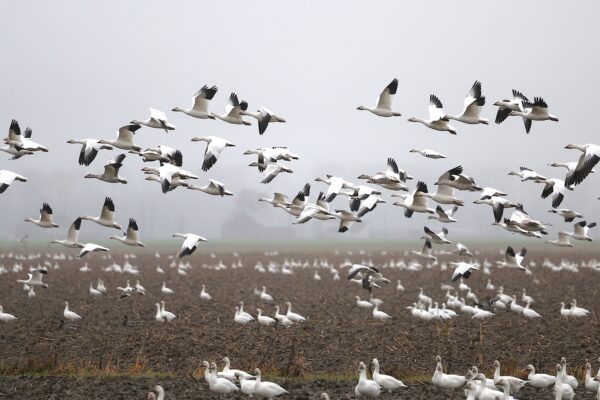
Bird migration is one of Earth’s great, and most indicative, connective systems. Migratory birds do not simply travel from A to B – they move through migratory pathways, often called flyways: broad ecological corridors that link breeding grounds, resting places, feeding sites, wetlands, coastlines, grasslands, mountains, and wintering areas across continents. These birds rely on stopover sites to rest, feed and rebuild energy. As a result, certain places become global bottlenecks because of enormous numbers of birds passing through. This is our locus of attention.
Climate change affects migration in ways that are surprisingly subtle at first. Birds often migrate using day length as a measurement tool – but food availability shifts with temperature: where insects have already emerged and scattered, plant flowering already finished, estuaries shrunk and seasonal wetlands already dried up. This is called phenological mismatch. Losing one stopover can break an entire migration route, with birds encountering less food and water than previous generations. This means that some species shift ranges poleward, others migrate shorter distances and some stop migrating entirely. Species loss isn’t the only concern – it is the loss of connection as bird migration is a key way that ecosystems “talk” across continents. Global migration networks are facing a critical crisis, with over 40 percent of migratory bird species in decline. Primary threats include habitat loss at stopover sites, and climate change causing the aforementioned ecological mismatches. At least efforts are being stepped up to harmonise conservation action between and within continents, as the United Nations Convention on the Conservation of Migratory Species of Wild Animals (pause for a breath) has a resolution to develop an action plan for the conservation and protection of migratory landbirds in the African-Eurasian flyways region. With hotspots like Langebaan Lagoon, the De Hoop Nature Reserve, the Berg River Estuary and the Okavango Delta featuring as bird habitats and stopover points, Southern Africa is not just an endpoint – it is part of an important interhemispheric avian highway.
They say love is in the air… but, then again, so is pollution.
According to a study by the Centre for Clean Energy and Research (CREA) and Greenpeace Africa, approximately 42,000 people in South Africa died from ambient fine particulate matter (PM2.5) in 2023. These teensy particles are one of the most hazardous pollutants in the air because of their ability to penetrate into the lungs and enter the bloodstream. The report also found that the entire country was exposed to PM2.5 levels that exceeded the World Health Organisation’s guidelines. Air pollution is linked to various disorders and is the second biggest threat to human health in our country – yet more than half of our government-owned air monitoring stations are completely offline and according to the Clean Air Fund, air-quality monitoring stations are not evenly distributed in South Africa, creating public health disparities. When properly functioning these stations measure particulate matter (PM), sulfur dioxide (SO2), nitrogen dioxide (NO2), ozone (O3), and carbon monoxide (CO), among other air pollutants. These pollutants are evaluated against the National Ambient Air Quality Standards (NAAQS) to assess whether concentrations of pollutants are within acceptable levels for human health.
According to a 2019 NASA study, 780,000 premature deaths in Africa each year can be attributed to air pollution. High mortality rates are brought on by the expansion of the oil and gas industry in Nigeria and South Africa, while deaths in West and Central Africa are mainly associated with fire emissions. According to UNICEF research titled “Silent Suffocation in Africa,” outdoor air pollution deaths increased by 60 percent across the continent between 1990 and 2017. Presently with more than 50 percent of monitoring stations operating at diminished or no capacity, the government is effectively blind to the extent of pollution and its impact on the environment and the health. However, the Department of Forestry, Fisheries and the Environment [DFFE] has recently launched a ZAR 625 million proposal to overhaul this strategic grid and thereby boost environmental governance. This comes just as climate and emissions negotiators are urged to focus on actually implementing agreements rather than reopening and rehashing old debates at the annual UN climate talks in Bonn, Germany – warning that the world is running out of time to respond to worsening climate impacts and economic shocks.
The Big Five and the Oxygen Apocalypse
The ‘Big Five’ in South Africa commonly refers to the lion, leopard, elephant, rhinoceros, and the Cape buffalo – but ask a geologist about the ‘Big Five’ and you may hear a response regarding the five major mass extinctions on Earth over the last 500 million years, during which at least 75 percent of all species were wiped out. The Great Oxidation Event [GOE] of approximately 2.4 to 2.0 billion years ago was the first mass extinction, triggered by cyanobacteria producing excess oxygen that poisoned the planet’s original anaerobic organisms, fundamentally reshaping the global biosphere forever. Human activity today is said to have initiated a sixth mass extinction with unprecedented biodiversity loss – ironically corrupting this respiratory necessity as we choke on our own fumes of industrialisation and reconsider the critical importance of safeguarding our atmospheric environment. It’s nothing to gasp at to say that air is a dominant force in shaping the world. Before roads, before cities, before the continents, there was air: already doing the work.
For its extraordinary meaning to all life on Earth the air is indeed a kind of magic and perhaps religious devotees in the years BCE were onto something with all their air-adoring ways. One can only hope that modern peoples will learn to treasure the skies with equal, science-enlightened respect.
But don’t hold your breath.
The substance of air seems oxymoronic at first glance, but with this the value and function of atmosphere (and its organisms) has been reified into an undeniable part of the conversation for National Environment Month.
Not for nothing; people today fundamentally undervalue insects, viewing them as pests or annoyances rather than foundational pillars of global ecosystems. But various mythologies have featured divine spirits associated with insects. “Bhramari” in Hinduism is the goddess of bees. The Maya civilization had “Ah-Muzen-Cab” – their god of bees and honey. In San mythology “Cagn” is a supreme creator deity associated with the praying mantis. The ancient Greeks regarded bees and honey as sacred conduits between the mortal and divine, and revered them for their social order. Bees represented prophecy, artistic inspiration, and the food of the gods, with figures like “Aristaeus” honored as the god of beekeeping. Bees were called the “birds of the Muses,” believing that a bee landing on a poet’s or philosopher’s lips would bestow the gift of eloquence and artistic genius. Apollo was frequently depicted with a laurel wreath entwined with bees, symbolising harmony with nature. Zeus, the king of the gods, is mythicised as having been fed on honey as a baby – in gratitude, transforming his caregiver Melissa into a honey bee. Thereafter priestesses who served the gods were historically referred to as “Melissae” – meaning “bees.”
The Hellenists were on the right track, but you don’t need to worship them to understand that without pollinators (and healthy air) human life would become far less abundant.