


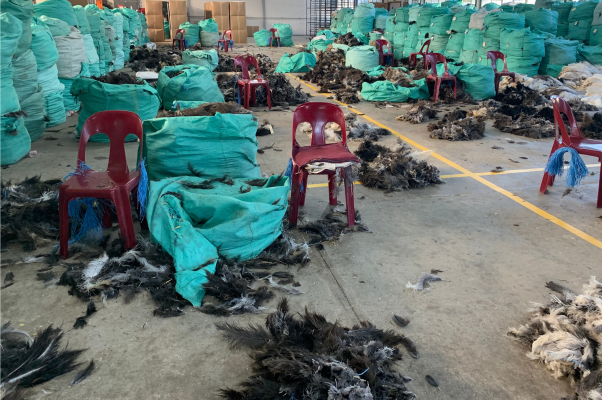
South Africa’s national animal welfare authority, the National Council of SPCAs (NSPCA), is preparing to lay criminal charges against several ostrich farms. The announcement comes after evidence gathered through World Animal Protection’s undercover investigation into the commercial ostrich farming industry in South Africa.
In a statement made by the NSPCA outlining the proposed charges, they reference the footage provided to them as ‘deeply disturbing’, and further state that ‘like all animals, ostriches feel pain, fear and suffering.’
In September, World Animal Protection submitted investigation findings to the NSPCA outlining the animal welfare concerns uncovered, with a request the NSPCA consider further investigation under the Animals Protection Act.
World Animal Protection’s investigation documented rare video evidence of the feather harvesting process. One clip shows a male ostrich being cornered by workers before a bag is then placed over the bird’s head to placate him and his feathers are cut and pulled from his skin using pliers. This is done without any pain relief.
Inspectors from the NSPCA’s Farm Animal Protection Unit have since visited the farms and issued warnings, and will carry out unannounced follow-up inspections.
Olivia Charlton, Campaign Lead at World Animal Protection, said: “This is a significant moment for ostriches. For too long their suffering in the name of fashion has been hidden away on farms.
“Let’s be clear, this is not just a case of a few bad farms but instead a sign of wider animal welfare issues within an industry that reduces social, emotionally-aware birds to a mere material for dresses and bags. Ostrich farming for fashion needs to be phased out.”
The NSPCA has raised its concerns directly with the South African Ostrich Business Chamber (SAOBC), the industry’s representative body, which will now conduct its own investigation.
The SAOBC’s standards scheme is voluntary, and is developed and overseen by the ostrich industry itself. The scheme is frequently cited by brands and retailers as evidence of responsible sourcing. However, World Animal Protection documented evidence that not even the minimum requirements of the standards are being met on farms investigated.
“The SAOBC talks up high welfare standards, but just like the birds on these farms, those claims don’t fly.
“If farms operating under industry-backed standards are failing to meet even the baseline requirements, it raises serious questions about the credibility of the SAOBC’s scheme.
“Fashion brands should be cautious about relying solely on industry assurances when independent investigations have uncovered significant welfare concerns. They should be critically assessing whether ostrich feathers can even be sourced ethically in the first place.” said Ms Charlton.
South Africa sits at the centre of the global ostrich feather trade. World Animal Protection and Collective Fashion Justice recently released their report ‘Blood Feathers’, which found in the 2024/2025 season 150,000 ostriches were slaughtered in South Africa, and more than 150 tonnes of ostrich feathers were exported around the world.
Emma Hakansson, Founder of Collective Fashion Justice, said: “No inspection or welfare policy will change that this industry can only exist through profit-driven objectification and the slaughter of birds who should live freely. The fashion industry does not need real feathers to create beauty.”
Given the evidence uncovered during World Animal Protection’s investigation, the animal welfare organisation is calling on brands and retailers to phase out the use of ostrich feathers in their supply chains.