


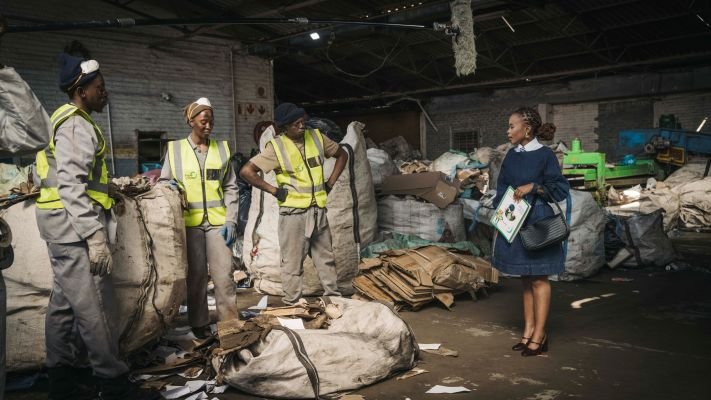
Fibre Circle, an organisation that manages extended producer responsibility programmes to keep paper and paper packaging out of South Africa’s landfills, has called for collective action to advance recyclable packaging and a shared circular economy.
The call came at its colloquium, where government, industry, recycling partners and value-chain participants discussed how packaging can be designed, collected and recovered.
Delivering the keynote address at the Fibre Circle Colloquium, Mvuselelo Matebola, Chief Director at the Department of Forestry, Fisheries and the Environment (DFFE), urged stakeholders to rethink the linear model of producing, using and discarding products.
Under the theme “Designed to Come Back”, he said paper, cardboard, newspapers and paper packaging should be seen as resources that can be recovered, recycled and returned to the economy.
“Circularity depended on decisions throughout a product’s lifecycle, from design and manufacturing to consumption, collection, sorting, recycling and markets for recovered materials,” said Matebola.
He described extended producer responsibility (EPR) as an important milestone, but stressed it must deliver more than compliance and reporting: tangible environmental, economic and social benefits.
Reflecting on EPR’s first four years, he acknowledged progress in governance, reporting, partnerships and programme delivery, alongside early challenges in establishing systems.
“I call for locally relevant solutions, noting that South Africa’s infrastructure, markets, consumer behaviour and socioeconomic circumstances differ from those elsewhere,” said Matebola.
Turning commitments into practical action
Matebola placed responsibility across the value chain saying producers, designers, manufacturers, recyclers, municipalities, waste businesses and communities must ensure packaging is recovered in practice, not merely appear recyclable.
He cautioned against innovation that ignores infrastructure and market conditions, urging stakeholders to measure success through recovery, resources kept in circulation and social and environmental gains.
According to Fibre Circle CEO Edith Leeuta, progress in this course depended on partnerships across the value chain. “This meeting is a space to exchange knowledge and build a shared understanding of packaging recyclability challenges and opportunities.”
Leeuta urged participants to move beyond theory and find ways to return materials to the value chain. “Packaging needs a home for it to be recycled,” she said, pointing to the need for collection systems and infrastructure. Where capacity is lacking, she said, alternatives must be explored.
She questioned how recyclability should be defined in South Africa, who should determine whether a product qualifies and which standards should guide assessments. Accurate labelling gives collectors reliable information about materials and their handling.
“Sustainable packaging,” she stressed, “involves policy, research, infrastructure and effective recycling systems, not design alone.”
Meanwhile, Martin Bothma of the government-recognised Producer Responsibility Organisation (PRO) highlighted the importance of environmental awareness, responsible consumption and partnerships between industry and municipalities.
He pointed to initiatives supporting local production, improved collection and landfill diversion, and called for stronger EPR implementation noting that accountability, open communication and reporting of measurable environmental and socioeconomic outcomes are priorities.
Designing for South African recycling realities
Coming from the panel discussions facilitated by Nastassia Arendse, which examined packaging design, recyclability and the economics of material recovery, panellists emphasised that a shared understanding of recyclability must be grounded in scientific evidence, local data and practical testing.
International reports and certifications, they cautioned, do not automatically prove packaging is recyclable in South African conditions.
A presentation on paper recovery distinguished pre-consumer from post-consumer pathways. It indicated more than 65% of paper tonnages were pre-consumer and less than 35% post-consumer, underlining the need for better separation by businesses and households.
Collection economics also shaped the debate. Collectors and waste pickers weigh material value against distance and recovery effort.
Concentrated, well-sorted paper streams can reduce costs and improve recovered value. Recyclers need accessible, affordable fibre, while coatings, waxes, polyethylene layers and some additives can complicate recovery and raise costs.
Balancing performance, impact and recovery
Panellists cautioned that paper is not automatically more sustainable than plastic. Decisions should begin with function: what must a package achieve, which materials meet those needs, and are viable recycling routes available?
Assessments should consider resource use, affordability, performance, social acceptance and lifecycle impacts. In this, scientific assessment tools can strengthen decisions, but must be practical and reflect local circumstances.
Participants also discussed how EPR regulations could complement the National Circular Economy Action Plan and waste-management legislation.
In sum, the message was that no organisation can build a circular packaging system alone. Designers and producers must engage recyclers; government and municipalities must support workable systems; consumers and communities must participate. Stakeholders were urged to move from commitments to coordinated implementation.
Connecting design with collection infrastructure, viable markets and recycling workers’ livelihoods can give materials life. The challenge is to make “Designed to Come Back” practical at every stage, recovering fibre and keeping it out of landfill.