


OMU-ARAN, Kwara State, November 2026 – For many farmers in Nigeria, years of hard work and successful harvests are not enough to secure a bank loan or attract international buyers.
In fact, despite producing and selling crops season after season, many cannot provide written evidence of their farm activities, income, expenses or production history.
However, a new digital platform, Recordance, developed by the country’s Landmark University graduate Ogberigbe Torishe Prince, aims to change that.
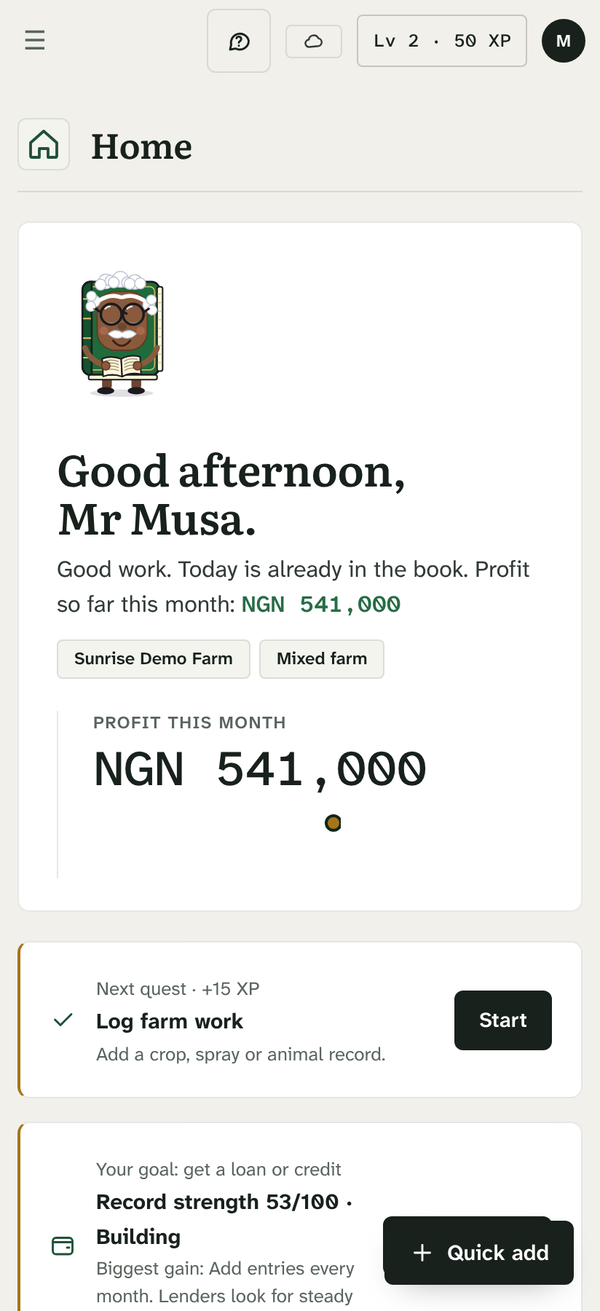
Recordance is a farm management and record-keeping platform that turns what farmers say or type into organised records of sales, expenses, livestock, crops and profits.
Designed to address the documentation gap in smallholder agriculture, it gives farmers a verifiable history of their operations that can help them demonstrate their financial capacity to lenders, investors and agricultural buyers.
“I come from a family of farmers, so I grew up seeing both the hard work that goes into a farm and how little of it ever gets written down,” Prince said.
The recent graduate of Landmark University, based in Omu-Aran, Kwara State, Nigeria, where he studied Animal Science and Agripreneurship, said his upbringing and interest in technology influenced the development of the platform.
His final-year seminar examined the conversion of cassava peels into energy-rich poultry feed, exposing him further to the value Nigerian farms lose through waste and inadequate information.
He also drew lessons from running businesses while at university, where he experienced the importance of accurate records and financial calculations.
“I’ve also always been a builder, the ‘tech bro’ among my friends. Over time, I noticed that most technology was never built with the farmer in mind,” he said.
Prince began developing Recordance in November 2025, completing its current version in November 2026 after approximately a year of independent development with a few friends.
The project has been self-funded, with an estimated investment of ₦6 million, largely covering software development, coding and hosting. It has not received external funding.
The platform is initially opening to its first 50 farmers in November 2026 ahead of a wider release through app stores.
Turning farm activities into financial evidence
At the centre of Recordance is a problem that often prevents smallholder farmers from accessing finance: the absence of reliable records.
Banks and other lenders typically require evidence of income, production and business performance before approving agricultural loans. However, farmers who conduct most transactions informally may have no documented history to support their applications.
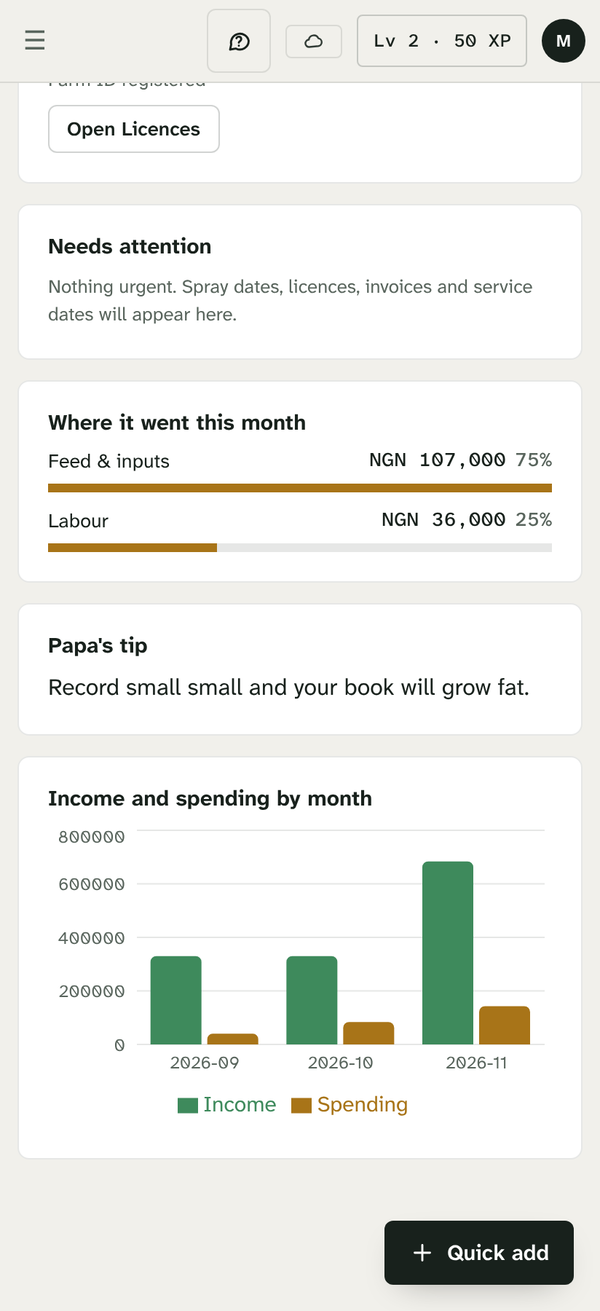
“Recordance saves every farm transaction with its date, creating a financial history that can be reviewed over time, while allowing farmers to upload bank statements in PDF, Excel or CSV formats to calculate their actual farm income and expenditure,” said the techie.
Each registered farmer receives a unique Farm ID linked to a verified phone number, while the platform generates a digital farm passport that compiles their farm records into a signed document that lenders and buyers can verify online.
The platform generates a financial health score based on a farm’s income, expenses and financial consistency to give lenders a clearer picture of its performance, while providing additional tools to calculate production costs, break-even points, return on investment and cash-flow forecasts.
“A farmer who sells every season still looks like a stranger to a bank, because nothing is written down. Recordance writes it down for them, in a way a bank or a buyer can trust,” Prince said.
He added that the platform’s credibility would depend on evidence rather than promises, noting that the team plans to conduct pilot programmes with lenders and approach institutions such as Afreximbank and the Bank of Agriculture to assess its records against farmers’ actual repayment behaviour, although formal partnership discussions have not yet begun.
Supporting farmers seeking export markets
Beyond financing, Recordance is designed to help farmers prepare for international agricultural markets, where buyers increasingly require information about the origin and production of commodities.
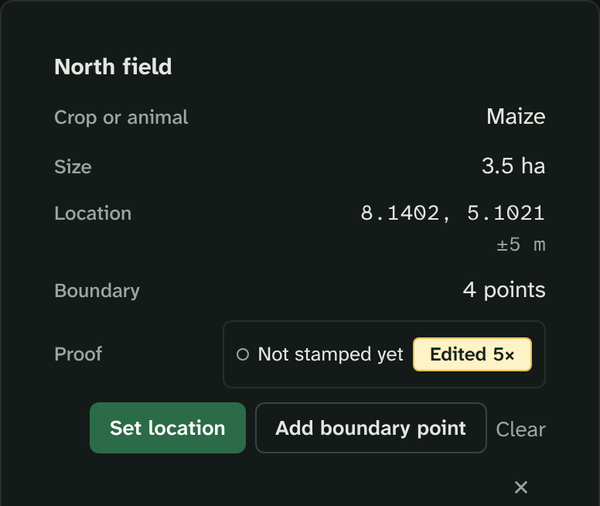
Its export features include GPS mapping of farm plots, recording their boundaries and sizes, a verifiable export passport, a spray log and an export-readiness checklist.
The checklist compares a farm’s records with regulatory requirements in its intended destination market and highlights outstanding requirements.
To strengthen data reliability, the platform uses verified accounts, timestamped entries that cannot be silently edited, GPS-tagged plots, photographic evidence and digitally signed passports.
The team also intends to work towards third-party verification through cooperatives and agricultural extension officers, Prince said.
Designed around smallholder realities
Recordance allows farmers to record their activities through voice or text without complicated data entry, while operating offline and automatically synchronising information once internet connectivity is restored, addressing network challenges common in rural farming communities.
“The platform covers 60 crops and 60 types of livestock, while also tracking buyers, workers, equipment and licences. It provides tax-ready summaries and protects accounts through PIN or fingerprint security,” said Prince.
Available in English, French, Swahili and isiZulu, the platform features an in-app assistant, Wazobia, which answers questions in simple language, a guide called Papa Ledger that provides spoken morning greetings, and a USSD option under development to serve farmers without smartphones or mobile data.
The core record-keeping features are free, while the full version costs ₦12,500 every three months, approximately ₦4,200 monthly. Farmers can access support directly from Prince through WhatsApp, with training planned through cooperatives, WhatsApp groups and field visits.
Ambitious plans for African agriculture
In the immediate future, Prince intends to onboard the first 50 farmers, gather feedback, improve the platform and prepare for its app-store launch.
By 2031, he hopes to onboard 30,000 farmers, help them access more than $30 million in loans and grants, and connect more agricultural producers to export markets.
His broader ambition is for Recordance to become a standard farm record system across Africa and beyond, recognised by financial institutions and international buyers.
“Better records lead to better credit. When farmers can borrow, they can invest in inputs, expand and hire, which means more food produced and more jobs created,” he said.
Recordance is currently available free to try at https://fastman419.github.io and works on Android, iPhone and Windows devices.
As the project seeks connections with banks, cooperatives, government agencies, exporters and development organisations, its success will ultimately depend on whether better documentation can translate into greater financial inclusion and market opportunities for African farmers.