

A packed programme of events marked the first day of the trade fair. Institutional highlights included the inauguration of the Dominican Republic and Peru stands. Special focus was placed on Mango and Avocado, the symbolic products of this edition.
A highly successful start for Macfrut, the international trade fair for the fruit and vegetable supply chain, which opened yesterday, Tuesday 21 April, under the best auspices. Numerous events took place on the opening day, including institutional moments such as the inauguration of the Dominican Republic and Peru stands, alongside several in-depth focus sessions starting with Mango and Avocado, the key products of this edition.
Mango & Avocado Next: emerging technologies for high-quality new products
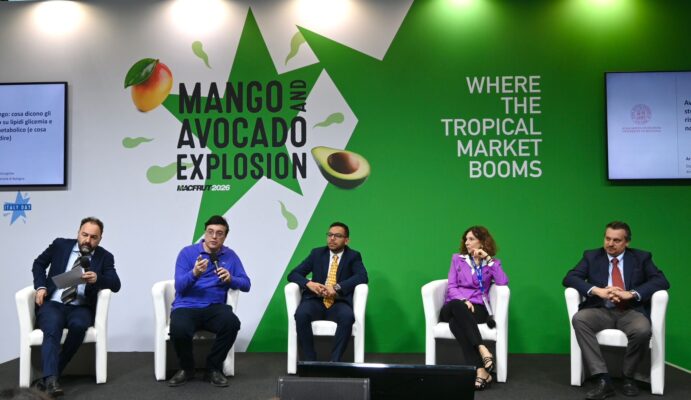
From the nutritional and health properties of mango and avocado to technological innovations and industrial applications of processed products: these were some of the technical topics explored during the first event held in the Mango&Avocado Arena dedicated to these two tropical fruits. During the workshop, Arrigo Cicero, Professor at the Department of Medical and Surgical Sciences at the University of Bologna, presented international studies on the health benefits of the two fruits, concluding that mango and avocado can have a positive impact on carbohydrate and lipid metabolism, as well as on other cardiovascular risk markers. Cicero also noted that incorporating these tropical fruits into a healthy diet requires a balanced approach to caloric intake and regular consumption.
Junior Bernardo Molina Hernandez, from the Department of Agricultural and Food Sciences and Technologies at the University of Bologna, focused his presentation on emerging technologies aimed at enhancing processed mango and avocado products. The expert outlined the critical issues associated with fresh-cut and processed products (specifically mango nectar and avocado flour and pulp), as well as the latest techniques to improve quality and extend shelf life using zero or low thermal impact methods. These include UV-C and pulsed light, cold plasma, high-pressure systems, ultrasound, ozone and electrolysed water, all of which help preserve the organoleptic and nutritional properties of fresh fruit.
Silvia Grasselli, Head of Process Technology HOM at GEA Group, illustrated advanced high-pressure homogenisation technologies for mango and avocado, which enhance the overall quality of processed products, including juices, concentrates and other beverages.
Stefano Concari, General Manager of Tropical Food, presented industrial processing technologies, highlighting mango and avocado processing lines and the different methods used to handle and transform these products efficiently.
Focus Mango: Market & Production
The global mango market has experienced rapid growth in recent years; nevertheless, it still offers significant potential for further expansion.
Philippe Binard, General Director of Freshfel Europe, analysed the global production and trade scenario, noting that worldwide production now exceeds 60 million tonnes, marking a 50% increase over the past 15 years. Over the same period, exports rose from 1.5 million tonnes to 2.2 million tonnes (+45%). Although India is the leading producer (26 million tonnes, accounting for 43% of total production, but with limited exports), Mexico is the largest exporter, with over 450,000 tonnes. For Europe, Brazil plays a central role, supplying 80% of its more than 265,000 tonnes exported to the continent. Binard also highlighted the steady growth of European mango imports (+110% over the last 15 years, with an increase of 233,000 tonnes, reaching 444,500 tonnes in 2025). Key challenges for the sector include product positioning, climate change, logistical uncertainties and rising transport costs, both maritime and air, also influenced by geopolitical scenarios. Consumption remains a crucial factor, with further growth potential in Europe through increased market penetration and higher quality standards.
Eryvan Pires, CEO of Fruitmarket Agribusiness, emphasised the evolution of mango from a simple commodity 15 years ago to a category product today, with the sector increasingly focused on delivering a more satisfying consumer experience.
A round table moderated by Antonio Felice, Director of Omnibus Comunicazione, explored production realities in Brazil, Colombia and India. Jorge De Souza, Project Manager at Abrafrutas, the association of Brazilian fruit and vegetable producers and exporters, highlighted Brazil’s export growth towards Europe and beyond, while underlining further potential and increasing attention to sustainable production, including the use of clean energy.
Gloria Isabel Morales Parra, General Manager of the Colombian federation Fedemango, revealed that Colombia aims to reach 500,000 tonnes of mango exports by 2030, positioning the fruit as a key national asset.
Sehreena Maqbool, representing India’s government agency Apeda for agricultural product promotion, reiterated that mango is considered the “king of fruits” in India, accounting for nearly half of global production with over 1,200 varieties, but only 5% of exports. The goal is to boost exports by strengthening relationships with importing countries.
Dominican Republic and Peru stands inaugurated
Macfrut President Patrizio Neri, together with representatives of the Central American country, inaugurated the Dominican Republic stand. On this occasion, Vice Minister of Agro-Industrial Development Anibelca Mena stated: “We are a country that not only produces, but also has a story behind all its products and crops. Every product we present here today represents our nation. We produce avocados, mangoes and bananas, and we aim to show other countries what the Dominican Republic truly is.”
This was followed by remarks from Rafael A. Lantigua Ciriaco, Ambassador of the Dominican Republic: “Today, this great trade fair brings us together, taking us from our beautiful island to Rimini, to demonstrate that our country is not only about tourism. Macfrut, which this year focuses on avocado and mango, shows that we are also major producers of these products. We are here to present the quality of our production to Italy and the world. We may be a small country of 48,000 square kilometres, but we have a big heart and are truly at the forefront in agriculture.”
Ada Hernández, Ambassador of the Dominican Republic to the FAO, also spoke at the event: “In this sector, the Dominican Republic is becoming a leader in Latin America and the Caribbean. While this leadership is shared with other regions, our efforts in production are gaining recognition. We currently produce more than 80% of what we consume. We are already exporting and are here at Macfrut to showcase the excellent quality of our products to all countries and visitors.”
During the day, the ribbon-cutting ceremony for the Peru stand also took place. As highlighted by Manuel Cacho-Sousa, Ambassador of Peru: “At Macfrut, we aim to connect with importing companies and distribution channels interested in purchasing directly from small Peruvian mango and avocado producers. Our economy is based on small agricultural cooperatives and producer associations made up of about 100 families.”
Jordan Steeve Deza Castilla, Director of the Productive Supply Management Directorate at Agromercado, added: “This is Peru’s first time at Macfrut and a great opportunity for us. The fruit and vegetable sector is extremely important in our country. In addition to mango and avocado, our key products include grapes, asparagus and oregano. Here at Macfrut, there are several Peruvian companies that export avocados and mangoes. We are an exporting country, we have already held various meetings with importers, and we are very satisfied.”
Info: macfrut.com