

The Digital Climate Advisory Services (DCAS) system—an innovative approach that delivers relevant, localized, real-time, and data-driven advisories directly to farmers is supporting Ethiopian wheat producers to anticipate climate risks and adapt to shifting weather patterns threatening their livelihoods.
According to a recent report by Desalegne Tadesse for the International Maize and Wheat Improvement Center (CIMMYT), the DCAS initiative was piloted in partnership with the Ethiopian Ministry of Agriculture (MoA) and the Global Center on Adaptation (GCA) to strengthen resilience in priority agricultural value chains, with wheat identified as a crop highly sensitive to climate variability.
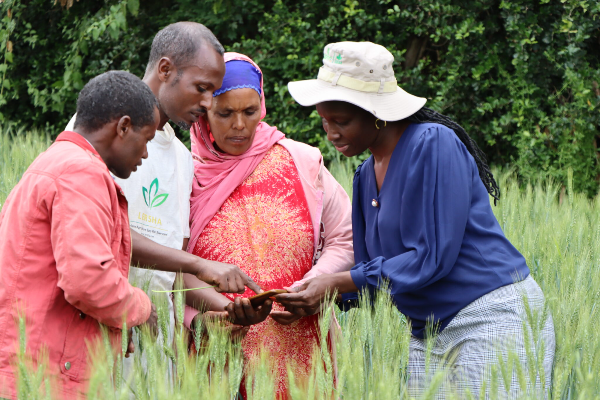
The advisory system provides smallholder farmers with localized climate information in their native languages, helping them make informed decisions on planting, soil preparation, pest control and harvesting.
In the pilot phase, 2,470 smallholder farmers—including 26 per cent women—began receiving the digital advisories, underscoring the service’s outreach within targeted communities.
Training efforts extended beyond farmers to include 190 government development agents and 65 LERSHA-Green Agro Solutions PLC field agents who now deliver digital advisories to local farming groups.
The DCAS system was developed after climate risk assessments mapped key vulnerabilities and identified adaptation options across Ethiopia’s diverse agroecological zones.
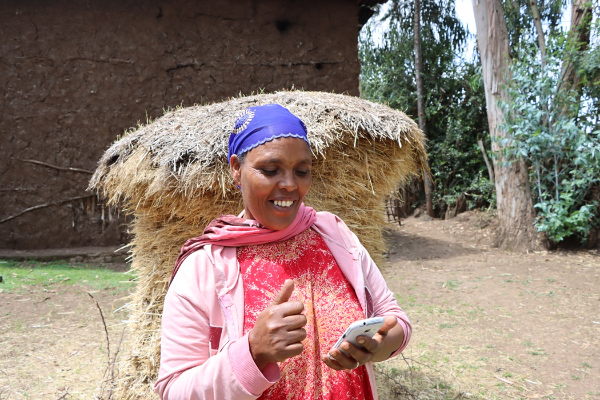 Hawa Abdeal smiles as she reads a climate advisory message, using the information to plan timely actions for her farm. (Photo: CIMMYT)
Farmers like Hawa Abdeal and Tadesse Tefesaa reported tangible benefits from the advisories, noting improved planning and yield outcomes due to timely climate information delivered directly to their phones.
“Before, I used to guess when the rains would start,” Hawa said, adding that the climate advisories helped her plan planting and save on seeds and fertilizer.
Tadesse likewise said the information gave him confidence in deciding the best times to plant, harvest and store wheat, resulting in increased yields and incomes.
At the institutional level, Dr. Mercy Nyambura, Senior Program Officer for Food Security and Rural Well-being at GCA, emphasized that the project is bridging science and practice, providing technical assistance, influencing policy and helping farmers adapt to climate change.
The DCAS initiative is part of broader efforts linked to national and regional adaptation policies, aligning with programs funded by the African Development Bank (AfDB) and the World Bank under the Africa Adaptation Acceleration Program (AAAP).
The system rests on four interconnected pillars: technical assistance, climate services, policy engagement, and holistic adaptation that incorporates agronomic practices with soil and water management for long-term food security.
In addition to delivering real-time weather information and planting recommendations, DCAS helps translate complex climate data into actionable advisories that are easily accessible for farmers confronting erratic rainfall and prolonged dry spells.
At the national level, evidence from DCAS is informing Ethiopia’s frameworks for climate-smart agricultural advisories, helping shape data-driven systems designed to expand reach to more farmers.
Collaborations with private sector actors such as LERSHA-Green Agro Solutions PLC aim to embed digital advisories in enduring service networks to sustain support beyond the project’s initial timeline.
Dr. Tesfaye Shiferaw, System Agronomist and Project Coordinator at CIMMYT, said seeing farmers adopt information and make decisions based on the advisories shows how digital innovation enhances production, productivity and livelihoods.
Government representatives echoed the urgency of scaling up DCAS to reach more farmers, noting that tailored advisory services can make a real difference in climate adaptation efforts.
As discussions on climate adaptation deepen, stakeholders are calling for intensified collaboration among governments, research institutions, private actors and communities to ensure climate resilience becomes a reality for all Ethiopian wheat farmers.