



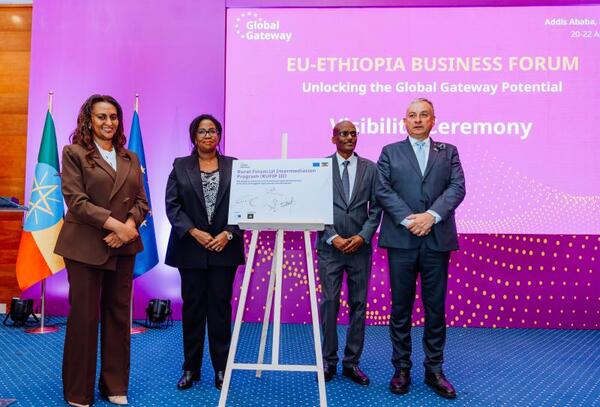
The European Investment Bank’s development arm, EIB Global, has committed €110 million to support farmers in Ethiopia, in a move aimed at boosting agricultural productivity, expanding rural businesses and strengthening resilience to climate change.
The financing will be channelled through the Development Bank of Ethiopia (DBE), which will on-lend the funds to local rural financial institutions, including microfinance institutions and Rural Savings and Credit Cooperatives (RUSACCOs).
These institutions will then provide loans to agricultural enterprises, particularly in rural areas. Half of the funding has been earmarked for women, while 20% will target climate adaptation initiatives.
The investment supports the third phase of Ethiopia’s Rural Financial Intermediation Programme (RUFIP III), a flagship government initiative designed to improve access to finance, enhance competitiveness and build resilience in the agricultural sector.
The programme is expected to benefit smallholder farmers and micro, small and medium-sized enterprises (MSMEs), with a strong focus on women and youth.
Women account for more than half of Ethiopia’s agricultural workforce but continue to face barriers in accessing finance. The initiative seeks to address this gap while advancing broader European Union objectives of improving rural financial inclusion globally.
The operation also places significant emphasis on environmental sustainability, with 20% of the funding dedicated to climate action. This includes helping rural communities cope with droughts, floods and pest outbreaks through improved risk management and adaptation strategies.
“In the face of two of today’s most pressing challenges – climate change and social inequalities – we need more inclusive finance to leverage the power of diversity and women’s role in climate action,” said Ambroise Fayolle. “This is not just the right thing to do but also a strategic investment in the overall resilience of communities.”
Expected outcomes of RUFIP III include improved access to finance, increased agricultural productivity, higher household incomes and stronger rural livelihoods. The initiative aligns with Ethiopia’s National Financial Inclusion Strategy II and the European Union’s Global Gateway strategy for Africa.
“The Development Bank of Ethiopia is honoured to play a central role in delivering this transformative financing to rural communities across the country,” said Dr. Esayas Kassa. “This program aligns closely with our strategic focus on sustainable development, climate-conscious investment, and inclusive financial systems. By strengthening rural financial institutions and expanding access to credit, we are laying the foundation for a more resilient, productive, and equitable agricultural sector.”
In addition to the credit line, the project includes an €8.5 million technical assistance component supported by the EIB-managed Africa, Caribbean and Pacific (ACP) Trust Fund. Part of this funding will subsidise insurance premiums for climate-risk products, enabling rural financial institutions to offer weather-index insurance to farmers. This is expected to protect smallholders from climate shocks while reducing lending risks for financial intermediaries.
The programme will also provide capacity-building support to RUSACCOs and microfinance institutions, helping them improve agricultural lending practices and strengthen environmental and social safeguards. Farmers and agribusinesses will receive financial literacy training, adopt improved farming techniques and implement climate adaptation measures.
The initiative builds on more than four decades of cooperation between EIB Global and Ethiopia and reinforces growing international partnerships supporting the country’s agricultural sector.
“This landmark agreement marks a significant strengthening of the longstanding partnership between Ethiopia and the EIB,” said Ahmed Shide. “By improving access to finance for micro-enterprises and small businesses through our rural financial institutions, this project will promote sustainable agricultural and economic practices across all regions of Ethiopia.”
European Commissioner for International Partnerships Jozef Sikela emphasised the broader impact of the initiative on rural communities and international cooperation.
“Ethiopian smallholder farmers, and especially women, will have access to finance they have never had before to grow their businesses, adapt to climate change, and build more stable livelihoods,” he said. “Through Global Gateway, Europe is investing in rural financial inclusion in one of Africa’s fastest-growing agricultural economies — because a more prosperous Ethiopia is a stronger partner for Europe.”
The financing also builds on collaboration with the International Fund for Agricultural Development (IFAD), the Food and Agriculture Organization (FAO) and the World Food Programme (WFP), which are supporting various aspects of the programme, including advisory services and climate risk insurance pilots.
EIB Global said it will continue working with the Ethiopian government across sectors such as energy, small and medium-sized enterprises, water, sanitation and hygiene, and women’s entrepreneurship, as it looks to expand its existing €577 million investment portfolio in the country with additional projects in the pipeline.



[…] The project fits Ethiopia’s National Financial Inclusion Strategy II. It matches the EU’s Global Gateway for Africa. This EU plan drives sustainable development. […]
Comments are closed.