

Across Africa, millions of people still cook with charcoal and firewood, which can be expensive, environmentally destructive, and bad for their health. While liquid petroleum gas (LPG) and electricity are often promoted as modern alternatives, they remain unaffordable or unreliable for many households. Ener-G-Africa (EGA), an innovative African energy access solutions company based in South Africa and Malawi, believes that pellet gasifier stoves are an often-overlooked technology that could help to bridge that gap.
Silvia Nanyangwe, Project and Country Manager at Ener-G-Africa Zambia, says pellet stoves burn cleanly, cost less and can be powered by Africa’s own agricultural by-products.
How pellet stoves work
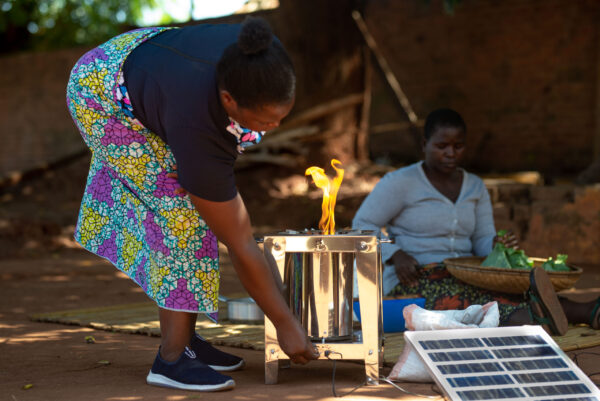
Pellet stoves work by turning small biomass pellets, made from residues like maize stalks, elephant grass or sawdust, into a clean-burning gas. A small fan helps regulate airflow, ensuring near-complete combustion and minimal smoke. When tested against international standards, these stoves consistently reach Tier 4 to Tier 5 for both efficiency and emissions, the same level achieved by modern gas or electric stoves.
The “tier” system, developed by the World Health Organization (WHO) and International Organization for Standardization (ISO), ranks cooking methods from Tier 1 (most polluting) to Tier 5 (cleanest and most efficient). Meeting Tier 4 or higher means a stove produces very little smoke and carbon monoxide, achieving indoor air-quality levels considered safe by WHO standards.
Pellet pilot in Zambia
EGA is demonstrating what this technology can achieve through its Zambia Clean Cooking Project, supported by the Modern Cooking Facility for Africa (MCFA). MCFA is funded by Sweden, Norway and the EU and managed by Nefco – the Nordic Environment Finance Corporation.
In Lusaka trials, 97% of participating households preferred EGA’s FAB pellet stove to charcoal or electric options. Families reported faster cooking times, less smoke, and cleaner kitchens. The economic benefits were equally striking: switching from charcoal to locally produced biomass pellets cut fuel costs by half, saving households around 2 730 ZMW a year (roughly 2 080 ZAR).
At current pricing, a full FAB stove kit, including a solar panel and power bank to run the fan and provide backup lighting, pays for itself within 21 weeks. The stoves are designed for everyday family use, even during power cuts, offering a reliable and affordable alternative to charcoal.
“Our goal is to show that clean energy doesn’t have to be imported or subsidised. It can be designed, produced, and powered by Africa itself,” says Nanyangwe. “This innovation can drive widespread health, economic, and ecological benefits, aligning with Zambia’s national goals for sustainable development and clean cooking access by 2030.”
Economic, social and environmental impact
Beyond household savings, EGA’s model supports local job creation and environmental protection. Pellets are produced from agricultural waste, reducing open-field burning and deforestation. “At the same time, it reduces charcoal dependency without displacing livelihoods, instead providing vendors with a cleaner, longer-term fuel product to sell,” says Nanyangwe.
The project’s design also prioritises gender equity. Around 60% of participants in Zambia’s trials were women, and EGA is targeting at least 50% female employment across its retail and field operations. For women, who shoulder most of the cooking burden, the cleaner, faster technology means better health and more time for income-generating work.
Building a clean-cooking ecosystem
EGA is now scaling its clean-cooking model nationwide, with plans for 20 retail shops, 100 community-based sales agents, and two pellet factories in Chongwe and Mazambuka. The initiative aims to make clean cooking accessible and convenient.
“Ener-G-Africa is an experienced and innovative provider of clean energy products and MCFA is pleased to support its market entry to Zambia,” says Heli Sinkko, Fund Manager for MCFA at Nefco. “By investing in local production and market-based approaches, we can make clean cooking affordable and sustainable for millions.”
Africa’s overlooked opportunity
Pellet gasifier stoves offer an African-made route to clean energy that requires no ongoing subsidies, no fossil fuel imports, and no grid dependence.
“The findings from our trial highlight the opportunity to replace traditional charcoal, which is still used by about 90% of Lusaka households, with sustainable biomass fuel made from agricultural by-products,” says Nanyangwe. “Beyond affordability, this supports local job creation, improves indoor air quality, and reduces pressure on Zambia’s forests. We believe facilitating the adoption of pellet stoves and creating a sustainable value chain around them is a practical solution to local needs that aligns with global climate goals.”
For more information, visit www.ener-g-africa.com.