

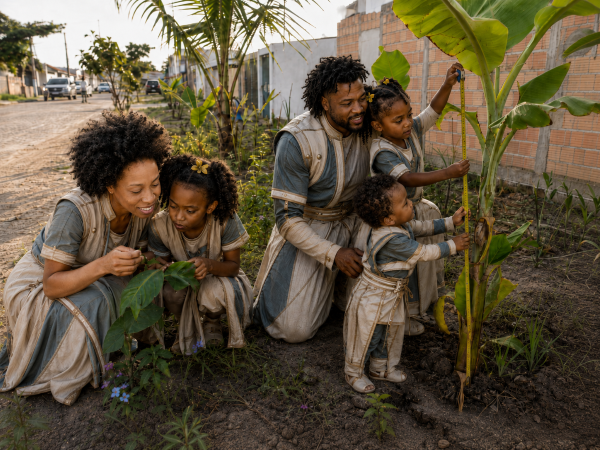
What a year of repeated observation in Prado, Bahia taught our family about sandy-soil recovery, low-cost digital field records and the value of sharing local agricultural knowledge.
By Kimroy Bailey, writing alongside Sherika Trott Bailey
When our family began planting in Prado, Bahia, the soil gave us no reason to be overconfident. Much of the ground was hot, pale and sandy. Water moved through it quickly. Some plants struggled. Others surprised us. The useful lesson did not arrive as a dramatic breakthrough. It arrived slowly, because we kept looking at the same ground long enough to notice what was changing.
That observation phase became the most important part of the work. Before deciding that a difficult site needed heavy clearing, expensive machinery or a single corrective formula, we tried to understand the land already in front of us. We watched where moisture lasted longer, what happened beneath existing vegetation, how fallen leaves accumulated, how decaying coconut trunks behaved, what survived dry periods, what returned after rain, and which plants seemed to make the next plant’s life easier.
Mango, pumpkin and coconut became some of our clearest performers. But the deeper finding was not simply a list of species. It was that the land was already producing information. Shade was information. Plant litter was information. A patch of spontaneous growth was information. A coconut trunk breaking down into organic matter was information. The problem was how to preserve those observations well enough to compare them over time.
How Big King Media turned memory into a field tool
That is where our own free technology, Big King Media, became unexpectedly useful for agriculture. We originally built Big King Media as a self-hosted media operating system for WordPress: a way to organize large volumes of photographs, video and other family media without allowing the archive to become an unsearchable pile of files.
For the Prado work, the important feature was World Within World, or WWW. A WWW is a focused, navigable media world nested inside the larger archive. It can gather the photos, videos and observations connected to one place, experiment, plant, event or system while keeping them linked to the wider record.
Instead of taking a photograph of a patch of land once and forgetting it, we could return to the same location over several months and add new media to the same WWW. The value comes from sequence. One image may show almost nothing. Five or ten observations from the same point can begin to reveal whether ground cover is increasing, whether a treatment seems to hold moisture, whether a plant is recovering, whether shade is changing the soil surface, or whether rain produces the same response each time.
This matters because many small producers already own the basic observation instrument: a phone. The missing piece is often not another sensor but a simple way to preserve context. What was photographed? Where? What changed? What happened before and after the rain? Which plant was cut back? Which area was mulched? Which patch remained untouched? A free digital record cannot replace agronomy, soil testing or local experience, but it can make patterns harder to lose.
Pattern detection does not have to begin with expensive equipment
Agricultural technology is often discussed as if useful data begins only after a farm buys specialized hardware. Those tools can be valuable, but there is another layer beneath them: disciplined observation.
A small producer who repeatedly records the same banana stool, drainage line, compost patch, slope or shaded edge can build a visual history. If those images are organized by subject instead of buried inside a phone gallery, the farmer can compare them. The comparison can generate better questions: Why is this banana holding greener leaves? Why did weeds return faster here? Why did one mound stay damp? Why is erosion worse on this edge?
The technology does not have to answer those questions automatically to be useful. Sometimes its first job is simply to stop evidence from disappearing. A good record lets the farmer, a neighbor, an agronomist or a student look backward and see what actually happened instead of relying on memory.
From one family record to the AgriGames Foodway
We did not want the observations to remain private. Outside our home in Prado, the work expanded into the AgriGames Foodway, a public-facing strip where food, flowers and ecological learning share the same ordinary walking route. Bananas, pumpkins, watermelons, tomatoes, coconuts, papaya and flowers became part of a space where growing food could also become family activity, public learning and local conversation.
The Foodway gives us a reason to show neighbors what we are observing and to ask what they are seeing on their own properties. Someone may know that banana leaves left on the ground behave differently from material removed immediately. Another person may know which part of a nearby property stays wet longest. Someone else may have noticed which fruit tree survives neglect, which insect appears before a plant declines, or how a particular mulch behaves in the local heat.
Those insights are small when isolated. Connected together, they become a local knowledge base. The goal is not to pretend that every observation is automatically scientific proof. It is to make useful local experience visible enough to be compared, questioned, tested and improved.
Pacorips and the municipality-sized opportunity
This is also where we see a role for Pacorips, another system our family has authored. Pacorips is designed to connect capabilities, needs, resources, knowledge and opportunities across a community. Applied to land rehabilitation, a small municipality could use the same principle to help people contribute what they know and what they have.
One household may have years of experience with bananas on sandy ground. Another may have compost material. A third may have a water tank, a trailer, seedlings, tools or a shaded nursery. A local technician may understand irrigation repair. A school may have young people who can help document plots. A farmer may have a degraded edge that can become a learning site. The useful question is not only, ‘Who can pay for what?’ It is also, ‘What capability, observation or idle resource is already nearby, and where can it help?’
Pacorips does not need to replace agricultural extension services or local government. It can sit underneath them as a connection layer, helping a community discover relationships that would otherwise remain invisible.
Land, wind and food can create a different kind of return
Our family is interested in a broader definition of agricultural return. Profit matters to producers because families need income and farms need resources. But a community can also become richer in ways that are not captured by a single sale.
If one household shares what it learned about sandy soil and ten other households avoid the same mistake, value has been created. If plant residues that were once discarded become soil cover, value has been created. If children learn how food grows because a Foodway runs through daily life, value has been created. If a degraded patch holds more organic matter a year later, the neighborhood is physically richer. If surplus fruit is shared freely among families, food abundance has produced a return even before money enters the story.
Land can become richer. Local knowledge can become richer. The network of people able to help one another can become richer. Free food can circulate. Better soil can remain for the next family. A municipality can know more about itself than it knew before.
That does not make money irrelevant. It simply means agriculture produces more than commodities. It produces memory, capability, resilience, fertility, shade, food, trust and knowledge.
Observation before prescription
Our year in Prado has made us much slower to prescribe from a distance. We are not presenting ourselves as soil scientists, and our family field record is not a substitute for controlled research. What it demonstrates is the usefulness of staying with a place long enough to notice its behavior.
For small producers, especially where capital is limited, that first phase can be powerful because observation is inexpensive. A phone, a repeatable recording habit and a system that keeps the evidence organized can help a farmer see change that daily familiarity would otherwise hide.
Then the next layer is social: compare the record with other people. Ask what they have seen. Test whether the same pattern appears elsewhere. Share the failure as readily as the success. Connect the person who has knowledge with the person who has the problem. Let the community build a memory larger than any one property.
We began with a difficult patch of sandy ground. The most useful thing we learned was not to rush past the observation phase. The land was already speaking through moisture, shade, roots, decay, regrowth and survival. Big King Media helped us keep the conversation. The AgriGames Foodway helped us make it public. Pacorips points toward how a whole municipality could connect what its people are learning.
Sometimes agricultural progress begins with a new machine. Sometimes it begins by making sure the knowledge already growing in the neighborhood does not disappear.
About the authors
Kimroy Bailey and Sherika Trott Bailey are a Jamaican-Brazilian husband-and-wife team documenting and building family systems in Prado, Bahia, Brazil. Their work includes Big King Media, AgriGames Foodway, Pacorips and a continuing field record of sandy-soil recovery and productive landscaping.
Field record: A Year of Growing in Prado • Big King Media: trottbaileyfamily.com/tbf-big-king-media/ • AgriGames Foodway: trottbaileyfamily.com/agrigames-foodway/