- This is an honest twenty-year account. The report sets out where AGRA catalysed progress, where gains proved limited or fragile, and what was learned, treating AGRA as one contributor among many.
- Africa’s agrifood sector has genuinely moved. Farmer incomes have doubled, cereal yields have increased by about 40%, and farm output has roughly doubled in real terms. Local seed industries have emerged alongside networks of more than 25,000 agro-dealers and 33,000 community extensionists.
- But the gains have not added up to transformation. Yields have not risen to the levels needed, farmer incomes remain lower than global averages, and farmers are not yet prospering. Many other actors across agrifood value chains, as well as the institutions and services that enable them, are not yet flourishing either.
- The current trajectory will not deliver the Kampala Declaration and CAADP 3.0 targets for 2035. Achieving those targets, and the wider transformation they are designed to advance, will require an integrated agenda and sustained delivery rather than more of the current approach at a larger scale.
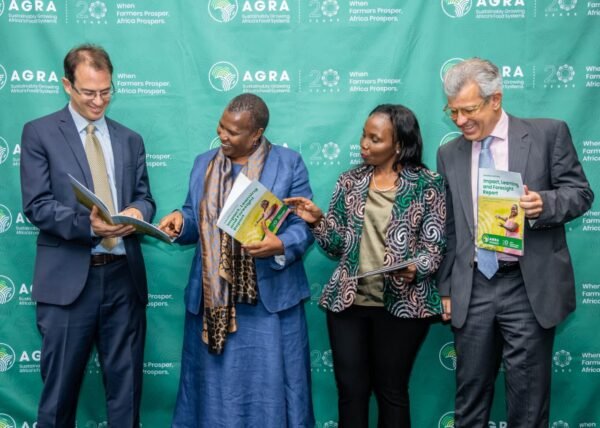
A new Impact, Learning and Foresight Report finds that Africa has built significant capacity across its agrifood systems over the past two decades and invites governments, farmers, businesses, financiers and researchers to build the alliance the next twenty years will require.
Africa’s progress must also be understood in its longer historical context. From the recurring famines and crop failures that marked the 1980s, the continent reached a turning point with the 2003 Maputo Declaration and the first Comprehensive Africa Agriculture Development Programme, which established a shared African agenda for agricultural transformation. AGRA’s role has been to support and help accelerate that African Union-led ambition alongside governments and many other partners.
Drawing on two decades of evidence and learning, the report argues that Africa’s agrifood sector is investable, strategic and deeply context-specific, but that production gains must more consistently translate into income, dignity, resilience and opportunity for farmers.
The report points to real movement over the last two decades. Agriculture Gross Value Added growth rose from about 2.3% to almost 4%, while farm output doubled in real terms after 2005. Farmer incomes have doubled and cereal yields have increased by about 40%. Yet the gains have been uneven and remain insufficient. Productivity gaps persist, hunger has risen, and too many farmers still struggle to convert production into reliable income.
“Twenty years of evidence show that Africa’s agrifood sector can move when the conditions are right. The task now is to turn that progress into income, resilience, dignity and opportunity for farmers. That will require a renewed alliance that brings governments, farmers, businesses, finance, researchers and development partners around a shared agenda for farmer prosperity,” said Alice Ruhweza, President, AGRA.
Looking ahead, the report identifies three priorities that must move together. Farmers must be able to produce reliably and resiliently. Production must be linked to markets, processing, trade and jobs so that farmers capture more value. Countries also need lasting institutional capability, finance, data, coordination and accountability to turn plans into sustained delivery. Progress in one area will not be enough if the others lag behind.
These priorities respond to three connected constraints described in the report as the productivity, value and capability traps. The productivity trap limits reliable, resilient production. The value trap prevents production from consistently becoming income, jobs, processing, trade and competitiveness. The capability trap weakens the institutions, finance, coordination, data and accountability needed to turn good plans into lasting delivery.
The report therefore calls for a renewed alliance. Agriculture can no longer be treated as the responsibility of agriculture actors alone. Farmer prosperity depends on choices made across finance, trade, water, energy, infrastructure, health, nutrition, education, climate, science and industry. If the outcomes affect the whole economy, the responsibility must sit in many hands.
“Progress becomes transformation only when productivity is restored, value is retained and capability is sustained. The question for the next decade is not only what Africa can produce, but whether the systems around farmers allow them to prosper,” said H.E. Hailemariam Dessalegn, AGRA Board Chair.
The report calls on governments, investors, researchers, businesses, financiers, civil society, the media and development partners to move beyond isolated projects and invest in integrated systems. When farmers cannot produce reliably, food prices rise, nutrition suffers, import bills grow, jobs are lost and young people lose confidence in the rural economy. When farmers prosper, countries build stronger markets, healthier communities, more resilient landscapes and more inclusive growth.
Within this wider account, AGRA is presented as a catalytic contributor working alongside governments, farmers, researchers, businesses, financiers and development partners. Over 20 years, AGRA and its partners helped strengthen critical capacities, supporting 118 seed companies, more than 650 improved seed varieties, over 25,000 agro-dealers, 33,000 community extensionists, five million farmers trained in soil health and climate-smart practices, and nearly 800 scientists. AGRA also helped leverage approximately USD 691 million for national agricultural investment plans. These are contributions within a much wider journey, not a claim of sole credit for Africa’s progress.
Commissioned as part of AGRA@20, the report is intended as a candid stocktake of what has worked, where progress has fallen short and what must change. It draws on independent evaluations, outcome assessments, published research and consultations with governments, funders, researchers and private-sector actors, supplemented by AGRA’s own monitoring data.
The report is being launched in Nairobi on 31st August as part of AGRA@20, with its findings and call to action carrying forward to the Africa Food Systems Forum in Kigali from 2nd to 5th September 2026. The full report can be downloaded from this link https://agra.org/foresight-report-2026/. It ids also available on the AGRA website www.agra.org.