

A communal reservoir with the potential to provide an estimated 1.62 million litres of water (every five to six weeks with the current pump installation) is creating new possibilities for smallholder farmers in Chief Mulendema’s area, where erratic rainfall, dry conditions and wildlife pressures make farming difficult.
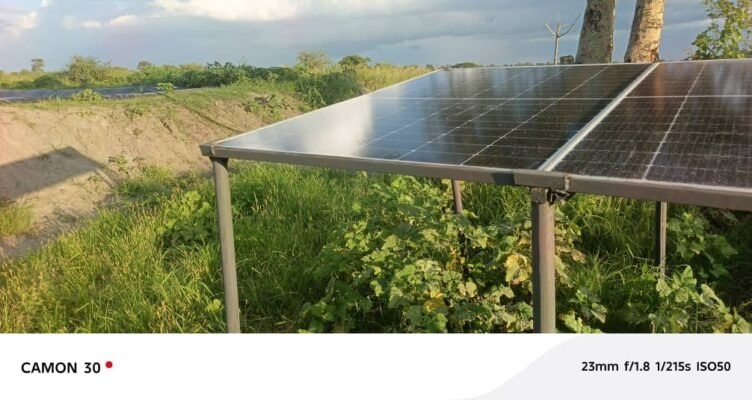
Established through the Water and Soil Accelerator (WASA) project, the reservoir aims to turn seasonal rainfall into a resource for agricultural production during dry periods. The Mini Water Reservoir has been installed to support 50 households (250 end-users) in the Nalusanga GMA, improving water access, reducing production costs, increasing yields, and enabling year-round farming.
Solidaridad (Southern Africa), with financial support from the International Water Management Institute (IWMI), works together with GreenCare Eco Solutions, Zambia’s Ministry of Agriculture, the [Zambian] Water Resources Management Authority (WARMA), and traditional leaders to improve water access for farming in the Nalusanga GMA. The partnership combines the installation of the communal reservoir with support for sustainable farming, responsible water management and inclusive community decision-making.
“This reservoir allows our community an opportunity to plan beyond the next rainfall. We must protect it, share its benefits fairly and ensure that women and young people have a voice in how it is managed. What we build around this water will depend on what we do together,” said His Royal Highness Chief Mulendema of Mumbwa district, Central Province of Zambia.
“When rainfall becomes less predictable, a dry spell can undo months of work on a small farm. The reservoir gives farmers in Nalusanga more room to plan when to plant and keep crops growing through dry periods. Through WASA, we’re pairing investment in water storage with practical support for farmers to manage water and soil together,” said Dr Jonathan Atkinson, Managing Director of Solidaridad Southern Africa.
Sheila Garakara, Solidaridad’s Country Manager for Zambia, said the intervention addresses a fundamental barrier facing smallholder farmers. “When water runs short, farmers’ choices narrow. This reservoir creates an opportunity to expand those choices, particularly for women working to grow food and strengthen household incomes. Our focus is on helping the community turn water access into productive, lasting opportunities,” said Garakara.
In addition, community members, particularly women and young people, have received compost and fertilizer, while the establishment of a vegetable garden is planned for later this year to support practical learning in vegetable production and efficient water use. “A reservoir can hold water, but farmers need the skills and support to put it to work,” said Lydia Banda, Programme Manager at Solidaridad. “We are connecting water harvesting with soil management, practical training and community ownership so that farmers can make the most of the resources available,” explained Banda.
WHO GETS WATER, WHO MAKES DECISIONS?
For IWMI, gender equality and social inclusion (GESI) are central to the reservoir’s long-term success. “Fair and equitable access to water starts with equal participation and representation in decision-making processes,” said Dr Ojong Enokenwa Baa, Gender, Social Inclusion and Youth Researcher at IWMI. “Women, young adults and socially-differentiated groups whose voices are often overlooked must help shape the rules for using and managing this reservoir. Strong governance means their priorities influence decisions from the beginning.” Dr Baa asserts that the women’s club provides an important foundation, although further support is needed to translate participation into meaningful benefits.
“Counting women in a group is only the starting point. We must also ask whether they can access water, attend training, influence crop choices and benefit from the income generated. The planned demonstration plot offers an opportunity to design learning around these realities,” added Dr Everisto Mapedza, Senior Gender and Institutional Governance Consultant at IWMI. Proposed support includes sustainable farming practices, crop selection, financial literacy, record-keeping and market access. A Village Savings and Loan Association (VSLA) is also being considered to help members save and reinvest.
Beatrice Mununza, a lead farmer from Mutti Village and treasurer of the horticultural group reiterated the importance of the various avenues the intervention is bringing to help the Nalusanga Community become more sustainable. “Thank you very much to Solidaridad, in collaboration with Greencare, for the development you have given us through the water reservoir here in Nalusanga, Nkolola Mutti Village. We are really happy and appreciative of this development.
“We have welcomed this development because, since the year we came here in 1986, we have never received any development like this in this and surrounding communities. To Greencare, we want to say thank you again for the organic fertilizer. Some of the samples you left were used in demos, and we observed positive results. Some used it on watermelons and vegetables, and positive results like better yields, healthy crops, and good flowering in fruit crops were seen.“
Vice-Chairperson of the horticultural group, Remu Kawenya said, “we want to learn more and grow more with this reservoir, and we would appreciate help connecting us to a better market. We are learning about Village Savings and Loan Associations (VSLA). As soon as we start gardening, we are set to start saving in groups as a community. We thank Solidaridad for bringing these VSLA lessons here at the right time.”
MAKING EACH LITRE COUNT
“Water and soil must work together,” said Wana Ngalande of Greencare Eco Solutions Ltd. “At Greencare, we believe that healthy soil means a healthy plant. The proposed training will help farmers manage soil health by exploring organic inputs and biochar, while practising sustainable water management at the reservoir.” Ngalande emphasised that soil health will be essential to making productive use of the harvested water.
Dominic Phiri, a Technical Officer for Irrigation at Zambia’s Ministry of Agriculture, highlighted the importance of connecting the investment with agricultural extension. “Suitable crops, sound production planning and efficient irrigation will help farmers make the most of this resource. Practical agricultural advice must accompany the infrastructure,” said Phiri.
Goodfellow Mphande, Catchment Manager at WARMA, explained the Authority’s role in managing and protecting Zambia’s water resources. “WARMA was formed under Water Resources Management Act No. 21 of 2011. Our mandate is to manage, regulate, develop, protect, preserve and conserve Zambia’s water resources. We regulate groundwater usage, monitor groundwater levels and surface water flows, and ensure that water is used sustainably.” Speaking on the importance of water storage for farmers, Mphande said, “we would like to see more dams or reservoirs constructed because they store water that can be used in dry periods. Farmers who had dams did not have the same problems as those abstracting directly from rivers.”
Working together allows one to reach further than any one organisation could alone, connecting investment in water with the skills, support and shared responsibility needed to turn it into lasting benefits. “This is the power of partnership: different organisations bringing their expertise together around a priority that matters to the community. Research, technical skills, public institutions and traditional leadership each have a role to play, alongside farmers’ own knowledge,” said Humphrey Nxumalo, Regional Head of Programmes at Solidaridad (Southern Africa).
As preparations for the demonstration plot continue, the next step is to connect harvested water with practical farming skills and inclusive local leadership, giving the community more options when rainfall becomes unreliable.