

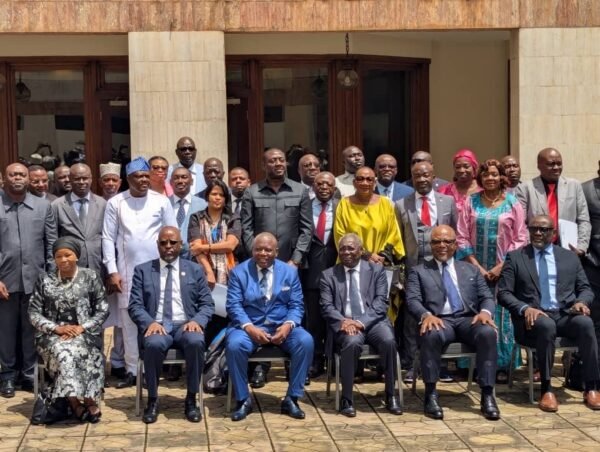
The International Fund for Agricultural Development (IFAD) today jointly launched the AgriConnect Country Compact with the Government of Cameroon, the World Bank Group and development partners. This action framework aims to accelerate agropastoral and agrifood sector transformation, strengthen food security, create jobs, particularly for young people and women, and mobilize public and private investment.
The Compact is built around three pillars – strengthening the foundations of the agrifood sector, accelerating policy and regulatory reforms, and providing access to finance for producers and businesses – and will target rice, maize, cassava, oil palm, cocoa, soybean, dairy and aquaculture value chains.
“IFAD is proud to be a founding partner of the AgriConnect initiative. We remain fully committed, alongside the Government of Cameroon and our partners, to leveraging our experience and investments to advance this shared vision particularly by supporting youth agropastoral entrepreneurship, developing inclusive value chains, increasing access to rural finance and stronger resilience to climate change,” said Eric Rwabidadi, IFAD Country Director, speaking at the ceremony on behalf of the United Nations Resident Coordinator in Cameroon.
Jointly developed by the Government and the World Bank Group in collaboration with the private sector and development partners, the Compact aims to accelerate Cameroon’s national priorities in alignment with the National Development Strategy 2020-2030 (NDS30), Rural Sector Development Strategy/National Agricultural Investment Plan (SDSR/PNIA) and Integrated Agropastoral and Fisheries Import-Substitution Plan (PIISAH).
Cameroon’s agrifood sector accounts for around 17 per cent of GDP and 42 per cent of employment, or some 4.7 million workers. Limited access to quality inputs, infrastructure, technologies, markets and finance continues to constrain the sector’s development. Food imports account for an average of 3.5 per cent of GDP, underscoring the potential for increased local production and processing.
By 2030, the Compact aims to increase annual maize production to 6 million tonnes and palm oil production to 800,000 tonnes; achieve a 55 per cent self-sufficiency rate in rice; meet 60 per cent of national milk demand through domestic production; and raise fisheries and aquaculture production to 450,530 tonnes. It also aims to reduce the food import bill by 28 per cent, from approximately US$1.6 billion to US$1.15 billion.
The Compact brings together 24 interventions regarding seeds, mechanization, irrigation, rural and storage infrastructure, processing, cold-chain development, agricultural extension, digital solutions, land tenure, policy and regulatory reforms and access to finance. The interventions are estimated to require approximately US$1.87 billion in investment over 2026–2030.
IFAD’s contribution to these priorities will draw on its experience working with small-scale farmers and its current programmes: PADFA II, on rice and onion value chains; ACREGIR, which focuses on green entrepreneurship and climate resilience; PAIDATA, promoting sustainable agricultural intensification and the agroecological transition in the cocoa and coffee value chains; and PEA-Jeunes II, supporting agropastoral entrepreneurship among young people and women.