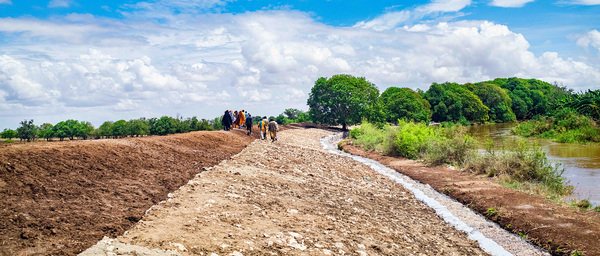
Flood defences built under JOSP to help protect surrounding communities and farmland from flooding. Jowhar, Somalia, 2026. ©FAO
The United Kingdom has allocated an additional £2.5 million through the RESTORE project to help vulnerable communities in Somalia prepare for anticipated El Niño-related flooding during the October–December 2026 Deyr rainy season.
The funding will support efforts to restore riverine ecosystems and strengthen water management along the Shabelle River, where floods pose a major threat to communities whose livelihoods depend heavily on farming and livestock.
The additional funding forms part of the UK’s newly announced £5 million humanitarian package for Somalia and will be implemented through the Food and Agriculture Organization of the United Nations (FAO), the International Organization for Migration (IOM) and World Vision.
The support will strengthen early warning systems, facilitate temporary relocation of vulnerable households to safer areas, improve flood protection and provide cash assistance to communities at risk.
FAO Representative in Somalia Etienne Peterschmitt said early intervention was critical to protecting communities before floodwaters arrive.
“Early action is essential to protect families and the livelihoods they depend on before flooding occurs. We thank the United Kingdom for this additional support, which will help RESTORE partners translate warnings into practical assistance,” Peterschmitt said.
He said emergency preparedness must be accompanied by longer-term investment in water infrastructure to address both floods and drought.
“Alongside immediate preparedness, we must continue investing in water management systems like JOSP that reduce flood risk and make water available to farmers during dry periods. These investments are critical to lasting food security,” he said.
British Embassy Mogadishu Development Director Chris Pycroft said timely intervention could prevent flooding from developing into a wider humanitarian crisis.
“Floods don’t have to become humanitarian disasters. Acting early means families can move to safety, essential services can remain available and livelihoods can be protected,” Pycroft said.
“By investing now, we can save lives and help Somali communities withstand future climate shocks,” he added.
Building resilience beyond emergency response
RESTORE, or Restoring the Riverine Eco-Systems for Climate Adaptation, is part of the wider Jowhar Offstream Storage Programme (JOSP), which combines water infrastructure rehabilitation, ecosystem restoration, climate-adaptive agriculture and stronger institutions for managing land and water resources.
The programme covers Jowhar, Balcad, Afgoye, Merka and Qooroley in Middle Shabelle, with restoration of the wider water management system expected to extend water availability and irrigation benefits to downstream communities in Lower Shabelle.
By diverting and storing excess river water for use during dry periods, the programme seeks to address Somalia’s recurring challenges of flooding and drought while supporting agricultural production and food security.
Community participation is also central to the initiative, with RESTORE supporting community-led preparedness planning and measures to increase the participation of women, displaced people and other marginalised groups in decisions on natural resources.
The new UK funding will therefore provide immediate assistance ahead of the Deyr rains while complementing longer-term investments aimed at reducing vulnerability to climate shocks and strengthening the resilience of Somali communities.