

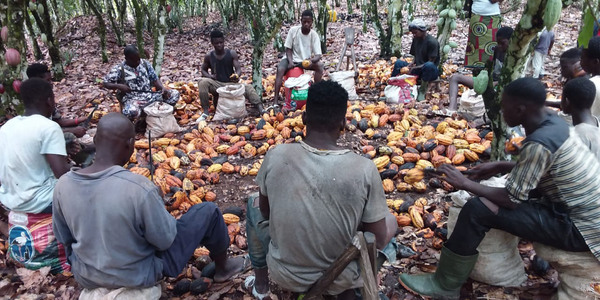
A new study published in Science has uncovered a significant weakness in the way sustainability performance is monitored in cocoa supply chains in Côte d’Ivoire, finding that field verification records were substantially more likely to be manipulated when auditors knew the target farmers were expected to meet.
The research, conducted across 407 cocoa farms in Côte d’Ivoire, found that false reporting occurred in roughly one in four verification records when field agents knew the compliance target. When the target information was withheld, the rate fell to about one in nine records.
The findings suggest that simply preventing auditors from knowing the desired outcome could significantly strengthen the credibility of sustainability monitoring.
The study, titled “False reporting undermines the integrity of supply chain sustainability initiatives,” was conducted by researchers Federico Cammelli, Johan Six and Rachael D. Garrett and published in Science.
Researchers examined field verification visits linked to shade-tree planting in Côte d’Ivoire’s cocoa sector. During the visits, agents checked farmers’ reported numbers of shade trees.
The experiment randomly determined whether agents would be shown the farmers’ original reported number or whether that information would be withheld. This allowed the researchers to test whether knowledge of the expected result influenced subsequent reporting.
The results point to a clear incentive problem. When a verification initially failed, agents were more likely to amend the recorded number of seedlings when they knew the farmer’s original target. The researchers estimate false reporting at 24.8% in the control group, compared with 11.2% when the relevant information was withheld.
Importantly, the researchers say the issue is not necessarily limited to cocoa or tree-planting programmes. Sustainability schemes frequently depend on field agents to collect or record information used to determine whether farms meet certification or programme requirements.
In Côte d’Ivoire, cooperatives can also have financial interests in maintaining certification, distributing sustainability premiums and minimizing recorded non-compliance.
That creates a potential conflict of interest because the same systems responsible for generating sustainability data can benefit when farms appear to meet the required standards. The study notes that monitoring and impact reporting are often funded and conducted by companies themselves, with limited external verification.
The implications extend beyond certification labels. Companies face increasing pressure to demonstrate that commodities such as cocoa are produced without practices linked to deforestation and other environmental harms.
The European Union Deforestation Regulation (EUDR) also places greater importance on reliable farm-level information, including evidence concerning the boundaries and deforestation status of agricultural plots.
The researchers warn that without stronger safeguards, compliance systems could continue to rely heavily on intermediaries and cooperatives that have an interest in favourable sustainability outcomes. Under EUDR, they argue, such actors could become even more important gatekeepers of market access and compliance information.
The study therefore points to a relatively simple intervention: keep compliance targets hidden from those responsible for verifying them wherever possible.
Rather than relying solely on more complicated auditing systems, reducing an auditor’s knowledge of the expected result could make manipulation more difficult and sustainability data more credible.
For companies, certification bodies and regulators, the message is significant. Sustainability claims are only as reliable as the information used to substantiate them.
Strengthening the independence of data collection—and reducing opportunities to tailor records to predetermined targets—could become an important part of making supply-chain sustainability commitments more trustworthy.