

By Johan Gerber for Kannar Earth Science
It is advisable to control ants when they are protecting sucking insects such as mealybug, aphids and scales against their natural enemies. Some of the most common ants found include pugnacious, Argentine, red and brown house ant.
Pugnacious ants are known for their aggressiveness and will attack humans and animals when disturbed. They feed on the honeydew excreted by sucking insects. Argentine ants tend to be aggressive towards other ants and sometimes invade their territories. As is the case with pugnacious ants, they feed on honeydew excreted by sucking insects. Red ants feed on other insects and are therefore considered to be meat-eaters. Brown house ants are small and walk back and forth in streams and can be extremely irritating in the household.
Citrus and subtropical fruit orchards as well as ornamental trees and shrubs are host plants for pugnacious ants. Some of the host plants for Argentine ants include deciduous fruit trees, grape vines, and ornamental trees and shrubs. As far as citrus and subtropical crops are concerned, Argentine ants are found in the orchards of the Western Cape. Brown house ants are often associated with mealybug, aphids, and scale insects on various crops.
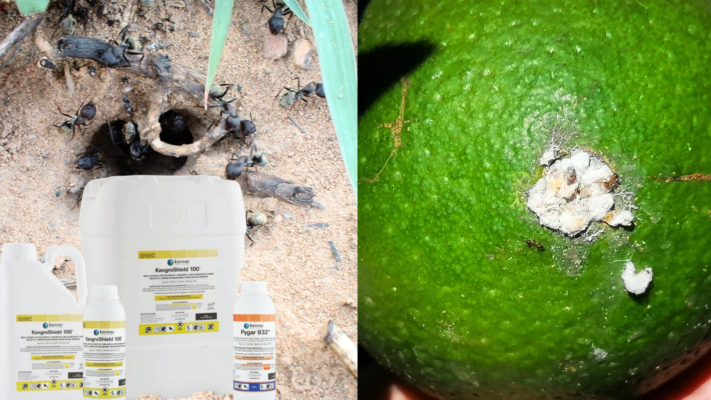
The presence of pugnacious ants in and around plants is responsible for an increase in sucking insect populations such as mealybug, scale, aphids and other honeydew-secreting insects. For example, by carrying young scale around they are partially responsible for the spread of scale infestations. Argentine ants are very aggressive, and they are associated with mealybug infestations on grape vines. They interfere with parasites and natural predators which would otherwise be able to provide some degree of biological pest control. Red ants are one of Nature’s own biological controls as they predate on various insects.
Nesting in and around buildings, brown house ants enter our homes through crevices in walls or through doorways and windows. They cause no direct damage but are irritating when they spoil our sugar pots, and get into our kettles, jams and other sugary foods.
The openings to the underground nests of pugnacious ants are easily visible in the soil. Activity occurs mainly from early spring to late autumn, with peaks in October and again from December to March. Argentine ants are active in summer and autumn and relatively inactive in winter, except for warm, sunny days. They nest in the ground from where they collect honeydew on plants. Red ants are often found on lawns and under buildings all year round, with activity peaking in summer and autumn. Brown house ants can be a nuisance all year round with most activity during summer and autumn
Methods of control
By controlling ants at ground level, you assist natural biological controls. The most effective way of dealing with ants is to pour diluted spray mixture of Kangroshield 100 containing natural pyrethrins down their nest entrances and flood the nests underground, which is a problem in agricultural crops. Kirchhoffs Ludwigs Insect Spray is available in small packs for home garden use. It is not always easy to drench due to the small nest entrances of most ant species, a large syringe can be used to inject mixture into small openings in and around the house. Alternatively, you can spray along the trails they form when foraging between the nests and host plants. Most ant species form a dense trail, but what you see foraging above ground is just a small portion of the ant population below. Kirchhoffs Organokil aerosol (contains natural pyrethrum) is ideal to use for the control of ants and other public health pests indoors.
With species such as the Argentine ant, you need to prevent the workers from feeding their larvae in the underground nests. The only way to do this is by preventing the workers from reaching the honeydew on the plants, by treating the lower stem or trunk or by concentrating on nest treatments. Kangroshield 100, Pygar 932, Kirchhoffs Ludwigs Insect Spray and Organokil contain natural pyrethrum which will kill ants on contact when applied. One of the main advantages of using any of these products is that it cannot cause secondary poisoning to the natural enemies of ants, such as birds, cold-blooded wildlife (lizards, geckos, chameleons and frogs will feed on certain ant species), as well as antlion larvae feeding on ants.